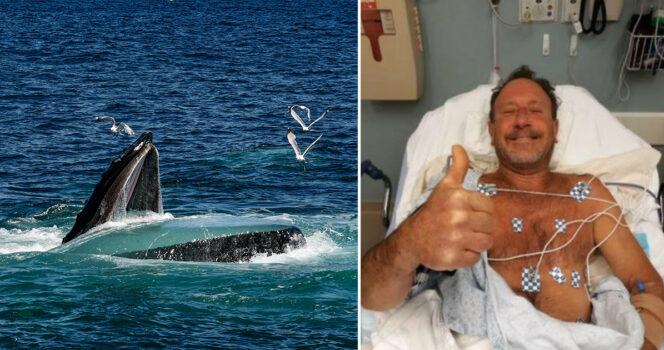
On a cool June morning off the coast of Provincetown, Massachusetts, commercial lobster diver Michael Packard plunged into the misty Atlantic waters near Herring Cove Beach. For decades, the ocean floor had been his second home, a calm and familiar environment where he routinely navigated the seabed in search of lobsters. Yet on this particular dive, within moments of leaving his boat, the Ja’n J, the familiar rhythm of the ocean was abruptly altered. A sudden, massive force engulfed him, plunging him into total darkness. Surrounded by powerful muscular contractions and rushing water, Packard realized he was trapped inside the mouth of a giant marine creature. For thirty intense seconds, he remained engulfed in darkness before the enormous animal surfaced, thrashing its head and expelling him back into the open sea.
This extraordinary encounter with a humpback whale captured international headlines, capturing the public imagination and evoking ancient maritime tales. Yet beyond the media reports, the event offers a fascinating window into the intersection of cultural mythology, marine biology, and human resilience. By examining the biological realities of baleen whales alongside humanity’s long-standing relationship with ocean giants, we gain a deeper appreciation for the mysteries that still lie beneath the waves.
The Cultural Mythos of the Great Sea Leviathan
Throughout human history, the idea of being swallowed by a giant sea creature has occupied a prominent place in global mythology, literature, and folklore. From ancient nautical legends to classical literature, the ocean has long been perceived as a realm of mysterious, untamed forces personified by colossal marine beasts.
In Western cultural traditions, the most famous narrative of this kind is the ancient story of Jonah, who entered the cavernous mouth of a great sea creature and remained within its belly before returning safely to shore. Similar motifs appear in ancient Mediterranean mythologies, where sea monsters known as Leviathans represented the vast, unpredictable forces of the deep. In Polynesian and Indigenous coastal traditions, whales are often revered as sacred guardians, ocean navigators, or ancestral deities possessing immense wisdom and power.
When extraordinary accounts like Michael Packard’s surface in modern times, they resonate strongly because they touch upon these deeply ingrained mythic archetypes. The narrative of an individual entering the depths of an ocean titan and emerging unharmed feels like an ancient tale brought into the modern era. Speculatively, our fascination with such events stems from a primal human wonder regarding the vast scale of the natural world and our relative place within it.
The Anatomy of Humpback Whales: Why Ingestion Is Anatomically Impossible
While legendary tales often depict giant sea creatures consuming whole vessels or humans, modern marine biology provides a very different perspective based on anatomy and evolutionary adaptation. Humpback whales (Megaptera novaeangliae) are among the largest mammals on Earth, growing up to fifty feet in length and weighing up to forty tons. Despite their colossal physical presence, their internal anatomy makes swallowing a human virtually impossible.
Humpback whales belong to the baleen whale suborder (Mysticeti). Instead of teeth, their jaws are lined with hundreds of flexible baleen plates composed of keratin, the same material found in human hair and fingernails. These plates act as a filtration system, allowing the whale to scoop up vast volumes of seawater containing small schooling fish, sand lance, and krill.
As the biological evidence shows, while a humpback whale’s mouth cavity can expand dramatically to hold thousands of gallons of water, its esophagus is remarkably small, measuring only four to eight inches in diameter when relaxed. This physical constraint means that even if a whale accidentally takes a large object or human into its mouth during a feeding lunge, it cannot swallow it. The whale’s natural response is to immediately expel the non-food item back into the water, precisely as occurred during Packard’s encounter off Cape Cod.
Understanding Lunge Feeding and Rare Marine Accidental Encounters
Marine scientists emphasize that humpback whales have no interest in harming humans. Their interactions with divers and swimmers are overwhelmingly peaceful, often characterized by gentle curiosity. To understand how an accidental encounter occurs, one must look at the mechanics of whale feeding behavior.
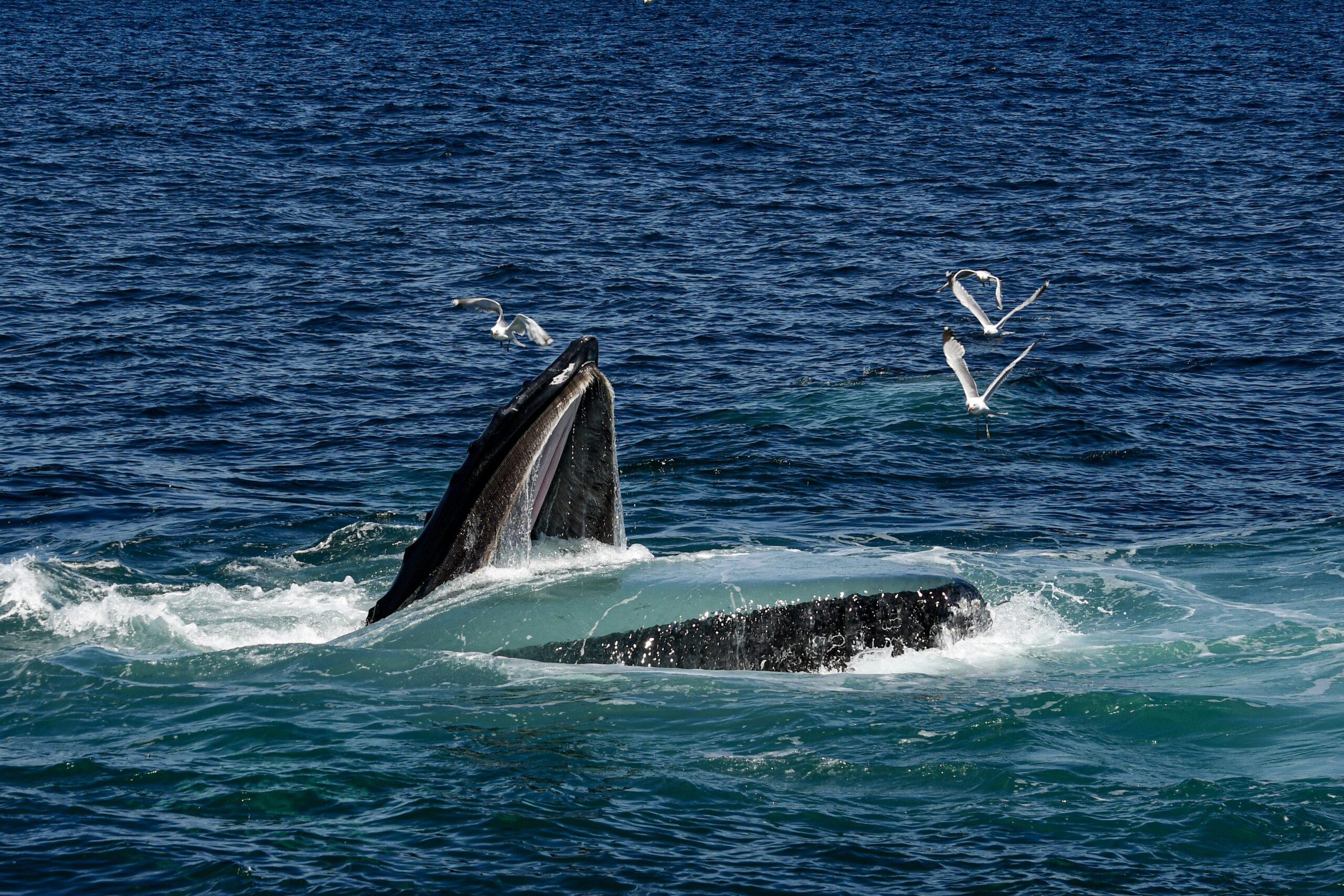
Humpback whales practice a technique known as lunge feeding. When hunting, the whale swims rapidly toward a dense school of fish or krill with its mouth open wide, expanding its pleated throat grooves to engulf both water and prey simultaneously. During this high-speed maneuver, the whale’s vision can be partially obscured by the dense cloud of prey and churning water.
Marine researchers note that for a human to end up in the path of a lunge-feeding whale, a very specific alignment of rare circumstances must occur. If a diver happens to be positioned directly within a dense bait ball where a whale is actively feeding, the animal may inadvertently scoop up the diver alongside its intended meal. However, sensory receptors within the whale’s mouth immediately register the presence of an unfamiliar, large object, prompting the animal to surface and open its jaws to release it.

Reflecting on Human Curiosity and the Wonders of the Deep
At its core, public fascination with extraordinary sea encounters reflects an enduring human curiosity about the natural world. Since the dawn of civilization, the ocean has represented the ultimate frontier, a vast, shimmering expanse that inspires awe, scientific inquiry, and poetic imagination.
Our innate drive to explore the deep leads marine biologists to map uncharted reefs, prompts engineers to design advanced diving equipment, and encourages storytellers to capture the magic of the sea. Accounts of rare marine encounters remind us that despite all our scientific achievements, planet Earth remains full of wonder, complexity, and unexpected moments. Embracing that sense of wonder inspires us to keep asking questions, seeking knowledge, and protecting the magnificent planet we share.
Sources
-
Center for Coastal Studies (Provincetown, MA): Scientific research and field studies on humpback whale behavior, population dynamics, and feeding mechanics in the Gulf of Maine.
-
National Oceanic and Atmospheric Administration (NOAA) Fisheries: Official species profiles, biological facts, and conservation guidelines for baleen whales in North Atlantic waters.
-
Journal of Experimental Biology: Peer-reviewed comparative anatomical studies examining the throat dimensions, baleen filtration, and lunge-feeding mechanics of mysticete whales.
-
Cape Cod Times: Contemporary journalistic reporting and primary interviews documenting the 2021 marine diver encounter off Herring Cove Beach.