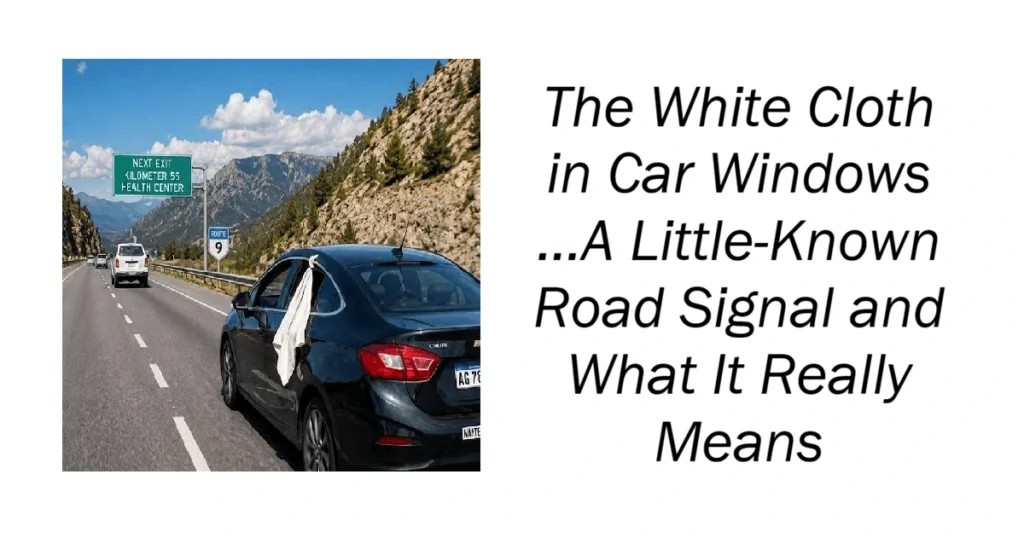

The White Cloth in Car Windows …A Little-Known Road Signal and What It Really Means
Modern driving is a skill that relies on the ability to quickly recognize and interpret a variety of signals—ranging from traffic signs to the blinking of hazard lights. Most signals are standardized and regulated, contributing to safer and more predictable experiences on the road. However, some signs go beyond the official handbook, emerging from informal traditions among motorists. One such unconventional signal is the white cloth hanging from a car window.
This practice is rarely documented in traffic manuals or law books, yet it persists across several regions of the world. Drivers who see it often wonder what it means and how they should respond. To fully understand the implications of this signal, it’s essential to explore its origins, typical interpretations, and the recommended actions for fellow motorists.
The Origins and Symbolism of the White Cloth
The use of a white cloth as a signal stems from broader cultural associations with the color white. In many societies, white is linked to peace, surrender, and calls for assistance. Its visibility makes it suitable for urgent signaling. Unlike the flashing lights of emergency vehicles or the reflective triangles used in breakdowns, a white cloth provides a simple but noticeable cue that relies on mutual understanding among drivers rather than official regulation.
This practice illustrates how motorists have adapted different methods to communicate situations that fall outside the scope of regular signals, bridging gaps where formal tools are lacking.
Common Situations Where the White Cloth is Used
Though not standardized, the white cloth is most commonly displayed in several scenarios that signal distress or the need for special attention from other road users:
Mechanical Failure or Breakdown
One of the most frequent uses is to indicate a vehicle immobilized by mechanical failure. Drivers may hang a white cloth out the window or tie it to a door handle to warn others that the car is stranded. This alert encourages caution among passing vehicles, reducing the risk of accidents and signaling the need for potential roadside assistance.
Medical Emergency
In some cases, drivers use a white cloth to communicate that someone inside the vehicle is experiencing a medical emergency. This practice is especially prevalent in regions where the response time of official services may be delayed or where motorists seek extra visibility while rushing to a hospital. The cloth does not grant legal privileges, but it may prompt others to yield or assist.
Group Identification
For convoy travel—including religious pilgrimages, funerals, or organized group journeys—a white cloth may help drivers identify vehicles belonging to the same group. This assists in maintaining formation, avoiding confusion, and ensuring the safety of all participants, especially in busy or unfamiliar areas.
Running Out of Fuel
On occasion, a white cloth may signal that a car has run out of fuel and is temporarily incapacitated. While less common, it alerts others to the situation and may encourage help from passing drivers or roadside service providers.
Legal Perspective: Does the White Cloth Grant Any Rights?
A widespread misconception is that a white cloth confers emergency vehicle status upon a personal car. However, this is not true. Traffic laws clearly define which vehicles may bypass standard rules—including ambulances, fire engines, police vehicles, and authorized emergency responders using lights and sirens. A private vehicle showing a white cloth does not receive legal exemption from traffic signals, speed limits, or restricted lanes.
Should other drivers choose to show courtesy, such as yielding or offering assistance, these actions are voluntary and not mandated by law. The white cloth serves only as an informal cue and not an official authority.
Interpreting the Signal: How Should Drivers Respond?
For drivers, encountering a vehicle with a white cloth requires balanced judgment. Overreacting or assuming the presence of an emergency can create unnecessary risks, while ignoring potential distress fails to uphold road safety principles. When you see such a signal:
- Reduce speed in a controlled manner, avoiding sudden stops that could endanger other vehicles.
- Maintain a safe distance from the car displaying the cloth, anticipating unexpected movements or stops.
- Assess the situation carefully before deciding whether to offer assistance or to contact authorities.
- If there are signs of a severe emergency—such as visible distress or unsafe behavior—promptly contact local emergency services for professional support.
- Prioritize security; do not engage directly if the scenario appears dangerous, unpredictable, or suspicious.
Ultimately, every road user is responsible for protecting their own safety and that of others, even when the impulse to help is strong.
Safety Protocols: Helping Responsibly
When encountering a stalled vehicle at the roadside with a white cloth, always assess whether it is safe to stop. If conditions allow—such as in broad daylight, on a shoulder well away from traffic—activate your hazard lights, pull over at a healthy distance, and offer help or call roadside assistance. If the area poses risks (heavy traffic, poor visibility, unsafe weather), it is often best to direct authorities to the scene.
Emergency professionals are trained to handle a wide range of issues, including mechanical failures and medical emergencies. Their intervention ensures that the situation can be managed efficiently, minimizing hazards for both the distressed vehicle and the broader travelling public.
The Persistence of Informal Road Signals
Despite advances in automotive technology and roadside communication, informal signals like the white cloth have endured. Official tools such as hazard lights or reflective triangles merely indicate that a car is stopped, but not always the reason behind it. By complementing these devices, the white cloth conveys urgency, distress, or the need for group identity in situations where regulatory signals fall short.
The practice also reflects the ingenuity of drivers—creating shared signals based on local custom and necessity. Many regions uphold this tradition, passing its meaning from seasoned drivers to newcomers and reinforcing the importance of situational awareness on the road.
International Context and Societal Reactions
The white cloth signal is primarily found in regions with strong community ties or where formal traffic infrastructure is less robust. For instance, parts of East Asia, Africa, and Latin America, as well as rural areas in North America, have a history of adopting unofficial signals to navigate road emergencies. Local motorists value these cues for their clarity and immediacy.
In developed countries, road authorities generally advise caution with unofficial signals, emphasizing the use of standardized safety devices. However, anecdotal evidence shows that the white cloth remains widespread, often accompanied by word-of-mouth explanations and educational campaigns to reinforce safer behaviors.
Global automotive and traffic safety experts recognize the need for improved communication tools and recommend updating official road manuals to address new challenges posed by informal signals. Programs promoting road awareness and safe behavior often highlight the importance of being alert for less predictable cues, such as the white cloth, which may not present in official codes but could signal genuine need.
Technological Alternatives and Future Outlook
With advances in vehicle technology—such as emergency call systems, automatic hazard notifications, and connected car networks—the reliance on informal signals could diminish over time. However, these technologies may not be universally available, especially in older vehicles or regions with limited access to digital infrastructure. Until official solutions become standard everywhere, informal signals like the white cloth are likely to persist as a vital component of driver communication.
Safety agencies suggest that if motorists choose to use such cues, it is important to accompany them with official safety measures—such as hazard lights, reflective triangles, and prompt notification of roadside assistance agencies—to ensure the clearest possible communication and minimize confusion.
Conclusion: Awareness, Caution, and Adaptability
The white cloth in car windows represents both ingenuity and an ongoing gap in formal road communication. As an informal signal, it conveys messages that cannot be delivered by standard tools, alerting fellow drivers to possible emergencies or the presence of group travel. However, this cue does not grant special rights, override traffic rules, or replace the protocols established for emergency vehicles.
The most prudent response is one of attentive caution—slow down, keep distance, and if in doubt, alert professional responders. Maintaining awareness of both official and unofficial signals on the road enhances safety for all, ensuring that acts of courtesy and assistance do not place anyone at risk.
As automotive technology continues to evolve, and as traffic safety education adapts to include informal signals, the core lesson remains: safety always comes first, and shared understanding improves the travel experience for everyone.
Sources
- Reuters
- BBC
- The Guardian
- World Health Organization (WHO)
- Centers for Disease Control and Prevention (CDC)
Disclaimer: This content is intended for entertainment purposes only and is not based on real events.