
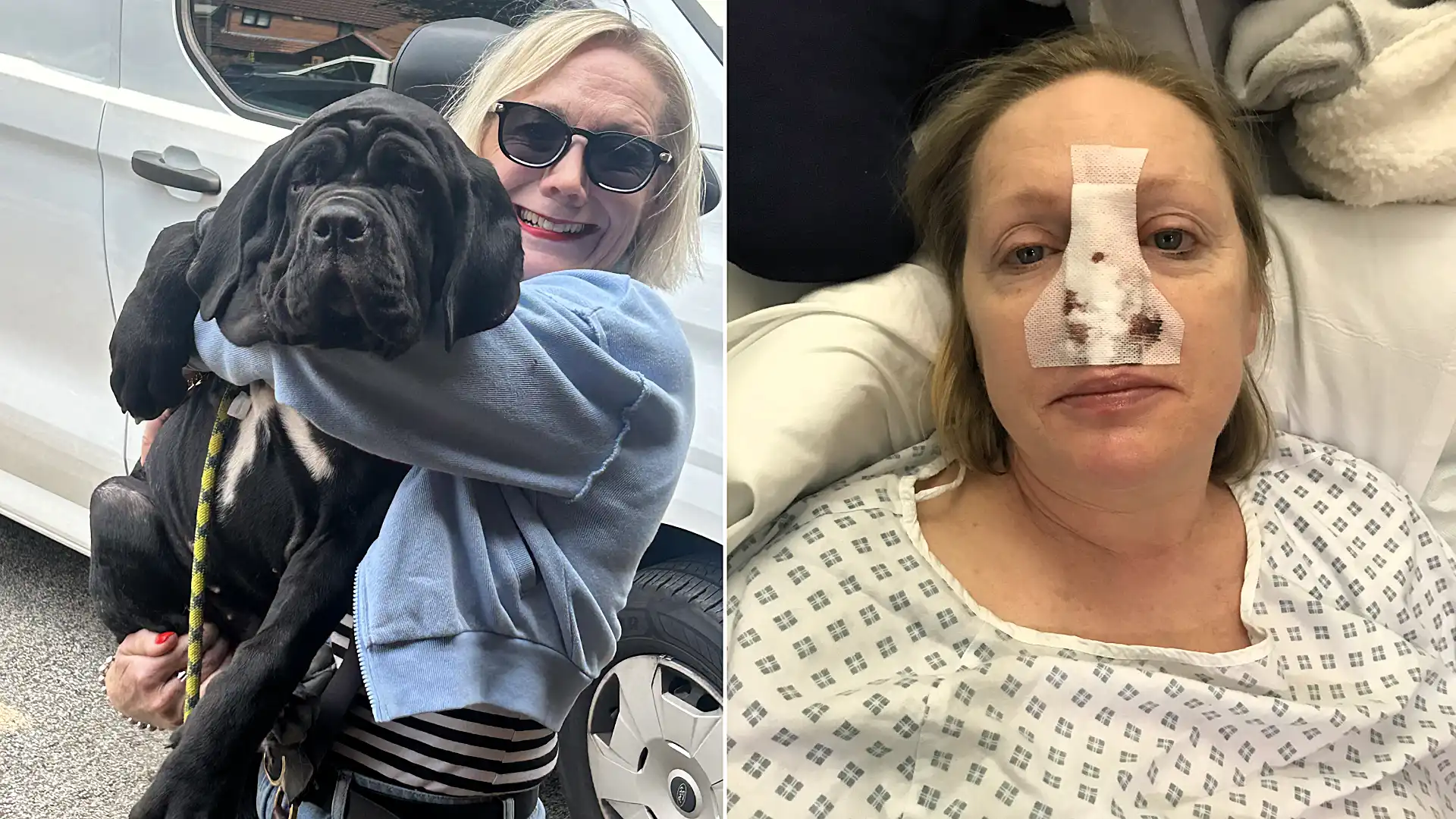
On a seemingly ordinary afternoon in 2012, Jayne Hardman was enjoying a quiet moment at her home in the United Kingdom, playing with her nearly 130-pound Neapolitan Mastiff named CeCe. During an enthusiastic bout of playfulness, the giant dog accidentally bounded up and struck Jayne across the face. At first, it appeared to be nothing more than an unfortunate bump—the sort of minor, clumsy injury common when living with large pets. Yet, instead of resolving after a few days, the incident triggered a cascade of persistent swelling, unexplained discomfort, and frequent nosebleeds that simply refused to stop.
Unbeknownst to Jayne, that playful nudge was the catalyst that set her on a remarkable journey. What initially felt like physical trauma turned out to be the first warning sign of a hidden, severe medical condition. Years later, reflecting on the turning point that ultimately led to specialized surgical intervention and a custom prosthetic, Jayne credits her beloved mastiff with saving her life by drawing attention to an illness that might have otherwise gone undetected until it was too late.
Myth, Mythology, and the Cultural Significance of Canine Guardianship
The idea that animals possess an extraordinary ability to sense danger or detect unseen human illness is deeply rooted in global folklore and mythological traditions. For thousands of years, civilizations across the world have revered dogs not merely as working animals or companions, but as spiritual guardians and intuitive protectors.
In ancient Egyptian mythology, the jackal-headed deity Anubis was associated with protection and guidance through life’s most vulnerable transitions. Similarly, in Celtic folklore, hounds were believed to walk between worlds, possessing heightened senses capable of perceiving unseen forces and impending personal crises. Across indigenous cultures, stories abound of domestic animals altering their behavior to alert their keepers to hidden ailments, natural disasters, or subtle environmental shifts.
In modern culture, stories like Jayne Hardman’s resonate powerfully because they touch upon this enduring mythic archetype: the animal guardian that acts as a sentinel for human well-being. While popular media often frames such events in terms of miraculous premonition or heroic animal intelligence, the narrative reflects a profound cultural truth—human beings share an ancient, deeply communicative bond with domestic species that continues to fascinate and comfort us.
The Medical Reality: Understanding Vasculitis and Tissue Loss
Beyond the compelling cultural narrative lies a grounded biological explanation. The underlying cause of Jayne’s progressive physical symptoms was eventually identified as vasculitis, specifically a rare autoimmune condition known historically as Granulomatosis with Polyangiitis.
Vasculitis occurs when the body’s immune system mistakenly identifies its own blood vessels as foreign threats, initiating severe inflammation. This inflammatory response restricts blood supply to local tissues, depriving them of vital oxygen and nutrients. In severe cases affecting the upper respiratory tract and facial sinuses, the lack of vascular nourishment can cause structural cartilage and surrounding soft tissue to gradually deteriorate and collapse.

The Scientific Perspective: Canine Olfaction and Bio-Detection Capabilities
While human folklore attributes animal alerts to mystical foresight, scientific research offers a fascinating biochemical explanation for how canine behavior can align with human health changes.
Dogs possess an extraordinarily sophisticated olfactory system. While human noses contain approximately 5 to 6 million olfactory receptors, a dog’s nasal cavity holds upwards of 300 million, coupled with a specialized vomeronasal organ dedicated to detecting subtle chemical signatures.
Comparative studies in veterinary science and medical bio-detection suggest that metabolic changes, cellular distress, and localized inflammation produce subtle shifts in human body chemistry. These shifts release micro-concentrations of Volatile Organic Compounds (VOCs) through the skin and breath.
Speculatively, canine experts suggest that when an underlying health condition causes localized tissue changes, an attentive domestic dog may detect the unusual chemical signature. To the animal, this alteration in scent represents something unfamiliar or unnatural, prompting behavioral reactions such as persistent sniffing, nudging, or heightened concern. What humans interpret as an intentional rescue effort may begin as an instinctual canine reaction to a distinct biochemical anomaly.
Modern Anaplastology and the Art of Facial Restoration
When progressive autoimmune damage leads to the loss of natural facial structures, modern medicine turns to the specialized field of anaplastology—the art and science of creating custom facial and somatic prosthetics.
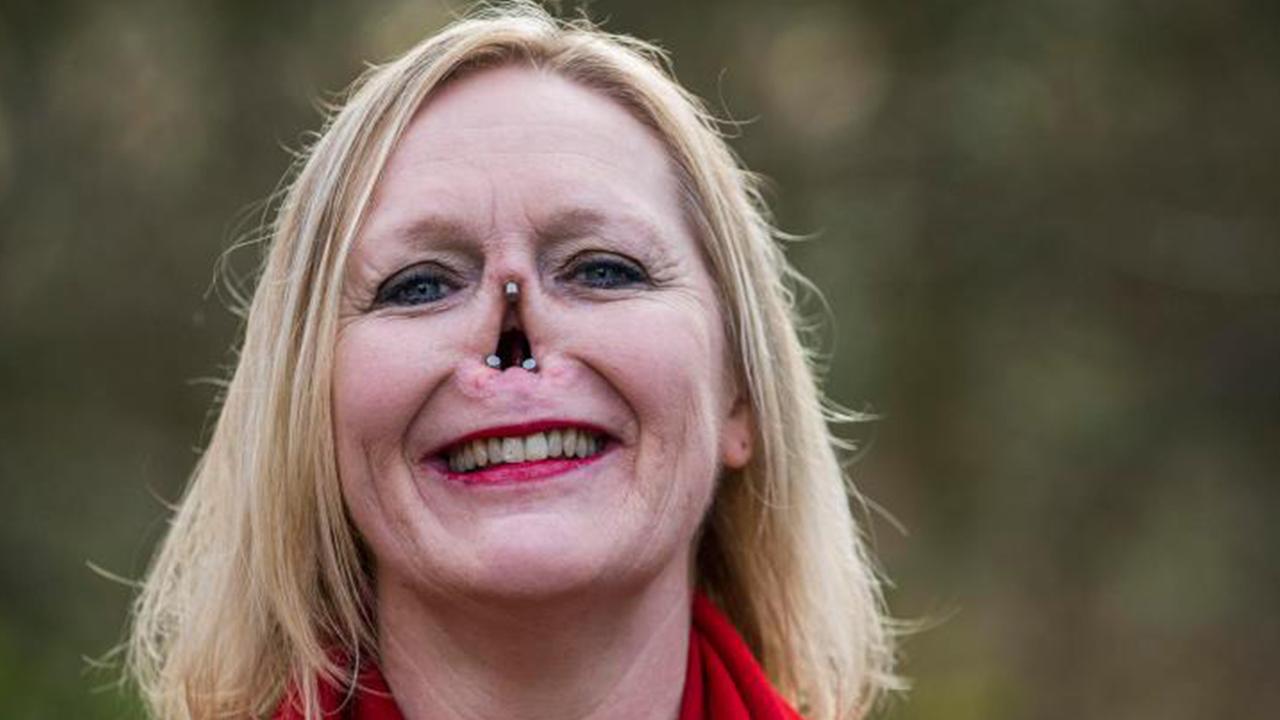
To restore both functionality and appearance, clinical specialists utilize bio-compatible materials, advanced imaging, and precision engineering. In cases involving extensive structural tissue loss, traditional adhesive methods can prove inconvenient or uncomfortable for daily wear. Advanced restorative medicine frequently employs osseointegrated implants: small, surgical-grade titanium posts anchored directly into the surrounding bone structure.
Living with Innovation: Quality of Life and Psychological Healing
Once osseointegrated anchors have healed, custom silicone prosthetics equipped with miniature magnetic fixtures can be attached securely in place. This innovative approach allows patients to apply and remove their prosthetic with ease, offering structural stability during daily activities while ensuring comfortable hygiene management.
Beyond physical restoration, these technological advances play a vital role in psychological recovery. The loss of a central facial feature presents profound emotional and social challenges, often impacting self-esteem and public confidence. Modern prosthetics are individually hand-sculpted and color-matched to fit seamlessly with a patient’s natural features and skin tones.
For individuals who have undergone reconstructive journeys, regaining a natural appearance restores the freedom to engage with society comfortably. Many individuals choose to speak openly about their experiences, utilizing lighthearted candor and advocacy to educate the public about autoimmune conditions, demystify prosthetic technology, and foster greater social acceptance for those living with visible facial differences.
Reflecting on Human Curiosity and Resilience
The story of how a playful pet helped uncover a rare medical condition ultimately reflects the beauty of human curiosity and our relentless search for understanding. When faced with unexpected challenges, human beings do not simply adapt; we investigate, innovate, and find meaning in the unexpected connections that surround us.
Our innate drive to explore the natural world—whether by studying the incredible sensory abilities of animals or developing state-of-the-art medical technology—allows us to transform moments of vulnerability into triumphs of resilience. It reminds us that curious minds, supported by scientific discovery and compassion, can uncover hidden truths, overcome daunting obstacles, and continually improve the human experience.
Sources
-
Cleveland Clinic: Comprehensive clinical overview of vasculitis types, symptoms, systemic inflammation, and autoimmune diagnostic procedures.
-
National Center for Biotechnology Information (NCBI): Peer-reviewed research on canine olfactory bio-detection and Volatile Organic Compound (VOC) analysis in medical diagnostic studies.
-
American Academy of Maxillofacial Prosthetics (AAMP): Clinical guidelines and technological overviews regarding osseointegrated facial prosthetics and anaplastology standards.
-
ITV News / “This Morning” Archives: Media documentation and personal narrative transcripts detailing patient advocacy, medical rehabilitation, and facial difference awareness initiatives.
