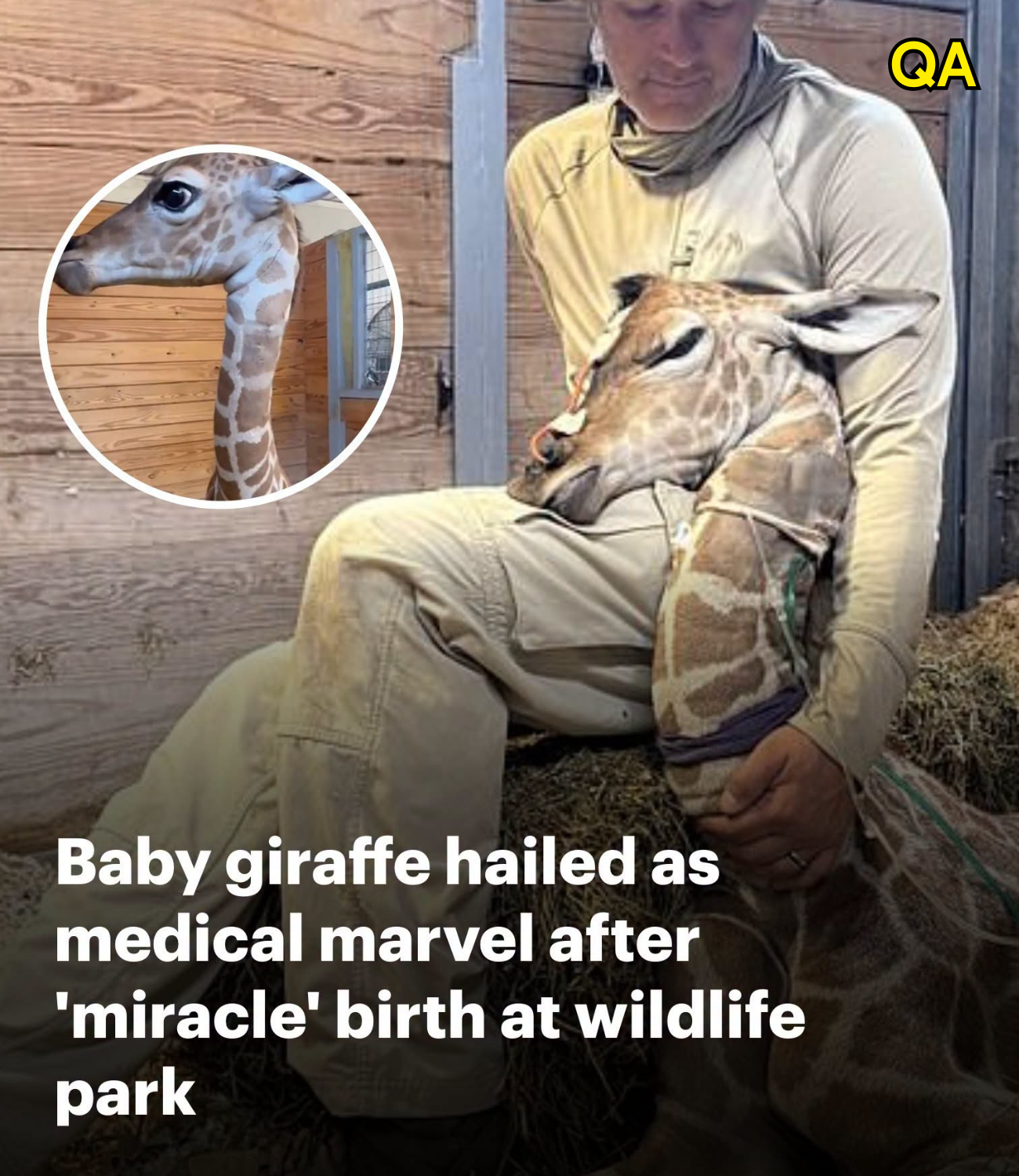

A Birth That Became an Extraordinary Test of Hope
Every new life begins with uncertainty, but some arrivals challenge even the most experienced veterinary teams.
At Tanganyika Wildlife Park in Wichita, Kansas, a newborn giraffe named Milani entered the world under exceptionally rare circumstances. Before she was born, veterinarians faced an impossible situation when her mother, Virtue, developed a rapidly worsening medical condition during pregnancy.
Their goal became clear: do everything possible to give the unborn calf a chance.
What followed was an intensive veterinary effort that has attracted attention from wildlife professionals and animal lovers alike. While park officials describe Milani’s survival as highly unusual, experts note that every medical case is unique, and ongoing monitoring remains essential.
Her story highlights both the remarkable advances in modern veterinary medicine and the dedication of the people who care for endangered wildlife.

A Difficult Medical Decision
Earlier this month, animal care staff noticed subtle but concerning changes in Virtue’s behavior.
According to Tanganyika Wildlife Park, the pregnant giraffe showed changes in her appetite and overall condition, prompting veterinarians to perform additional examinations.
Within days, laboratory testing revealed that her health had deteriorated significantly. Veterinarians reported evidence of serious organ dysfunction along with other complications that left very few treatment options.
After consulting giraffe specialists and veterinary experts, the team concluded that Virtue’s condition could not be reversed.
Their remaining focus became saving her unborn calf if possible.
To provide Milani with the best opportunity, veterinarians performed a rare emergency cesarean delivery while Virtue was under full sedation. Following the procedure, Virtue was humanely euthanized because her condition was considered irreversible.
According to the park, this difficult decision was made only after careful medical evaluation and consultation with specialists.

Why Giraffe Births Are Normally Very Different
A giraffe birth is unlike that of almost any other land mammal.
Female giraffes usually give birth while standing, allowing the newborn calf to drop approximately six feet to the ground.
Although this may sound dramatic, wildlife biologists explain that the fall serves important biological purposes.
It helps stimulate the calf’s first breath.
It also naturally separates the umbilical cord.
Healthy giraffe calves often begin attempting to stand within about 20 minutes and usually nurse within their first hour of life.
This early nursing provides colostrum, the antibody-rich first milk that plays an essential role in supporting the newborn’s developing immune system.
Because Milani was born prematurely through surgery, she was unable to experience this normal sequence of events.
That created additional challenges from the very beginning.
The First Critical Moments
After delivery, Milani required immediate veterinary attention.
According to the wildlife park, it took approximately two minutes before she drew her first breath.
Veterinary staff immediately cleared her airways, provided oxygen support, stimulated breathing, and carefully monitored her heart and lungs.
Because she could not receive antibodies naturally from her mother, veterinarians developed an alternative plan.
She received plasma donated by another giraffe, helping provide immune support during her earliest days.
The plasma donor was a giraffe named Mili, whose contribution later inspired part of Milani’s name.
The name Milani has been described by the park as representing “new birth” or “new era” while also honoring Mili’s role in her recovery.
Around-the-Clock Veterinary Care
Premature newborn animals often require constant observation, and Milani was no exception.
The veterinary and animal care teams provided continuous monitoring throughout the day and night.
Her care included:
Carefully controlled bottle feedings.
Assistance with standing.
Monitoring hydration.
Respiratory support when needed.
Regular veterinary examinations.
Close observation of growth and development.
Each successful milestone represented progress that had once seemed uncertain.
Wildlife professionals frequently emphasize that newborn care involves countless small achievements rather than one dramatic breakthrough.
A Story That Inspired Animal Lovers
As Tanganyika Wildlife Park shared updates, people around the world followed Milani’s progress.
Photos and videos documented her learning to stand independently, resting comfortably, exploring her enclosure, and eventually moving confidently without intravenous support.
Each update reflected weeks of dedicated teamwork involving veterinarians, animal care specialists, nutrition experts, and wildlife professionals.
For many observers, the story became a symbol of perseverance.
For veterinary professionals, it also demonstrated the value of preparation, collaboration, and scientific expertise.
Is Milani Truly the First?
Tanganyika Wildlife Park has stated that, after consulting giraffe neonatal specialists and veterinarians, they were unaware of any previously documented premature giraffe calf surviving a similar emergency surgical delivery.
Because medical records from wildlife institutions around the world continue to evolve, researchers generally avoid making absolute historical claims without comprehensive documentation.
However, experts agree that Milani’s case is exceptionally rare and represents an important contribution to veterinary knowledge.
Her ongoing progress may help veterinarians better understand how to care for future giraffe calves facing similar challenges.
The Science Behind Colostrum
One of the greatest concerns following Milani’s birth involved the absence of natural colostrum.
Colostrum is the first milk produced by mammals shortly after giving birth.
Unlike regular milk, colostrum contains high concentrations of antibodies that help protect newborns from infections during their earliest days.
Without these antibodies, newborn animals may face increased health risks while their immune systems continue developing.
Veterinary medicine has developed several supportive techniques for situations where natural nursing is not possible.
One option involves plasma transfusions from healthy donors, providing antibodies that help support immune function until the newborn becomes stronger.
Milani’s treatment followed this scientific approach.
Giraffe Conservation and Veterinary Innovation
Giraffes remain one of the world’s most recognizable animals, yet several giraffe populations have experienced significant declines over recent decades because of habitat loss, human activities, and environmental pressures.
Modern zoological institutions increasingly contribute to conservation through breeding programs, veterinary research, education, and international collaboration.
Every birth provides valuable opportunities to improve scientific understanding of giraffe reproduction and neonatal medicine.
Cases like Milani’s may help veterinarians refine emergency care techniques that could benefit future animals under human care.
Honoring Virtue’s Legacy

Although much attention has focused on Milani’s remarkable progress, wildlife park staff have also remembered Virtue.
Veterinary examinations performed after her passing revealed advanced heart and kidney disease along with additional reproductive complications.
According to the park, these findings confirmed that her medical condition had become irreversible.
While her life ended unexpectedly, her calf now carries forward a living legacy.
For the caregivers who worked tirelessly through those critical hours, Milani represents both hope and remembrance.
Looking Toward the Future
Milani continues growing under the careful supervision of experienced veterinarians and animal care professionals.
Her development will likely continue to be monitored closely as she matures.
Like many premature animals, she may require ongoing evaluations to ensure healthy growth.
Each new milestone contributes not only to her own journey but also to the broader scientific understanding of giraffe neonatal medicine.
Her story reminds us that progress in wildlife care often comes through careful observation, teamwork, and continuous learning.
A Reflection on Curiosity, Science, and Compassion
People have always been fascinated by extraordinary animal stories because they reveal both the resilience of wildlife and the dedication of those who care for them.
Milani’s journey illustrates how curiosity drives scientific discovery, while compassion inspires people to devote countless hours to protecting vulnerable lives.
Although every medical case is different and outcomes can never be guaranteed, stories like this encourage ongoing research that benefits animals far beyond a single wildlife park.
In the end, Milani’s remarkable beginning is not only a story about one giraffe calf. It is also a reminder that hope often grows through knowledge, teamwork, and an enduring commitment to wildlife conservation.
Sources
-
Tanganyika Wildlife Park – Official announcements and veterinary updates: https://www.twpark.com
-
Association of Zoos and Aquariums (AZA). Animal Care and Conservation Resources: https://www.aza.org
-
Smithsonian’s National Zoo & Conservation Biology Institute. Giraffe Facts: https://nationalzoo.si.edu
-
San Diego Zoo Wildlife Alliance. Giraffe Information and Conservation: https://animals.sandiegozoo.org
-
International Union for Conservation of Nature (IUCN). Giraffe Conservation Status: https://www.iucnredlist.org
