
A Small Brass Pocket Pipe and the Stories Everyday Objects Hold
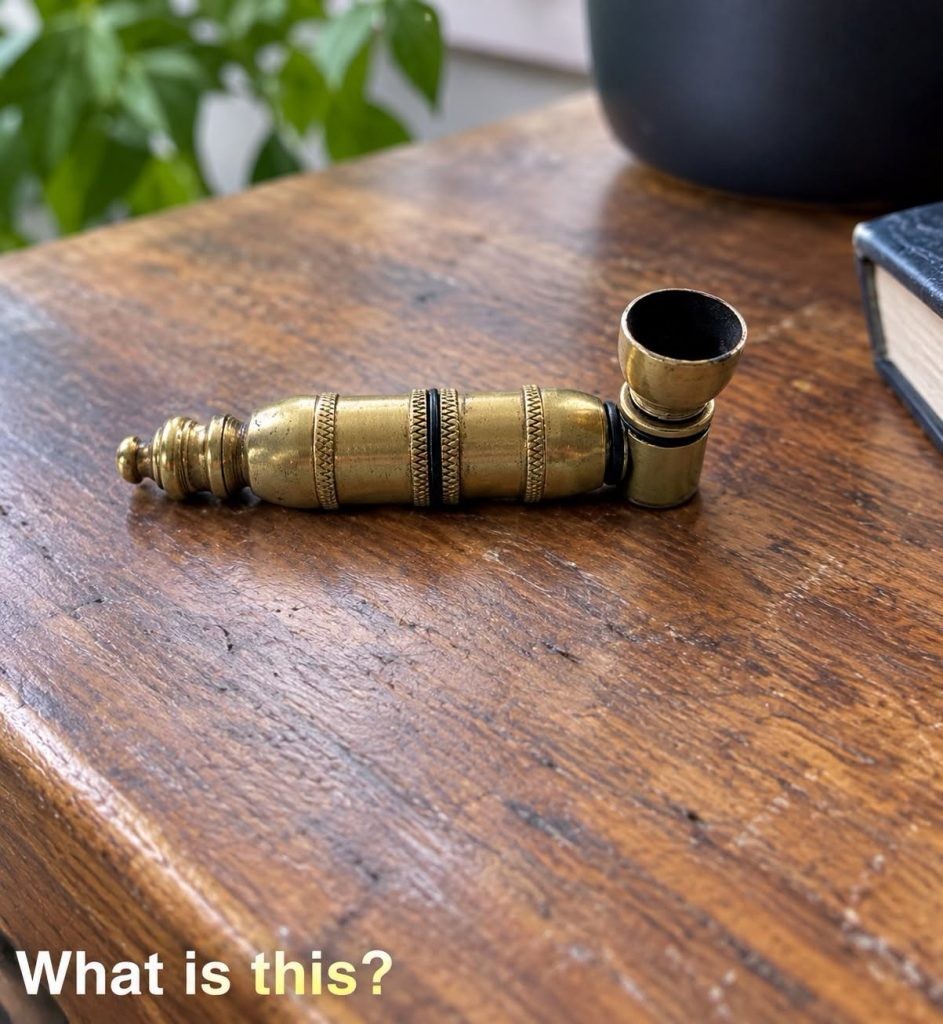
My grandfather’s drawer once held an unexpectedly personal mystery. Beneath old receipts, folded handkerchiefs, spare buttons, and faded photographs, I found a heavy brass object with rounded edges and a small opening. It was tarnished from age, compact enough to fit comfortably in one hand, and unlike anything I had seen among the ordinary belongings left behind.
At first, its purpose was difficult to understand. The object had curved sections, visible seams, and a worn surface marked by years of handling. It did not immediately resemble a tool, a piece of jewelry, or a household item. Like many objects found in family drawers, it seemed to belong to a world of routines and habits that had never been fully explained.
After comparing its form with photographs and catalogues of historical personal accessories, the object appeared to be a small brass pocket pipe. Its compact shape, metal construction, and separable-looking components were consistent with portable tobacco pipes made for personal use. The discovery was surprising, not because the object was especially rare, but because it revealed a detail of my grandfather’s everyday life that I had never known.
Finding an unfamiliar family possession can create a connection between personal memory and material history. A brass pocket pipe is more than an old object: it can offer clues about changing habits, manufacturing traditions, public health awareness, and the private lives people often leave only partly documented. At the same time, identifying an antique object requires care. Without a maker’s mark, date, or family record, no one can know every detail of its history with certainty.
How a Small Brass Pocket Pipe Was Designed
Pocket pipes were designed to be portable. Unlike larger wooden pipes commonly associated with home use, compact metal examples could be carried in a pocket, bag, or travel kit. Brass was a practical material because it was durable, relatively easy to shape, and resistant to breaking when dropped. Over time, untreated brass develops a darker patina as its surface reacts with air, moisture, and handling. That dull finish can make an old object look less decorative, but it may also provide useful evidence of age and use.
Many portable pipes were built with separate sections. A bowl or chamber held tobacco, while a narrow passage directed smoke toward a mouthpiece. Some designs could be opened for cleaning, an important feature because residue could build up after repeated use. The seams visible on a brass pipe may therefore reflect functional construction rather than ornamentation.
Not every small brass item with an opening is necessarily a pipe. Antique objects can be easily misidentified, particularly when they are incomplete or have no labels. Some personal accessories, small tools, containers, and mechanical parts may have similar shapes. Collectors and museum professionals usually look at several features before making an identification, including airflow channels, bowl depth, mouthpiece form, manufacturing marks, wear patterns, and comparisons with documented examples.
For families trying to identify an inherited item, photographs taken from several angles can be helpful. Images of the interior, underside, seams, and any stamped letters or numbers may make it easier to compare the object with museum collections, auction archives, or specialist reference guides. A local museum, historical society, or qualified antiques appraiser may also be able to offer a more informed opinion.
What an Inherited Object Can Reveal About Family History
The most meaningful part of the discovery was not the pipe’s material value. It was the realization that an ordinary object could suggest an aspect of my grandfather’s life that had not been included in family stories. I knew him through familiar memories: his voice, his routines, the places he liked, and the stories others told about him. Yet this small brass object hinted at quieter moments that remained his own.
Personal possessions often preserve this kind of incomplete history. A fountain pen may recall someone’s work. A recipe card may point to family traditions. A ticket stub, watch, coin purse, or pocketknife can reveal what a person carried and considered useful. These objects do not tell a complete story on their own, but they can encourage questions that might otherwise never be asked.
Family historians frequently use everyday items alongside letters, photographs, official records, and oral histories. A possession may help establish a timeline, identify a workplace or travel destination, or prompt relatives to share memories. In some cases, the object’s importance is not historical in a public sense at all. It may matter simply because it was held, kept, repaired, or stored away by someone who mattered to the family.
That distinction is important. An item does not need to be rare, expensive, or museum-quality to have emotional significance. The brass pipe in my grandfather’s drawer was meaningful because he had chosen to own it and preserve it among his everyday belongings. Its value came from association, memory, and the sense of closeness that a physical object can sometimes create.
Brass, Patina, and the Care of Vintage Personal Items
Old brass objects deserve careful handling. Brass is an alloy made primarily from copper and zinc, and its appearance changes naturally over time. A darkened surface, greenish spotting, or uneven color may be signs of oxidation and environmental exposure. While it can be tempting to polish brass until it shines, aggressive cleaning can remove original surface details and reduce historical interest.
Conservation guidance generally favors a cautious approach. Before cleaning any inherited object, it is wise to document its condition with clear photographs. Record any markings, scratches, inscriptions, and distinctive areas of wear. Store the item in a dry, stable environment away from direct sunlight, high humidity, and strong household chemicals. Soft acid-free tissue or an archival storage box can help protect it from dust and unnecessary handling.
If cleaning is necessary, a gentle method is usually safer than harsh abrasives or chemical dips. However, the best approach depends on the object’s condition and whether it has mixed materials, coatings, or decorative details. Professional conservators can advise on preservation when an item appears fragile, corroded, or historically important. The American Institute for Conservation provides public information on finding conservation professionals and caring for personal collections.
For a possible tobacco-related object, there is an additional practical consideration. Vintage pipes may contain old residue or residue from past cleaning products. It is sensible to avoid placing such an item near the mouth or attempting to use it. Preserving it as a family artifact is a safer and more appropriate way to respect its age and history.
Tobacco Use in Historical Context
A brass pocket pipe also belongs to a broader social history. Tobacco use was once much more common in many parts of the world, and pipes, cigarettes, cigars, and chewing tobacco were woven into daily routines, social customs, advertising, and military life. During much of the twentieth century, smoking was widely normalized in public places and homes before the full scale of tobacco-related health risks became broadly understood and acted upon.
Today, public health authorities are clear that tobacco use carries serious health risks. The World Health Organization states that tobacco kills more than eight million people each year, including people exposed to second-hand smoke. The United States Centers for Disease Control and Prevention also notes that smoking can harm nearly every organ and is linked to cancer, heart disease, stroke, chronic lung disease, and other conditions.
Recognizing this evidence does not require judging people from earlier generations by today’s standards. Many people who used tobacco lived in periods when health information, social expectations, and advertising practices were very different. A family artifact such as an old pipe can be viewed honestly as part of that history while also acknowledging modern medical knowledge and the importance of preventing tobacco-related harm.
For people who currently use tobacco and want support to stop, evidence-based help is available through healthcare professionals, national quitlines, counseling services, and approved cessation treatments. Public health organizations emphasize that quitting can improve health at any age, and that support can make the process more manageable.
Why Everyday Objects Carry Powerful Memories
There is something distinctive about holding an object that once belonged to a relative. A photograph shows a moment, but a physical possession has weight, texture, and marks of use. It can make the past feel present in a way that documents alone may not. The brass was cool and heavy in my hand, its surface worn smooth in certain places, as though it had passed through the same familiar gesture many times.
Of course, an object cannot answer every question. I do not know when my grandfather acquired the pipe, whether it was a gift, how often he carried it, or why he kept it in that drawer. Those details may be lost unless another family member remembers them or a written record emerges. The limits of the story are part of its meaning. Family history is often built from fragments rather than complete accounts.
Instead of filling those gaps with assumptions, it can be more meaningful to preserve the questions. Asking relatives about a discovered item may uncover memories that would otherwise disappear. A conversation might reveal a nickname, a job, a journey, a friendship, or a habit that was never written down. Even when no additional information is found, the act of looking closely can become a way of honoring someone’s life.
Documenting Family Heirlooms for Future Generations
Small inherited possessions are easier to understand when they are documented. A simple record can help future family members know what an object is, who owned it, and why it mattered. This does not need to be elaborate. A written note stored separately from the item can include a description, approximate dimensions, photographs, known dates, the owner’s name, and any memories connected to it.
For the brass pocket pipe, a useful record might state that it was found in my grandfather’s drawer among personal effects, that it appears to be a portable brass tobacco pipe, and that its exact date and maker are unknown. This approach separates confirmed facts from family recollections and reasonable interpretations. It also gives future relatives a starting point for further research.
Digitizing family records can add another layer of protection. Photographs, scanned letters, audio interviews, and short written recollections can be stored in more than one location. Libraries, archives, and genealogy organizations often provide guidance on organizing personal collections. The goal is not to turn every household object into a formal museum piece. It is to ensure that the stories connected to ordinary possessions are not lost.
A Quiet Connection Across Generations
Among the ordinary things left behind, the small brass pipe became a quiet connection to my grandfather. It was not important because of rarity or price. It mattered because it had been part of his world, even if only in a small and private way. The object reminded me that people are always more complex than the versions of them preserved in family anecdotes.
Everyday possessions can hold memory without offering certainty. They invite curiosity, careful research, and conversations with those who remember. They can also teach a more modest lesson: that a life is made not only of major events, but of the objects people carry, repair, save, and place in drawers for reasons no one else may fully understand.
In that sense, the old brass pocket pipe was never merely a mystery to solve. It became a reminder that the smallest objects can sometimes bring us closest to the people we miss.
Sources
Disclaimer: This content is intended for entertainment purposes only and is not based on real events.