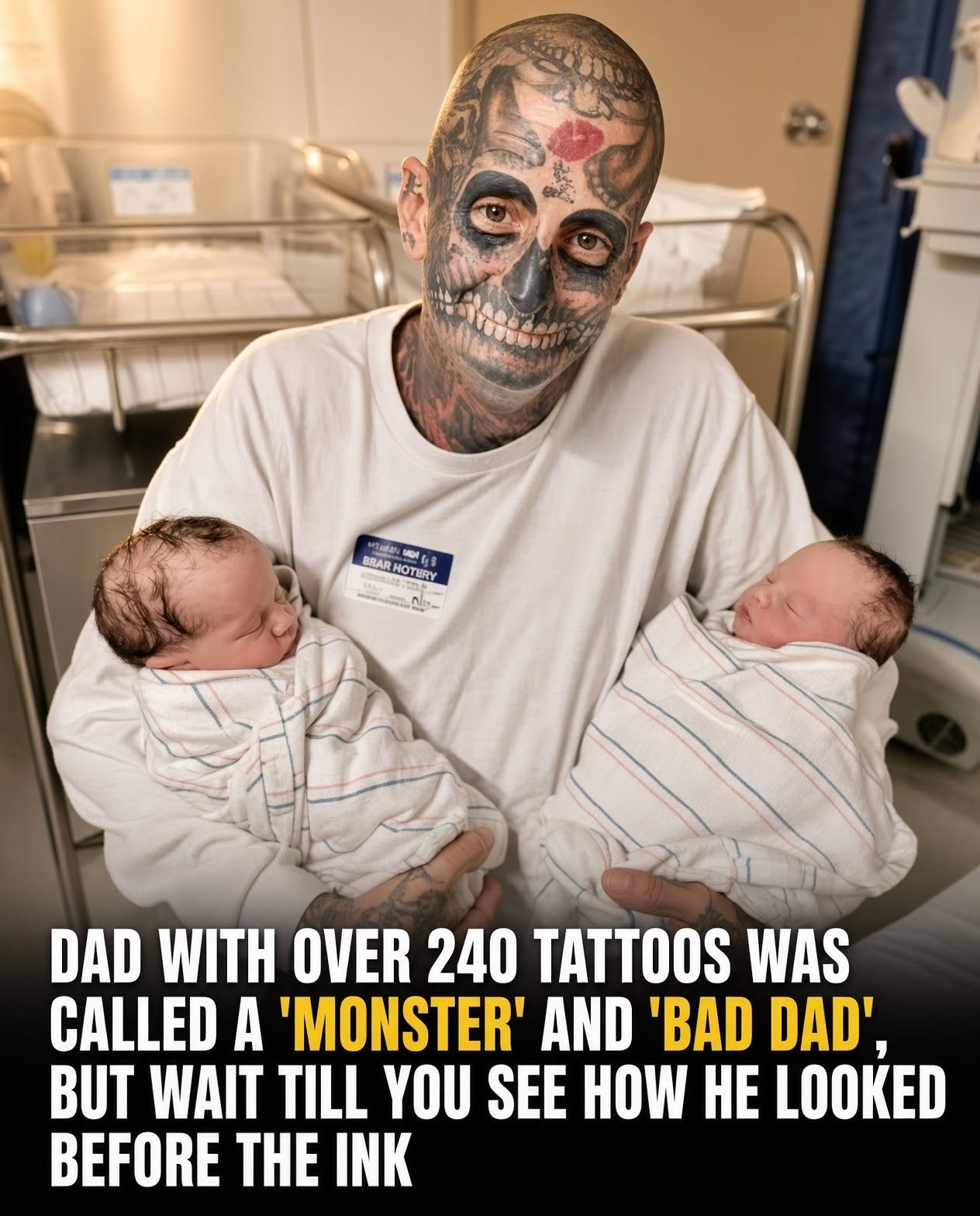

Richard Huff’s Tattoos and the Meaning of Personal Expression
For Richard Huff, tattoos are not simply decorative images placed on the skin. They are a long-term form of personal expression, with designs that he has connected to his identity, interests, family, and life experiences. His heavily tattooed appearance has attracted public attention, particularly because the artwork extends across much of his body, including highly visible areas such as his neck and face.
Stories about people with extensive body art often focus on the immediate visual impact of tattoos. Yet appearance alone rarely explains the motivations behind a person’s choices or the role those choices play in everyday life. In Richard’s case, public discussion has frequently centered on the contrast between strangers’ first impressions and the way his family knows him: as a father, partner, and individual with a strong interest in tattoo art.
His experience also reflects a broader cultural conversation about body modification, social expectations, parenting, and the assumptions people make when someone looks different from familiar social norms. Tattoos have become increasingly visible in many countries, but attitudes toward them can still vary widely depending on age, profession, community, and personal experience.
Richard Huff’s Tattoo Journey
According to accounts shared in interviews and widely circulated reports, Richard’s tattoo journey began with designs on his legs. Over time, his interest in tattoos expanded, and he added artwork to other areas of his body, including his arms, chest, neck, and face. What started as an interest in individual designs gradually developed into a major personal collection.
For many tattoo enthusiasts, the process is as meaningful as the finished result. Choosing an idea, discussing it with an artist, considering placement, and watching a design take shape can all be part of the experience. Tattoos may commemorate a relationship, represent an important value, honor a milestone, or simply reflect a person’s visual taste. In other cases, they are appreciated primarily as body art.
Richard has described being drawn to both the creative process and the personal significance of adding new tattoos. His appearance may seem unusual to people who prefer minimal or no body art, but he has presented his decisions as a matter of individual choice rather than a deliberate effort to provoke others.

Public descriptions of Richard have stated that he had tattoo coverage across approximately 85 percent of his body at the time of certain interviews and that he hoped to continue adding more work. Because body art can change over time, such figures should be understood as self-reported descriptions from a particular period rather than a confirmed, current measurement.
The distinction matters. Online stories can turn a person’s appearance into a fixed label, even though tattoo collections, personal goals, and public accounts may evolve. Responsible discussion should avoid overstating details that have not been independently verified or treating an individual’s body art as the sole fact that defines them.
Family Tattoos and Personal Meaning
Among Richard’s tattoos are designs reportedly connected to his children, including their names and images representing their lips. These kinds of tattoos illustrate an important point about body art: a design that is highly visible to strangers can carry a private or emotional meaning for the person wearing it.
Family-related tattoos are common across many cultures and tattoo styles. Parents may choose names, birth dates, symbolic images, handwriting, portraits, or other visual references to mark an important relationship. Such choices do not have one universal meaning, but they often show how tattoos can function as records of memory and connection.
In Richard’s case, the family references within his tattoo collection can be overlooked when photographs or headlines focus only on the quantity of ink or the visibility of facial tattoos. A picture may communicate that someone has extensive body art, but it does not necessarily explain why a particular image was chosen or what it means to the wearer.
This is one reason first impressions can be incomplete. People often form quick judgments from clothing, hairstyles, facial expressions, or tattoos. Those judgments may be understandable as an immediate human response, but they are not a reliable substitute for learning about someone’s character, actions, and relationships.
Why He Draws Attention in Public
Extensive tattoos, especially facial tattoos, remain relatively uncommon in many public settings. As a result, Richard’s appearance can make him immediately recognizable. Some people may be interested in the artistic detail of his tattoos and ask respectful questions. Others may feel uncertain because they are not accustomed to seeing highly visible body art.
Social reactions to tattoos have changed considerably over recent decades. Tattoos are now widely represented in sports, music, fashion, entertainment, and everyday life. Research from the Pew Research Center has found that tattoos are especially common among younger adults in the United States, although views differ by generation and by the visibility of the tattoo.
At the same time, visible tattoos can still be associated with stereotypes. In some workplaces and communities, people may assume that tattoos indicate a certain personality, lifestyle, or level of responsibility. These assumptions are not dependable indicators of a person’s conduct. Like many visible traits, tattoos can invite interpretation without offering enough information to justify a conclusion.
Richard’s story is often presented through this tension: he has made a conspicuous personal choice, but he also encounters reactions from people who may know nothing about his life beyond his appearance. The attention is not always hostile. However, repeated curiosity, comments, or snap judgments can become a regular part of life for people whose appearance falls outside conventional expectations.
Children, School Communities, and First Impressions
Public reactions can become particularly noticeable when a heavily tattooed parent participates in school activities or other child-centered spaces. Children may respond directly to unfamiliar appearances, sometimes using words such as “scary” or “intimidating” because they are still learning how to interpret visual differences.
According to the account associated with Richard’s family, some children at school have been surprised by his appearance. His daughter has offered a different perspective, explaining that she knows her father is not frightening. For her, his tattoos are simply part of his appearance and not a measure of his personality.
That response highlights the difference between familiarity and first impressions. A child who has only seen a striking image or met someone briefly may focus on visible features. A child who knows a parent through daily routines, conversations, support, and shared experiences has a far more complete understanding of that person.
Families can use these moments to encourage thoughtful conversations about difference. Adults do not need to insist that everyone share the same aesthetic preferences. It is entirely reasonable for people to have different views about tattoos, facial tattoos, or other forms of body modification. The more important lesson is that personal preference should not become a reason to treat someone disrespectfully or assume negative qualities without evidence.
Appearance Does Not Measure Parenting Ability
Richard Huff’s story raises a broader question: what information can appearance truly provide about a person’s ability to care for children? The answer is limited. Parenting involves responsibility, emotional availability, communication, consistency, safety, and ongoing involvement in a child’s life. These qualities cannot be accurately measured by the number, size, or location of tattoos.
Health and child-development organizations consistently emphasize the importance of supportive relationships, stable care, and responsive communication in children’s well-being. A parent’s outward style may be noticeable, but it is their behavior and the quality of their caregiving that matter most in daily family life.
This does not mean that appearance never affects social experiences. Visible tattoos can influence employment policies, public interactions, and the way people respond in formal settings. But these social consequences should be distinguished from claims about moral character or parental competence. Someone may personally dislike tattoos while still recognizing that tattooed parents, like all parents, should be evaluated by how they treat and support their children.
For Richard, the central contrast appears to be between what strangers may imagine and what his family experiences. His tattoos are a major part of his visual identity, yet they exist alongside the ordinary tasks of family life: being present for children, taking part in school-related activities, and maintaining relationships at home.
Tattoos in Modern Society
Tattoos have a long and varied global history. Archaeological evidence indicates that tattooing has existed for thousands of years, while living traditions remain important in communities around the world. In some cultures, tattoos have been associated with heritage, spirituality, status, identity, protection, military service, or artistic expression.
Modern tattoo culture is equally diverse. Styles range from traditional designs and fine-line work to realism, geometric patterns, lettering, cultural motifs, and abstract art. As tattooing has become more mainstream, the industry has also developed stronger conversations about professional standards, hygiene, consent, and safe aftercare.
People considering a tattoo should seek a licensed or properly regulated studio where applicable, ask about sanitation practices, and follow professional aftercare guidance. The U.S. Food and Drug Administration notes that tattoo inks and procedures can involve health considerations, including the possibility of allergic reactions or infection. Consulting a qualified health professional is appropriate if someone experiences concerning symptoms after a tattoo.
These practical issues are separate from personal judgments about style. A person can support safe, informed tattoo practices while recognizing that body art is ultimately a personal decision. Not everyone will want tattoos, and not every tattoo trend will appeal to every observer. Respectful disagreement is possible without reducing people to stereotypes.
A Reminder to Look Beyond Surface-Level Judgments
Richard Huff’s public story is not necessarily an argument that everyone should embrace extensive tattooing. It is instead a reminder that people are more complex than their most noticeable visual feature. Tattoos may reveal something about artistic interests, memories, or preferred style, but they cannot independently reveal a person’s values, kindness, responsibilities, or relationships.
The story also shows why children benefit when adults model respectful curiosity. When young people see adults respond to differences calmly and without ridicule, they can learn to separate appearance from character. They can also learn that it is possible to ask polite questions, acknowledge unfamiliarity, and treat others with basic dignity.
Richard continues to be recognized for his unusually extensive tattoos, but the details linked to his children offer another dimension to the story. Behind the visual impact are personal choices, family connections, and an everyday life that cannot be fully understood through a photograph or a brief social-media caption.
In the end, tattoos are one form of self-expression among many. Whether a person has none, a single small design, or artwork covering much of their body, their appearance should not automatically define how others judge their humanity or their role within a family.
Sources
- Pew Research Center: Tattoos and public attitudes in the United States
- U.S. Food and Drug Administration: Tattoo safety information
- Centers for Disease Control and Prevention: Child development and supportive relationships
- World Health Organization: The importance of supportive social environments
- BBC Culture: Historical context on tattoo traditions
Disclaimer: This content is intended for entertainment purposes only and is not based on real events.