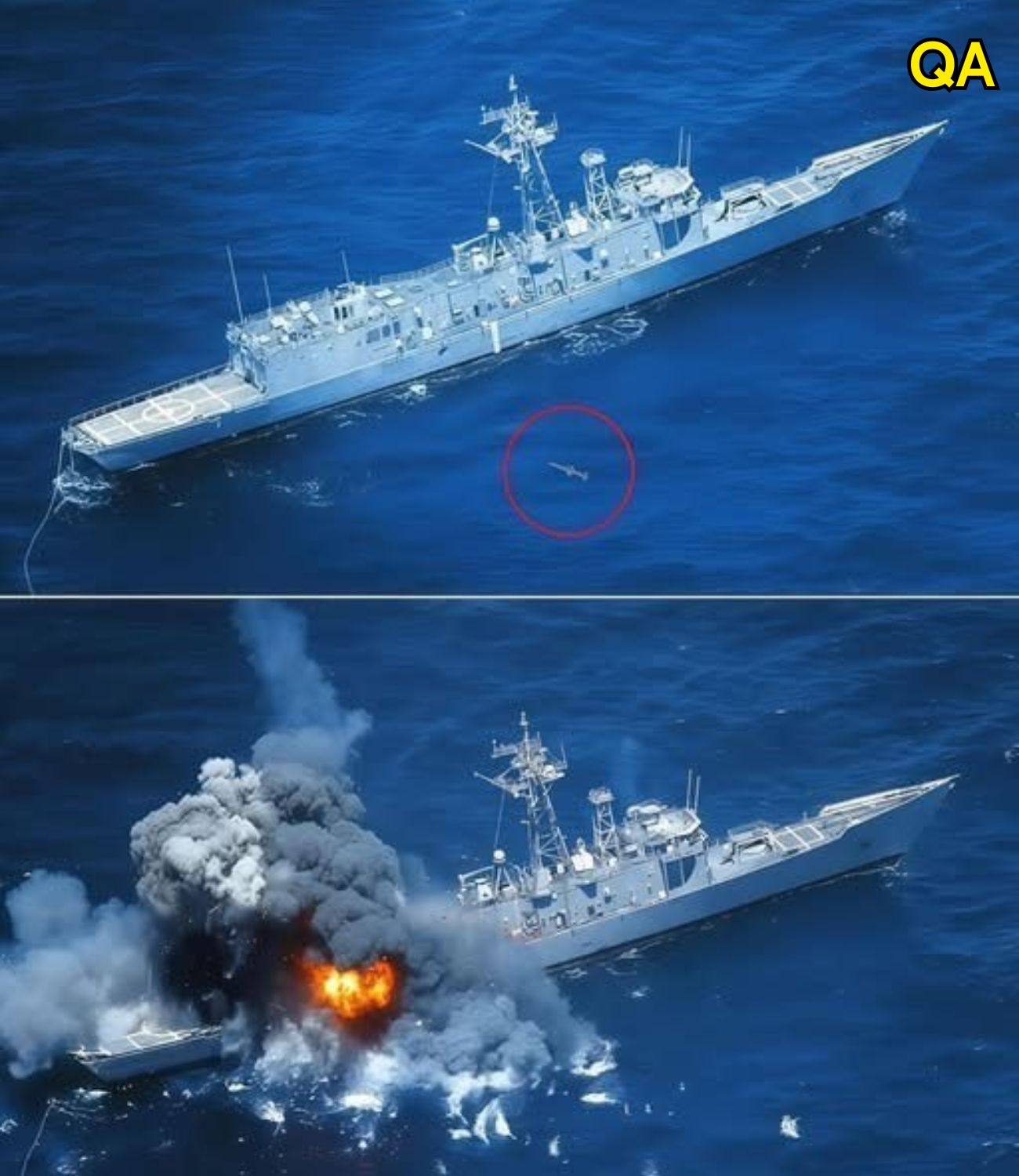

A headline claiming that a United States Navy warship was “destroyed in a massive missile strike” immediately suggests conflict. For many readers, it raises urgent questions about global security and potential escalation.
But in this case, the reality is very different.
The event described involves a planned military exercise, not an act of war. Understanding this distinction is essential to avoid confusion and unnecessary alarm.

The Ship Behind the Story
The vessel mentioned is the USS Rodney M. Davis, a guided-missile frigate that served in the United States Navy for decades.
Commissioned during the Cold War era, the ship was part of the Oliver Hazard Perry-class frigate fleet, designed primarily for:
Escort missions
Anti-submarine operations
Protection of larger naval groups
Over its service life, it participated in patrols and joint exercises across multiple regions, including the Persian Gulf.
What Actually Happened: A SINKEX Exercise
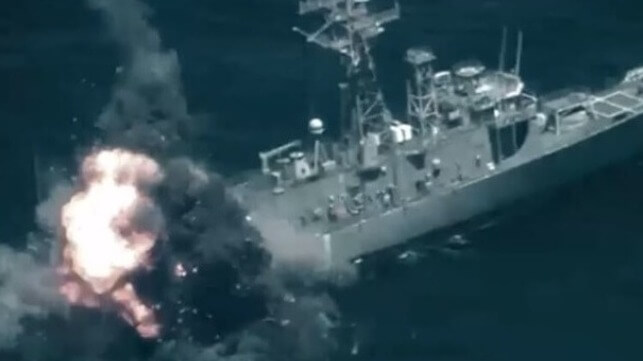
The ship was not destroyed in combat. It was intentionally sunk during a military training operation known as a SINKEX (Sinking Exercise).
These exercises are conducted by naval forces to:
Test weapons systems
Train personnel in realistic scenarios
Evaluate ship durability and targeting
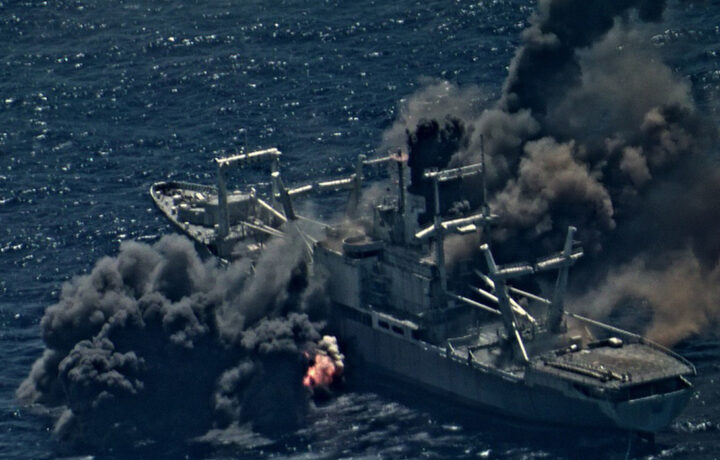
During a SINKEX, decommissioned ships are used as targets under controlled conditions. The process is carefully planned and monitored.
Why Navies Conduct SINKEX Operations
While the visuals of a ship being struck and sinking can appear dramatic, the purpose is practical.
Military organizations use these exercises to improve readiness and ensure that systems perform as expected. Real-world testing provides data that simulations alone cannot fully replicate.
For the United States Navy, such exercises contribute to long-term operational effectiveness and safety.
Environmental and Safety Considerations
Before a ship is used in a SINKEX, it undergoes extensive preparation.
This includes:
Removing hazardous materials
Clearing fuel and oils
Stripping sensitive equipment
These steps are required to meet environmental standards and reduce impact on marine ecosystems.
In many cases, the remains of the vessel become an artificial reef, supporting ocean life over time.
Why Headlines Can Be Misleading
The phrase “destroyed in a missile strike” is technically accurate in describing how the ship was sunk, but it lacks critical context.
Without mentioning that it was a controlled exercise, the headline can easily be misinterpreted as a real conflict.
This highlights a common pattern in viral content:
Use of dramatic language
Omission of key context
Focus on emotional impact
Understanding this pattern helps readers approach such stories more critically.
The Importance of Context in Military News
Military activities are often complex and involve specialized terminology. Without context, even routine operations can appear alarming.
In reality, exercises like SINKEX are conducted regularly by multiple countries as part of standard training.
They are not indicators of active conflict, but of preparation and readiness.
A Broader Perspective on Naval History
Ships like the USS Rodney M. Davis represent decades of service and technological evolution.
Decommissioning and eventual sinking mark the end of their operational life, but also contribute to future development through training and research.
In this way, even their final mission serves a purpose.
A Reflection on Human Curiosity
Stories involving military power and dramatic visuals naturally capture attention. They spark curiosity and sometimes concern.
But curiosity becomes most valuable when paired with understanding.
Taking a moment to look beyond the headline, to ask what really happened and why, transforms reaction into insight.
Because in a world of fast-moving information, clarity is more powerful than urgency.
Sources
U.S. Navy. “Sinking Exercises (SINKEX) and Training Operations.”
Naval History and Heritage Command. “Oliver Hazard Perry-Class Frigates.”
Reuters. “Military Training Exercises Explained.”
BBC News. “How Naval Exercises Support Defense Readiness.”
NOAA. “Artificial Reefs and Marine Ecosystems.”
