
Jimmy Stewart’s World War II Service and Return to Hollywood
Jimmy Stewart was already one of Hollywood’s most admired leading men when the United States entered World War II. Known for his understated style, distinctive voice, and performances in films such as Mr. Smith Goes to Washington and The Philadelphia Story, Stewart had won the Academy Award for Best Actor in 1941. He was also a major box-office figure at a time when the American film industry was becoming increasingly important to national morale.
Yet Stewart’s wartime story was not limited to celebrity appearances, morale tours, or film productions. He entered military service before the attack on Pearl Harbor and went on to serve in the U.S. Army Air Forces, eventually flying combat missions over occupied Europe. His service became a defining part of his public legacy, alongside a screen career that lasted for decades after the war.
Stewart’s experience reflects a broader history of Americans who left established professional lives to serve during World War II. It also offers context for the changes visible in his postwar work, including his acclaimed performance in Frank Capra’s 1946 film It’s a Wonderful Life.
Jimmy Stewart’s Hollywood Career Before World War II
Born James Maitland Stewart in Indiana, Pennsylvania, in 1908, Stewart initially studied architecture at Princeton University. His interests later shifted toward acting, and he joined theatre groups before moving into motion pictures during the 1930s. His early Hollywood career developed rapidly through collaborations with major directors, including Frank Capra, George Cukor, and Ernst Lubitsch.
By the end of the decade, Stewart had become one of the era’s most recognizable actors. In 1939, he starred in Capra’s political drama Mr. Smith Goes to Washington, playing an idealistic senator confronting corruption in the U.S. political system. The role earned him an Academy Award nomination and helped define his image as an everyman character with integrity and emotional depth.
His role in The Philadelphia Story, released in 1940, earned Stewart the Academy Award for Best Actor. Although he was skeptical about whether he deserved the award over other nominees, the honor confirmed his standing as one of Hollywood’s leading performers. At that moment, he had professional success, financial security, and a highly visible public profile. His military service nevertheless became an increasingly important priority.
Early Military Training and Enlistment
Stewart’s interest in aviation predated America’s direct entry into World War II. He earned a private pilot’s license in 1935 and joined the U.S. Army Air Corps as a reserve pilot in 1938. Aviation was still a relatively new and prestigious field, and Stewart viewed flying as more than a hobby. It became the route through which he hoped to contribute to national defense.
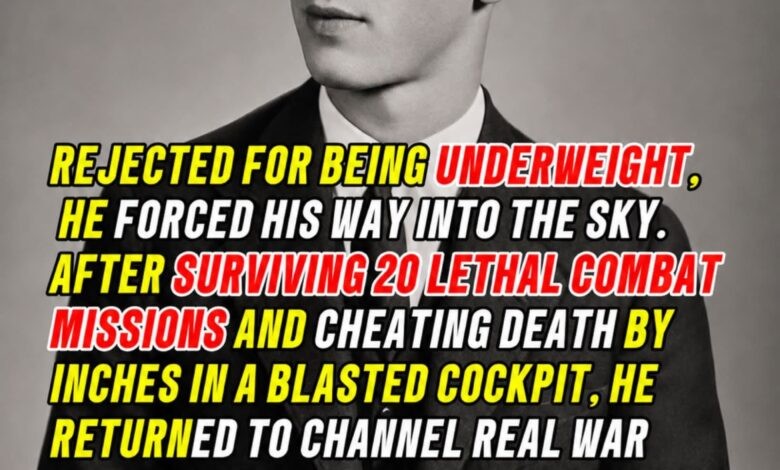
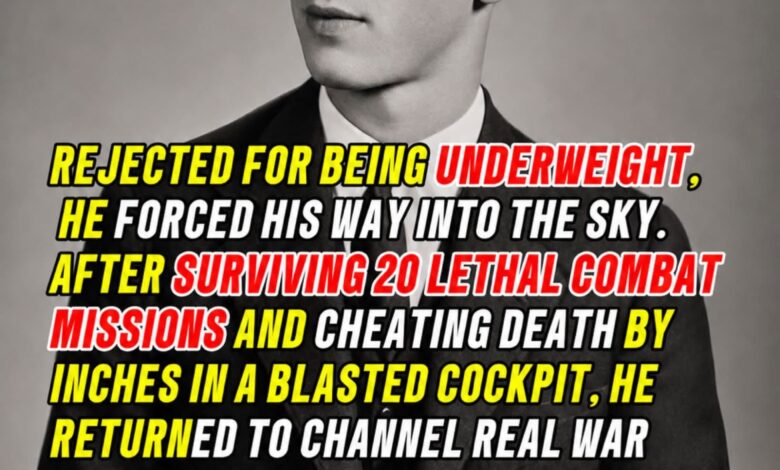
In March 1941, months before the United States entered the war, Stewart was drafted into the U.S. Army. According to the National Museum of the United States Air Force, he initially faced a setback during his physical examination because he was below the Army’s required weight for his height. He subsequently worked to meet the requirement and was accepted for service.
His celebrity status did not exempt him from the military’s rules or procedures. Like many recruits, he completed training and was assigned responsibilities based on the Army Air Forces’ needs. During the early period of U.S. involvement in the war, the military used his aviation experience and public profile in training and recruitment-related activities. However, Stewart wanted a more direct operational role.
From Flight Instructor to Combat Leader
Stewart’s early wartime assignments included work as a flight instructor. The Army Air Forces needed experienced pilots to prepare a rapidly expanding force for overseas operations, and Stewart’s qualifications made him valuable in that role. He also appeared in training films and supported efforts designed to encourage enlistment and aviation instruction.
However, he continued to seek assignment to an operational unit. In 1943, Stewart was sent to England and joined the 445th Bombardment Group, part of the Eighth Air Force. The Eighth Air Force played a central role in the Allied strategic bombing campaign against Nazi Germany and German-occupied Europe.
Stewart flew the Consolidated B-24 Liberator, a heavy bomber used extensively by U.S. forces in the European theater. B-24 crews faced difficult conditions: long flights at high altitude, severe weather, mechanical challenges, and the constant threat posed by enemy fighters and anti-aircraft artillery. Combat missions required close coordination among pilots, navigators, bombardiers, engineers, radio operators, and gunners.
His military duties expanded beyond the cockpit. Stewart served as a squadron operations officer and later became a group operations officer. These positions involved planning, leadership, and responsibility for other airmen as well as participation in missions. The official U.S. Air Force historical account states that he flew 20 combat missions during the war.
Combat Missions Over Europe
The air campaign over Europe was one of the most demanding aspects of Allied military operations. American heavy bombers attacked industrial facilities, transportation networks, aircraft factories, oil targets, and other sites considered important to Germany’s war effort. The strategy was controversial then and remains the subject of historical debate, particularly because aerial warfare could affect civilian populations as well as military infrastructure.
For individual air crews, the immediate experience involved long hours, complex equipment, and extraordinary pressure. Stewart flew missions into heavily defended areas, including targets in Germany. His service placed him in the same hazardous operational environment faced by thousands of other bomber personnel.
Many accounts of wartime aviation emphasize the risks of flak, the term commonly used for anti-aircraft fire, as well as attacks by enemy aircraft. Losses among bomber crews were substantial during the war, especially before Allied fighter escorts could provide more consistent protection over long distances. Stewart’s leadership record must therefore be understood in the context of an air campaign that demanded significant sacrifice from airmen of many nationalities.
Although later retellings sometimes focus on individual dramatic incidents, the most reliable record is that Stewart served as a combat pilot and operational commander in the European theater. His service was recognized with decorations including the Distinguished Flying Cross, the Air Medal with three oak leaf clusters, and France’s Croix de Guerre with Palm.
Promotion, Decorations, and Continued Reserve Service
Stewart rose through the ranks during the war and was promoted to colonel in 1945. The promotion reflected his operational responsibilities and leadership within the Army Air Forces. At the end of World War II, he returned to civilian life with a military record that was unusually extensive for a Hollywood star of his generation.
His connection to the military did not end when filming resumed. Stewart remained in the Air Force Reserve after the creation of the independent U.S. Air Force in 1947. He continued to participate in reserve activities for many years, including overseas visits and official duties related to aviation and national defense.
In 1959, Stewart was promoted to brigadier general in the Air Force Reserve. He retired from military service in 1968. The National Museum of the United States Air Force identifies him as Brigadier General James M. Stewart, recognizing both his military career and the distinction he brought to the service as a widely known civilian figure.
Returning to Hollywood After the War
Stewart returned to Hollywood at a time when both the country and the film industry were changing. Millions of U.S. service members were coming home, and the years immediately after the war brought economic adjustment, political uncertainty, and personal challenges for many veterans and their families.
His first major film after the war was Frank Capra’s It’s a Wonderful Life, released in 1946. Stewart played George Bailey, a man whose aspirations are repeatedly set aside because of family obligations and the needs of his community. The story eventually became one of the best-known American holiday films, though its initial box-office performance was modest compared with its later reputation.
One of the film’s most remembered scenes occurs when George Bailey, overwhelmed by despair and financial pressure, prays for help in a bar. Stewart later discussed the emotional intensity of performing the scene, saying that his character’s breakdown affected him deeply. Critics and historians have often noted that his postwar performances seemed to carry a greater emotional complexity than some of his earlier screen roles.
It is important, however, to distinguish documented facts from interpretation. Stewart’s wartime service is well established through military records and institutional histories. Claims that a specific scene represented a direct expression of combat trauma are more difficult to prove conclusively. What can be said is that Stewart’s performance resonated strongly with audiences, including generations of viewers who saw in George Bailey a portrayal of anxiety, responsibility, and the need for human connection.
How World War II Shaped Jimmy Stewart’s Later Roles
After It’s a Wonderful Life, Stewart rebuilt and broadened his film career. He appeared in westerns, suspense films, comedies, and dramas, working with directors such as Alfred Hitchcock, Anthony Mann, and John Ford. His later films included Winchester ’73, Rear Window, The Man from Laramie, Vertigo, and The Man Who Shot Liberty Valance.
His postwar characters were often more conflicted, guarded, or morally uncertain than the optimistic figures associated with some of his prewar work. Film scholars have frequently connected this evolution to shifts in American cinema after World War II, when audiences encountered darker themes involving fear, guilt, violence, social change, and personal alienation.
Stewart did not publicly define all of his roles through the lens of military service, and it would be inaccurate to reduce his acting career to a single experience. Nevertheless, his wartime record provides important context. He was not simply portraying fictional people affected by conflict and loss; he had served in an air war that shaped an entire generation of Americans and Europeans.
Jimmy Stewart’s Enduring Legacy
Jimmy Stewart remains notable because his public life combined two highly visible paths: a celebrated career in entertainment and sustained military service. His achievements as an actor are preserved in films that continue to be watched worldwide. His military history is preserved through official records, museum collections, biographies, and the history of the Army Air Forces.
His story is also a reminder that World War II touched people across occupations, regions, and social classes. Actors, factory workers, teachers, farmers, engineers, and countless others entered military or civilian service during a global conflict that changed international politics and everyday life. Stewart’s fame makes his experience especially recognizable, but he was one of many airmen who served in dangerous conditions far from home.
For modern audiences, the lasting value of Stewart’s story lies in its historical context. His career demonstrates how a prominent public figure could move from the film set to military service and then return to a changed creative landscape. His record as a pilot, combat leader, reservist, and later brigadier general remains an important part of the broader history of American aviation and World War II.
Sources
Disclaimer: This content is intended for entertainment purposes only and is not based on real events.