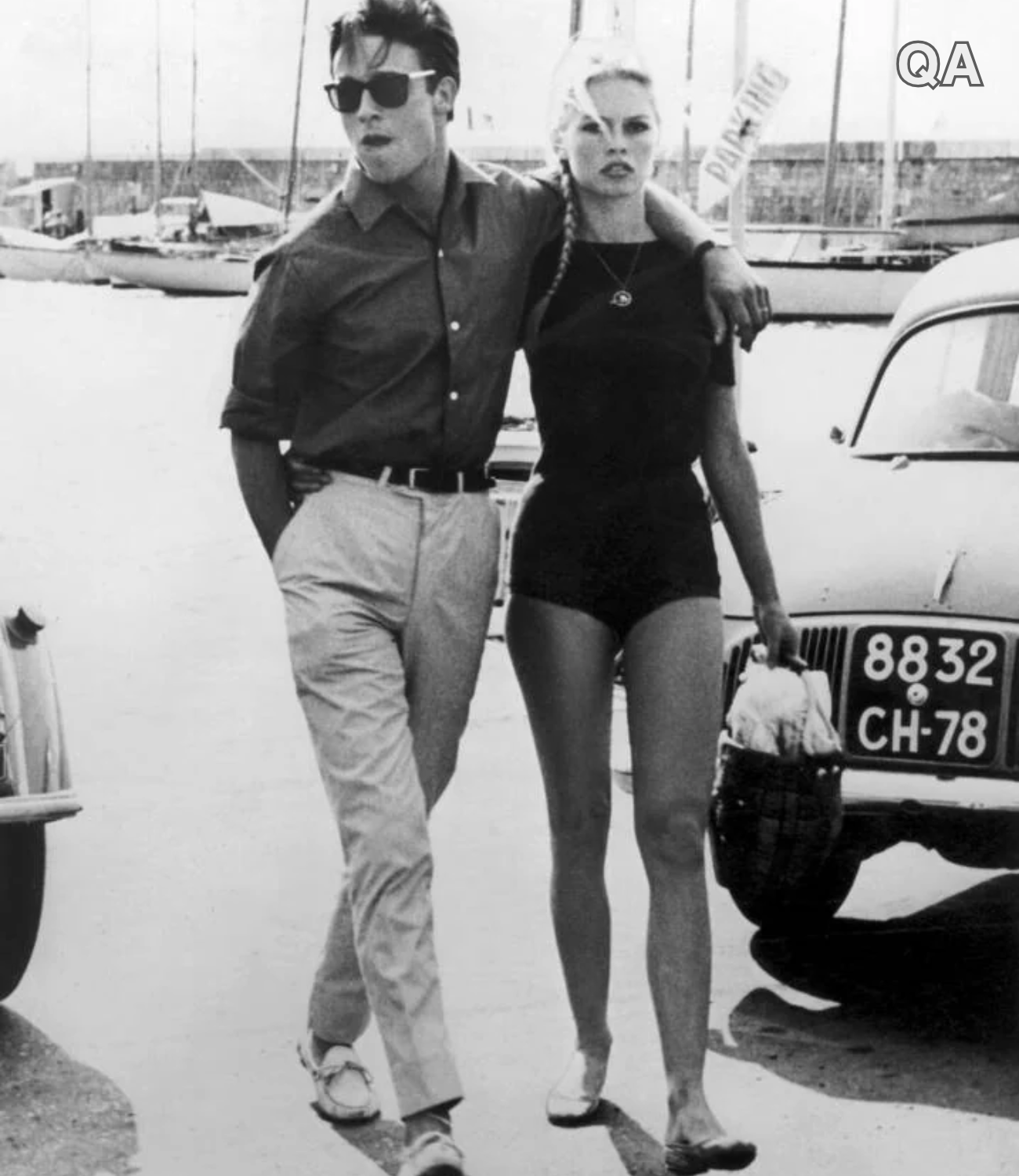

Their marriage ended while the world was still admiring the picture. Brigitte Bardot and Jacques Charrier seemed to embody Riviera romance, but behind the glamour were two people navigating fame, parenthood, and relentless attention. From their dazzling wedding to the birth of their son, every milestone invited fascination, while the photographs could never reveal the whole, deeply complicated tru
By the late 1950s, Brigitte Bardot’s success in And God Created Woman had helped make her an international sensation. Saint-Tropez became closely associated with her image: sunlit, glamorous, and seemingly carefree. Her June 1959 marriage to actor Jacques Charrier brought fresh attention to a life already under intense scrutiny. When their son, Nicolas-Jacques, arrived in January 1960, public fascination extended beyond the screen and into the intimate territory of their family life.

The couple divorced in 1962, bringing their brief marriage to an end without resolving the distance between its beautiful imagery and its private complexities. Bardot later spoke about her difficulties surrounding motherhood, revealing experiences that challenged the expectations attached to her celebrity. Yet neither those reflections nor contemporary headlines can fully explain why the relationship ended. The surviving photographs preserve youth and elegance; the fuller story leaves room for uncertainty, family responsibilities, and lives no single image could contain.
To understand why the marriage between Brigitte Bardot and Jacques Charrier fractured so quickly beneath the glare of flashbulbs, it helps to examine the unprecedented media ecosystem emerging in late-1950s France. Before the modern vocabulary of paparazzi culture was fully codified, Bardot stood at its absolute epicenter.
Her breakout role in Roger Vadim’s 1956 film And God Created Woman did not merely launch a movie star; it transformed a quiet Mediterranean fishing village into an international stage and turned Bardot into France’s most valuable cultural export. By the time she met Charrier—a handsome, rising young actor cast alongside her in the 1959 comedy Babette Goes to War—her private life had ceased to belong to her.
Their wedding in Louveciennes on June 18, 1959, demonstrated how completely public curiosity had overtaken private ceremony. Hundreds of photographers and reporters swarmed the town hall, turning an intimate civil union into a chaotic press scrum. For two young performers in their early twenties, there was no quiet honeymoon phase in which to build a foundation away from public commentary.

Postwar magazines presented Bardot and Charrier as the ultimate modern couple—youthful, stylish, and effortlessly liberated. Behind closed doors, however, the pressures weighing on both individuals were starkly at odds with the breezy black-and-white photographs printed on newsstands across Europe and North America.
When Nicolas-Jacques was born in January 1960, Bardot could not even safely travel to a maternity clinic without risking a dangerous media stampede. Instead, doctors delivered the child inside her Paris apartment while photographers scaled neighboring buildings and bribed staff for glimpses through shutters. What should have been a sheltered, restorative milestone became a claustrophobic ordeal.
Decades later, in her candid 1996 memoir Initiales B.B., Brigitte Bardot shocked many readers by refusing to soften her memories of pregnancy and early motherhood. Rather than adopting the conventional script expected of female screen icons, she described feeling trapped, overwhelmed, and emotionally unequipped for maternal life at the height of her global fame.
At the same time, Jacques Charrier—who later published his own account, Ma réponse à Brigitte Bardot (My Response to Brigitte Bardot), in 1997—offered a distinctly different perspective, emphasizing his devotion to their son and the painful complexities of trying to sustain a household under extraordinary public pressure. Following their 1962 divorce, Charrier assumed primary custody and raised Nicolas largely outside the entertainment spotlight, shielding him from the relentless scrutiny that had defined his parents’ union.
The divergence between their recollections illustrates a timeless truth about intimate relationships: two people can experience the exact same years through profoundly different emotional realities, and neither public sympathy nor courtroom decrees can capture every nuance of how love unravels.
Even more than sixty years later, vintage photographs of Brigitte Bardot and Jacques Charrier strolling along cobblestone streets or laughing on Mediterranean beaches continue to circulate endlessly online. Part of their enduring appeal lies in pure aesthetic nostalgia—they capture the effortless elegance of French New Wave–era style at its peak.
Yet those images also serve as a cautionary reminder about how audiences consume celebrity romance. A camera shutter isolates a fraction of a second—a shared glance, a sunlit smile, a tailored silhouette—while leaving out the exhaustion, the invasive headlines, the competing ambitions, and the quiet loneliness that often follow once the crowd disperses.
In the end, the brief marriage of Brigitte Bardot and Jacques Charrier cannot be reduced to a cautionary tale or a simple romantic tragedy. It was a collision between two ordinary, imperfect young adults and an extraordinary cultural phenomenon that neither could fully control.
The surviving photographs preserve what the world wanted to see: youth, beauty, and the golden promise of the French Riviera. Remembering the fuller history—with empathy for the human complexity behind the lens—allows us to appreciate both the art they created and the quiet dignity of lives that refused to remain frozen inside a picture frame.