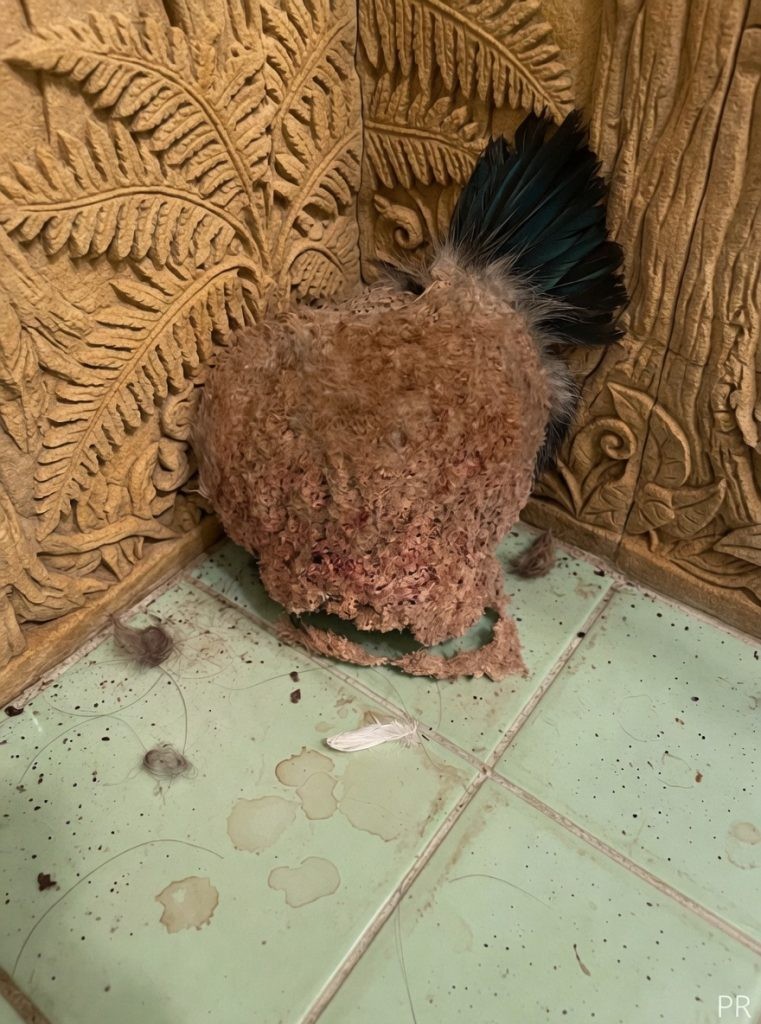

Strange Object Found on Bathroom Wall: How to Identify a Possible Hornets’ Nest Safely
Returning home after time away is usually a welcome routine: unpacking bags, checking the mail, and settling back into familiar surroundings. However, an unexpected object on an interior wall can quickly turn that routine into a source of concern. In one household, a family returning after a week away noticed an unfamiliar folded, textured structure fixed high in the corner of a bathroom wall. It had not been there before they left, and its layered appearance suggested that it had been deliberately built rather than accidentally left behind.
At first, the object prompted several reasonable questions. Could it be damaged insulation, dried construction material, a discarded piece of paper, or an insect structure? The family did not immediately touch it or try to pull it down. Instead, they observed it from a distance and looked for reliable information. That decision reflects widely recommended home safety guidance: when an unfamiliar object may involve stinging insects, it is better to avoid disturbing it until it has been properly identified.
After comparing its shape and papery layers with images from pest-management and extension resources, the family concluded that it could be a hornets’ nest or another social wasp nest. They then contacted a pest-control professional, who could assess the structure, determine whether insects were active, and remove it using appropriate protective equipment and methods.
While every situation is different, this experience offers a useful reminder for homeowners and renters. Paper-like nests can be built in sheltered places around a property, including attics, wall voids, sheds, eaves, garages, and occasionally bathrooms or other indoor spaces if insects can enter through a gap, vent, or opening. Understanding what these structures are, why they appear, and how to respond safely can help prevent unnecessary risks.
Why a Paper-Like Structure May Appear in a Home
Many stinging insects in the wasp family build nests from a paper-like material. Hornets, yellowjackets, and paper wasps gather weathered wood fibers from fences, decks, trees, cardboard, or other surfaces. They mix those fibers with saliva and use the resulting pulp to create cells, outer coverings, and support structures. The finished nest can range in color from gray and tan to brown, depending on the wood source.
A new nest may begin as a relatively small structure. In temperate climates, a fertilized queen commonly starts a new colony in spring after surviving the colder months in a protected location. She initially builds the nest and cares for the first generation of workers. Once workers emerge, they take on much of the work of enlarging the nest, gathering food, and defending the colony.
Because insects can work continuously when conditions are favorable, a nest can become noticeable over a relatively short period. Still, the speed of construction depends on the species, weather, available materials, location, and the number of workers present. A structure found after a week away cannot be identified with certainty simply because of its appearance or timing. Professional inspection is the best way to confirm whether a nest is active and which insect species may be involved.
What Does a Hornets’ Nest Look Like?
Hornets are a type of social wasp, and the term is sometimes used casually for several different wasp species. In the United States, the European hornet is the only true hornet species, according to entomological references. However, people often use “hornet” to describe bald-faced hornets, which are technically a type of yellowjacket. Both can create enclosed, paper-like nests.
A possible hornets’ or yellowjacket nest may have several recognizable characteristics:
- A gray, beige, brown, or mottled paper-like exterior.
- Visible layers that resemble swirls, wood grain, or thin sheets of papier-mâché.
- A rounded, oval, cone-like, or irregular shape.
- An outer envelope that covers the internal combs.
- A small opening that serves as an entrance or exit point.
- Regular insect activity near the structure during daylight hours.
Not every wasp nest is enclosed. Paper wasps commonly build open comb nests with visible hexagonal cells. These are often attached under eaves, porch ceilings, deck railings, outdoor light fixtures, or other protected surfaces. By contrast, some yellowjackets nest underground, in wall cavities, or in enclosed structural spaces, making the colony harder to see.
A folded item on a wall may also have non-insect explanations. It could be peeling wallpaper, a patch of old adhesive, packaging material, insulation, a damaged wall covering, or another household item. For this reason, visual comparison alone should be treated as a preliminary step, not a final diagnosis.
Why Bathrooms and Interior Corners Can Attract Nesting Insects
Bathrooms are not the most typical place to find a large social wasp nest, but they can offer features that make nesting possible. A bathroom may contain exhaust vents, ductwork, pipe openings, ceiling gaps, window frames, and access points behind fixtures or walls. If an insect can enter through an opening from outdoors or from an attic, it may find a sheltered void suitable for building.
Warm, dry, undisturbed spaces are especially attractive to many nesting insects. A family away from home for several days may not notice early activity around a vent or opening. Insect movement can be subtle at first, particularly if the nest is hidden behind a wall or in an upper corner that is not regularly inspected.
Moisture issues can also complicate identification. Bathrooms may develop peeling paint, lifting wall coverings, or damaged materials caused by humidity and leaks. Before assuming that any unusual formation is a nest, homeowners should consider whether water damage or building maintenance could be involved. A qualified pest professional, building inspector, or maintenance technician can help determine the cause.
Why It Is Best Not to Touch or Remove a Suspected Nest
The safest first response to a suspected wasp or hornet nest is usually to keep a distance and avoid sudden disturbance. Social wasps may defend their nesting area if they perceive a threat. Knocking, spraying, poking, vacuuming, sealing an active entry point, or trying to burn a nest can make the situation more difficult and can create avoidable hazards.
People with a known allergy to insect stings should be particularly cautious. The Centers for Disease Control and Prevention notes that insect stings can cause allergic reactions in some individuals. Symptoms of a severe allergic reaction can include difficulty breathing, swelling of the face or throat, widespread hives, dizziness, or fainting. Anyone experiencing signs of a severe reaction should seek emergency medical help immediately.
Even for people without a known allergy, several stings can be painful and may require medical advice, especially for children, older adults, or people with underlying health conditions. Pets should also be kept away from areas where stinging insects may be active.
Avoiding direct contact is not only about personal safety. It also improves the chances that a professional can identify the nest accurately. If the structure is damaged before inspection, it may become harder to determine whether the issue involves wasps, bees, building material, or another source.
What to Do When You Find a Possible Hornets’ Nest Indoors
A calm, practical response can reduce risk while a homeowner gathers more information. The following steps are commonly recommended for a suspected nest inside or attached to a home:
- Keep people and pets away from the immediate area. Close the bathroom door or limit access if this can be done without approaching the structure.
- Do not touch, spray, or cover the object. Household chemicals may not solve the issue and can trigger defensive insect behavior if a colony is active.
- Observe from a safe distance. Look for insects entering or leaving, but do not stand directly near the suspected nest.
- Take a photograph only if it can be done safely. A clear image from a distance may help a licensed professional provide initial guidance.
- Check for obvious entry points from outside. Look around vents, soffits, windows, siding, and utility openings without blocking an active route.
- Contact a licensed pest-control company or local extension service. These professionals can advise on identification and safe removal options.
- Arrange repairs after removal. Once insects are no longer active, gaps, damaged screens, loose vents, and cracks should be sealed to help prevent future nesting.
For tenants, reporting the issue to a landlord or property manager may be the appropriate first step. Local housing rules and lease agreements often define who is responsible for pest management and structural repairs. Clear documentation, including the date the object was discovered and photographs taken safely, can help support a prompt response.
Professional Removal and Why Identification Matters
Licensed pest-management professionals have training, equipment, and products designed for specific situations. They can inspect the property, identify likely insect activity, determine whether a nest is active, and choose a removal approach appropriate to the location. Indoor nests may require special care because access through walls, ceilings, or vents can affect both the insects and the building structure.
Identification is important because not all flying insects should be handled in the same way. Honey bees, for example, are important pollinators and may sometimes be relocated by a beekeeper rather than treated as a conventional pest-control problem. Wasps, hornets, and yellowjackets are also ecologically useful predators of many insects, but an active nest near living spaces, entryways, or indoor rooms can present a practical safety concern.
A professional may also inspect surrounding areas for related issues. This can include checking vents, rooflines, exterior wall gaps, attics, crawl spaces, and utility penetrations. Finding and correcting the entry route is an important part of preventing recurrence. Removing a nest without addressing access points may leave the property vulnerable to future insect activity.
How to Help Prevent Wasp and Hornet Nests Around the Home
Prevention does not guarantee that insects will never nest near a property, but regular maintenance can make homes less inviting. Homeowners can begin by examining exterior features during spring and early summer, when many colonies are just getting started. Small early nests are often easier for professionals to address than large, established colonies.
Useful preventive measures include repairing torn window screens, fitting covers on vents where appropriate, sealing cracks around pipes and cables, securing loose siding, and maintaining weather stripping around doors and windows. Outdoor trash should be kept in closed containers, while fallen fruit and food residue should be cleaned up promptly. These steps can reduce food sources that attract some wasp species.
It is also sensible to inspect less visible parts of a home. Garages, sheds, attics, porch roofs, outdoor storage areas, and wall-mounted fixtures can all provide sheltered nesting locations. When inspecting, remain alert for insect traffic and avoid getting close to any suspected nest.
A Lesson in Caution, Research, and Home Safety
An unfamiliar object on a bathroom wall can understandably create uncertainty. The most important lesson from this type of situation is not to jump to conclusions or attempt a quick removal. A layered structure may resemble a hornets’ nest, but only careful observation and professional assessment can establish what it is and whether it is active.
By pausing, researching credible information, restricting access to the area, and seeking professional help, homeowners can make a measured decision that protects their household and the property. Whether the object turns out to be a wasp nest, a building-material issue, or something else entirely, a cautious response is usually the most effective path forward.
Sources
Disclaimer: This content is intended for entertainment purposes only and is not based on real events.