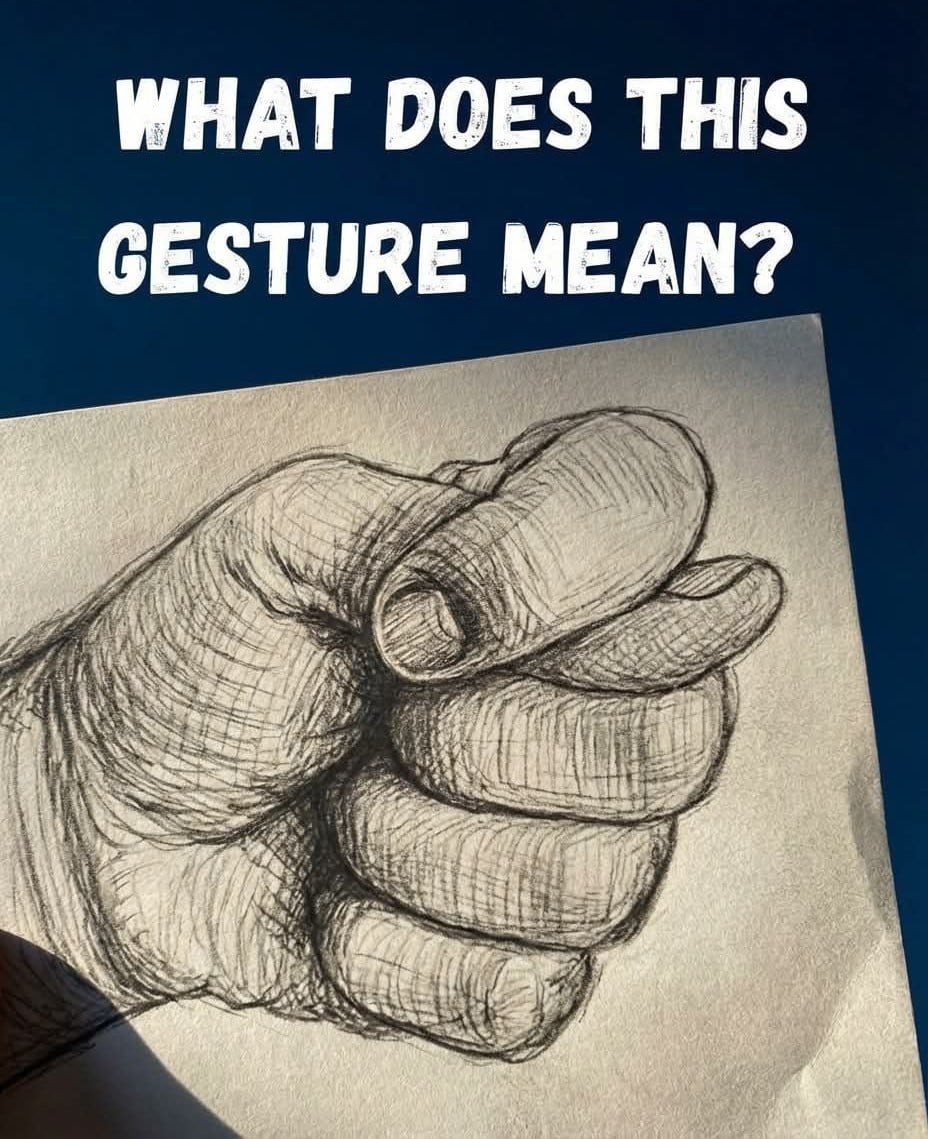

At first, it was a weapon. Not of violence—but of quiet rebellion, hidden protection, and wordless refusal. A simple fist, a buried thumb, and an entire conversation no one dared to say out loud. It survived empires, crossed borders, slipped into families as a joke, a charm, a promise. Now, in a world of screens and noise, its silent message still whis…
Tucked between two fingers, the hidden thumb once carried more weight than shouted arguments. The fig gesture let people say “no” without humiliation, resist without open conflict, and protect themselves with nothing but a small, knowing movement. In an age when reputation, honor, and social control ruled daily life, this tiny sign became a quiet shield—polite on the surface, powerful underneath.
As generations passed, its sharp edges softened. What began as subtle defiance turned into a shared wink within families, a private language between grandparents and children, a comforting ritual at doorways and train platforms. Even if few recognize it now, the gesture’s legacy lives in how we still try to set boundaries gently, protect what we love, and speak volumes without a single word. Its shape may fade, but the human need behind it never did.
Ancient Roots: Superstition, Fertility, and Spiritual Armor
To understand how a simple hand movement acquired such potency, one must travel back to the ancient Mediterranean world. Known to the Romans as the manus fica (the fig hand), the gesture—formed by curling the fingers into a fist and tucking the thumb between the index and middle fingers—was originally rich with anatomical and spiritual symbolism.
In antiquity, the gesture represented fertility, life force, and the union of opposites. Because ancient cultures believed that life-giving symbols possessed the power to repel envy, malice, and bad fortune, the manus fica quickly became an apotropaic talisman—an amulet used to ward off the “Evil Eye” (malocchio).
Roman citizens wore tiny carved fig-hand amulets made of bone, bronze, or coral around their necks, and parents tucked them into infants’ cribs. In a world where invisible curses and ill will were feared as real physical threats, curling one’s fingers around the thumb inside a cloak pocket was an instant, portable shield against bad luck.
A Geography of Meaning: How Borders Transformed the Gesture
As trade routes, migrations, and empires carried the gesture across continents, its meaning fractured and evolved. Depending on where a traveler stood, the exact same hand shape could be a blessing, a playful tease, or an unforgivable insult.
This dramatic divergence illustrates a fascinating truth about human communication: gestures are empty vessels filled entirely by cultural consensus. In Lisbon, holding a figa charm brings comfort and optimism; in Istanbul or Rome, flashing the exact same hand sign in traffic can provoke an immediate confrontation.
The Psychology of Non-Verbal Defiance
Why have humans relied so heavily on hidden hand gestures throughout history? The answer lies in the tension between power and vulnerability. Throughout centuries of rigid class hierarchies, authoritarian rule, and strict social etiquette, speaking one’s mind openly often carried severe consequences—imprisonment, exile, or social ruin.
The fig gesture offered a brilliant psychological workaround: plausible deniability.
-
Low-Visibility Resistance: A merchant forced to accept an unfair tax, a servant reprimanded by a harsh master, or a citizen watching an unpopular parade could slip a hand behind their back or inside a coat pocket and make the sign. The act restored a sense of personal agency and dignity without triggering retaliation.
-
Emotional Regulation: Psychologically, making a physical boundary-setting gesture releases internal tension. Even when a person cannot change their external circumstances, the physical act of closing the fist and shielding the thumb signals to the nervous system: I still own my mind; I do not consent.
-
In-Group Solidarity: When two people across a crowded room exchanged a fleeting glimpse of the gesture, it functioned as a secret handshake—confirming shared skepticism, humor, or mutual protection without alerting outsiders.
From Rebellion to Tenderness: The Domestic Evolution
Perhaps the most touching chapter in the life of the fig gesture is how it was domesticated. Over generations, immigrants carried the figa or kukish across oceans, where its sharp historical edges gradually wore smooth inside family kitchens and living rooms.
Grandparents who once used the sign to ward off bad luck or express stubborn refusal began using it to tease grandchildren. When a parent gently pinched a toddler’s face and revealed a thumb tucked between two fingers—declaring, “I’ve got your nose!”—they were unknowingly performing an ancient protective ritual stripped of all hostility. What had once been a ward against malevolent spirits became a game of affection, reassurance, and shared laughter.
Similarly, in many Eastern European and Latin American households, a mother pressing a small figa charm into her child’s palm at a train station or doorway transformed an ancient symbol of defiance into a quiet prayer for safe passage.
The Enduring Need for Quiet Boundaries
Today, we live in an era of relentless transparency and instant, public reaction. Digital culture rewards loud declarations, immediate outrage, and hyper-visible opinions. Subtlety often feels like a lost art.
Yet, beneath the noise of modern screens, the fundamental human instincts that gave birth to the fig gesture remain unchanged. We still crave ways to protect our peace without starting a war. We still look for subtle cues to tell those we love that they are safe, and we still need private mechanisms to say “no” when the world demands our compliance.
Whether expressed through a tucked thumb in an old photograph, a lucky charm dangling from a bracelet, or a quiet, knowing glance exchanged across a dinner table, the legacy of the fig gesture endures. It reminds us that true strength rarely needs to shout—and that sometimes, the most powerful boundaries are the ones held quietly in the palm of your hand.