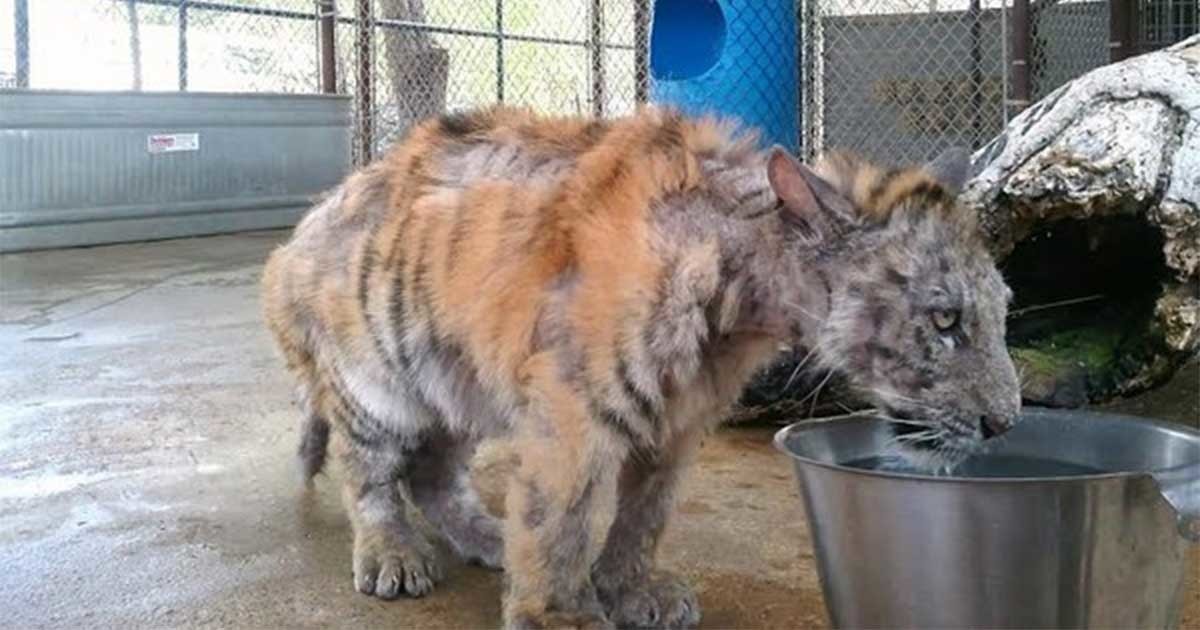

Sickly Tiger With Stripes Missing Saved From Circus Falls In Love with Soulmate
Aasha the Bengal tiger’s remarkable journey from a difficult early life in captivity to recovery, companionship, and dedicated sanctuary care highlights the importance of animal welfare and responsible wildlife protection.

Aasha the Bengal Tiger: A Rescue Story That Changed Her Life
Wild animals have highly specialized physical, social, and behavioral needs. For large predators such as Bengal tigers, meeting those needs in captivity can be particularly challenging. Aasha’s story offers a powerful example of how appropriate veterinary treatment, patient rehabilitation, and a carefully managed environment can make a difference in the life of an animal that has experienced difficult conditions.
Aasha was a young Bengal tiger who arrived at In-Sync Exotics Wildlife Rescue and Educational Center in Texas on March 25, 2011. Before reaching the sanctuary, she had already experienced several changes in her living arrangements during the first months of her life. According to her rescuers, each relocation was accompanied by a deterioration in her physical condition and a loss of trust in people.
Historical accounts of her rescue describe her as a tiger kept in a traveling circus environment. Her circumstances attracted attention because of her unusually poor physical condition and the challenges she faced at such an early age.
When Aasha arrived at In-Sync Exotics, she was approximately seven months old and weighed just 37 pounds. Her growth was significantly behind what caretakers expected for a tiger of her age. Much of her fur was missing, and her skin showed extensive signs of infection and irritation.
Her condition required immediate veterinary attention and a structured rehabilitation plan. Fortunately, the organization had experience caring for rescued big cats and was prepared to provide the specialized treatment she needed.

Understanding Aasha’s Medical Condition
One of the most significant health problems identified after Aasha’s arrival was ringworm, a fungal skin infection that can affect both animals and humans. Despite its name, ringworm is not caused by a worm. It is a fungal condition that can produce patches of hair loss, irritated skin, and other visible symptoms.
For a young tiger already dealing with the effects of repeated relocation and inadequate living conditions, the infection represented an additional challenge. Her skin was inflamed, her paws were swollen, and the area around her abdomen was particularly irritated.
In-Sync Exotics placed Aasha in a separate enclosure while her treatment began. Isolation was important because fungal infections can spread through contact with infected animals or contaminated surfaces. It also allowed her caretakers to monitor her condition and provide consistent medical attention.
The rehabilitation process involved medicated shampoo, therapeutic baths, and oral medication prescribed as part of her treatment. Her caretakers followed a regular schedule to help control the infection and support the recovery of her skin and coat.
According to the sanctuary’s published account, approximately four weeks of medicated treatment helped resolve the infection. Her recovery, however, required more than simply treating the visible symptoms. Aasha also needed time to develop confidence, become comfortable with her surroundings, and establish a predictable relationship with the people responsible for her care.
This distinction is important in wildlife rehabilitation. Physical recovery and behavioral adjustment are closely connected, particularly when an animal has experienced stressful conditions early in life.
The Caretakers Who Helped Aasha Recover
Vicky Keahey, the founder of In-Sync Exotics, played an important role in Aasha’s rehabilitation. Her approach involved regular medical care, patience, and consistent interaction with the young tiger.
During the early stages of treatment, Aasha was not particularly comfortable with the medicated baths. Like many animals unfamiliar with medical procedures, she initially resisted the process. Her caretakers needed to approach each treatment carefully while ensuring that the medication was administered as prescribed.
However, the regular routine gradually became more familiar. As her health improved, Aasha also became increasingly comfortable around the people caring for her.
Her fur began growing back, and the visible signs of infection gradually disappeared. The transformation was not instantaneous, but the progress demonstrated the value of consistent veterinary treatment and appropriate long-term care.
One particularly interesting development involved Aasha’s growing interest in water. The baths that had initially been part of her medical treatment eventually became something she appeared to enjoy.
After the medical necessity for frequent bathing had passed, her caretakers continued providing opportunities for her to interact with water. A small pool and other forms of environmental enrichment allowed her to explore and play in a more natural and stimulating way.
This became one of the recognizable features of Aasha’s life at the sanctuary. Swimming and splashing in water provided an opportunity for physical activity and enrichment while allowing her to express behaviors that were not possible in her earlier living conditions.

From a Vulnerable Tiger Cub to a Healthy Adult
As Aasha’s medical condition improved, her physical development became increasingly noticeable. Her coat returned, her skin healed, and she gradually grew into a much stronger and healthier tiger.
The transformation also changed the way her caretakers interacted with her. When she was very young, staff members could spend time close to her inside her enclosure. As she grew larger and stronger, those interactions had to be adjusted to maintain appropriate safety boundaries.
Rather than continuing direct contact, her caretakers increasingly interacted with her through the enclosure. This approach allowed Aasha to maintain familiar relationships with the people who had cared for her while respecting the fact that she was growing into a powerful wild animal.
Her progress illustrated an important principle of responsible sanctuary management: providing affection and attention does not mean treating a wild animal like a domestic pet. Appropriate care requires understanding the animal’s natural behavior, physical strength, and individual needs.
After approximately eight months of rehabilitation, Aasha had made substantial progress. Her caretakers considered her healthy enough to begin the next stage of her development: carefully introducing her to another tiger.
Meeting Smuggler: A New Chapter in Aasha’s Life
One of the most memorable developments in Aasha’s story was her introduction to Smuggler, a male Bengal tiger who was already living at In-Sync Exotics.
Smuggler had his own difficult history. He was rescued near the United States-Mexico border after authorities discovered him in a small transport crate during an alleged attempt to bring him into the country illegally. According to In-Sync Exotics, he was only around four months old when he arrived and required veterinary attention.
Both tigers had therefore experienced challenging circumstances during the earliest stages of their lives. Their individual rehabilitation journeys eventually brought them together at the same sanctuary.
Introducing two large cats requires careful planning. Tigers are naturally solitary animals in the wild, and their responses to other individuals can vary considerably. Simply placing two unfamiliar animals together without preparation could create unnecessary risks.
For that reason, Aasha and Smuggler were initially housed in neighboring enclosures. This arrangement allowed them to see and smell one another while maintaining a secure physical separation.
Their caretakers monitored their reactions and gradually assessed whether the two animals appeared comfortable in each other’s presence.

How Aasha and Smuggler Developed Their Bond
According to the sanctuary’s account, Aasha and Smuggler responded positively to their initial introductions. Their caretakers observed encouraging interactions and decided to proceed with carefully supervised visits.
Although Smuggler was considerably larger than Aasha, the important consideration was not simply their difference in size. Their behavior, comfort levels, and ability to interact without signs of conflict were central to the introduction process.
Supervised meetings provided an opportunity for the animals to become more familiar with one another while allowing staff members to intervene if necessary.
As these encounters continued successfully, the sanctuary determined that they could eventually share an enclosure.
The arrangement became an important part of both tigers’ lives. Their relationship developed into a close companionship, and photographs and updates shared by In-Sync Exotics showed them spending time together, playing, and enjoying their surroundings.
Their story also demonstrates why social arrangements for captive wildlife should be based on individual animals rather than assumptions. Although wild tigers generally live solitary lives, some rescued individuals can form compatible relationships under carefully managed sanctuary conditions.
In-Sync Exotics has explained that Aasha and Smuggler formed their bond when they were young. Their relationship became a distinctive feature of their lives at the facility.

Life at In-Sync Exotics: Enrichment, Swimming, and Specialized Care
Following her recovery, Aasha continued living at In-Sync Exotics, where she had access to an environment designed around the needs of captive big cats.
Environmental enrichment is an essential part of responsible wildlife care. It involves providing animals with opportunities to explore, investigate, exercise, and engage in activities that stimulate their physical and mental abilities.
For tigers, enrichment can include pools, climbing structures, objects to investigate, different surfaces, and opportunities to use their natural senses. These features help make an enclosure more engaging than a simple restricted living space.
Water was particularly important in Aasha’s story. Her interest in swimming developed during the same period that her medical condition improved. What initially began as part of her treatment became an enjoyable activity that continued throughout her life at the sanctuary.
Her relationship with Smuggler also provided opportunities for social interaction. Their caretakers could observe how the two animals responded to one another and maintain an arrangement suited to their individual temperaments.
These aspects of sanctuary management reflect broader principles recognized in animal welfare research. The United States Department of Agriculture’s National Agricultural Library explains that environmental enrichment can improve the well-being of animals in captivity by making their surroundings more complex and providing opportunities for appropriate behaviors.
For rescued animals, these considerations are especially important. Rehabilitation does not end when an infection disappears or an animal regains a healthy appearance. Long-term welfare requires continued attention to nutrition, veterinary care, appropriate surroundings, behavioral needs, and opportunities for stimulation.
Why Aasha Could Not Be Released Into the Wild
One question that naturally arises from Aasha’s recovery is why she could not eventually return to the wild.
Although her physical health improved considerably, surviving in a natural tiger habitat requires a complex combination of abilities. Wild tigers must develop hunting skills, identify suitable territories, understand their surroundings, and respond to potential threats.
Animals raised in captivity may not develop all the skills necessary to survive independently. Their early experiences, limited exposure to natural environments, and reliance on human-provided food and veterinary care can make release inappropriate.
For Aasha, remaining at a professionally managed sanctuary was considered the more suitable option. Her long-term care could provide the food, medical attention, environmental enrichment, and protection she required.
This is an important distinction between wildlife rescue and wildlife reintroduction. Not every rescued animal can safely return to its original habitat. In some cases, permanent sanctuary care offers the most responsible outcome.
What Aasha’s Story Reveals About Wild Animals in Circuses
Aasha’s early experiences also raise broader questions about the use of wild animals in traveling entertainment.
Organizations concerned with animal welfare have raised concerns about the conditions that wild animals may experience in traveling shows. Frequent transportation, restricted living spaces, limited opportunities for natural behavior, and unsuitable social arrangements can create significant welfare challenges.
The American Society for the Prevention of Cruelty to Animals (ASPCA) opposes the use of wild and exotic animals in circuses and traveling shows. Its position highlights concerns about confinement, stress, and the difficulties of providing appropriate conditions for large wild animals in mobile entertainment environments.
It is also important to distinguish between individual rescue stories and broader conclusions about animal welfare. Aasha’s experience illustrates the consequences of her particular circumstances; it should not be treated as evidence that every captive animal has experienced identical conditions.
Nevertheless, her rehabilitation demonstrates why specialized facilities, veterinary professionals, and qualified animal caretakers are important when addressing the needs of rescued wildlife.
Public awareness can also contribute to more informed decisions about wildlife entertainment. Learning about the natural behavior of animals and the responsibilities involved in their care helps audiences evaluate whether particular forms of entertainment are compatible with modern animal welfare principles.
Remembering Aasha: An Important Update on Her Story
Aasha’s story continued long after the remarkable transformation that first attracted international attention. She spent more than a decade at In-Sync Exotics, where her caretakers provided ongoing attention and opportunities for enrichment.
Her official sanctuary biography records that Aasha was born on November 25, 2010, rescued on March 25, 2011, and remained at the facility for many years.
There is also an important update for readers revisiting her story today: according to In-Sync Exotics, Aasha passed away on December 7, 2025. Her life at the sanctuary had extended well beyond her initial recovery, and her story remains part of the organization’s record of rescued animals.
Although she is no longer alive, the transformation she experienced continues to illustrate the importance of providing appropriate care to animals that cannot return to the wild. Her journey from a vulnerable young cub to a confident adult tiger was made possible through veterinary treatment, consistent attention, and a carefully managed living environment.
Her relationship with Smuggler was another memorable part of her life. The two tigers demonstrated how individual animals can develop compatible companionships even when their natural behavior differs from that of domesticated species.

Why Wildlife Rescue and Sanctuary Protection Matter
Aasha’s life offers several important lessons about wildlife protection. First, early veterinary intervention can make a substantial difference when animals arrive at rescue facilities with treatable health problems. Second, rehabilitation requires patience and a long-term commitment rather than a short period of medical treatment. Third, the needs of individual animals must guide decisions about their housing, enrichment, and social interactions.
Her experience also highlights the responsibilities associated with keeping large wild animals in captivity. Tigers are not domestic animals, and their care requires specialist knowledge, appropriate facilities, and substantial resources.
Reputable wildlife sanctuaries can provide permanent homes for animals that have experienced unsuitable conditions or are unable to survive independently. Their work can include veterinary treatment, behavioral monitoring, public education, and long-term welfare management.
Readers interested in supporting wildlife protection can learn more about established rescue organizations, review their animal welfare policies, and explore educational resources about tiger conservation. Supporting responsible organizations and making informed choices about wildlife entertainment are practical ways to contribute to greater awareness.
Aasha’s journey was remarkable not simply because her appearance changed, but because she was given the opportunity to live in an environment better suited to her needs. Her story remains a reminder that every rescued animal deserves thoughtful, knowledgeable, and compassionate care.
Wild animals deserve environments that respect their natural needs. Aasha’s story reminds us why responsible wildlife rescue, lifelong sanctuary care, and greater awareness of animal welfare matter.
Sources
- In-Sync Exotics – Aasha’s Official Rescue and Life History
- In-Sync Exotics – Smuggler’s Rescue and Sanctuary Biography
- Tigers in America – Aasha Arrives at In-Sync
- ASPCA – Position on Circuses and Traveling Shows
- USDA National Agricultural Library – Behavioral Management and Environmental Enrichment
- Merck Veterinary Manual – Welfare of Captive Wildlife
- Houston Chronicle – Two Rescued Tigers Living at In-Sync Exotics
Disclaimer: This content is intended for entertainment purposes only and is not based on real events.