
Mama the Chimpanzee’s Final Reunion With Jan van Hooff
Some animal stories resonate because they reveal the depth of long-term relationships between humans and other species. The final reunion between Mama, an elderly chimpanzee at Royal Burgers’ Zoo in Arnhem, the Netherlands, and Dutch primatologist Jan van Hooff became one such moment. Recorded shortly before Mama’s death in 2016, the encounter drew worldwide attention and encouraged renewed public interest in chimpanzee behavior, memory, social bonds, and animal welfare.
Mama was a well-known member of the chimpanzee community at Royal Burgers’ Zoo, often described by researchers and zoo staff as an influential female within the group. She was 59 years old when she died, an advanced age for a chimpanzee. Her long life made her an important figure not only to the animals around her, but also to generations of scientists, keepers, visitors, and students who observed the social lives of chimpanzees.
Her final meeting with van Hooff was widely shared online because it appeared to show immediate recognition between two individuals who had known one another for decades. While scientists are careful not to make assumptions about an animal’s internal feelings based on a brief video alone, the reunion is consistent with a substantial body of research showing that chimpanzees can form enduring social relationships, recognize familiar individuals, and respond to important changes within their communities.
Mama’s Life at Royal Burgers’ Zoo
Royal Burgers’ Zoo in Arnhem has played a significant role in the study and care of chimpanzees in Europe. Mama was part of a colony that became familiar to behavioral researchers because of its complex social structure. Chimpanzees live in communities with shifting alliances, close family relationships, competition, reconciliation, grooming, and cooperative behavior. Adult females can hold considerable social influence, particularly when they have extensive experience and strong ties across the group.
According to accounts from the zoo and from Jan van Hooff, Mama was a prominent and respected chimpanzee. She had lived through many changes in the community and had developed relationships with other chimpanzees over the course of decades. Her position illustrates an important point about chimpanzee societies: leadership and influence do not always depend solely on physical strength. Experience, alliances, maternal connections, and social knowledge can all shape an individual animal’s standing.
Chimpanzees are humans’ closest living relatives alongside bonobos. Humans and chimpanzees share a common ancestor that lived millions of years ago, and modern chimpanzees display many behaviors of scientific interest, including tool use, cooperation, communication through gestures and vocalizations, and cultural differences between communities. Observing chimpanzees in carefully managed settings and in the wild has helped researchers better understand primate cognition and social evolution.
Jan van Hooff and a Longstanding Connection
Jan van Hooff is a Dutch biologist and primatologist affiliated with Utrecht University. His career has included influential work in ethology, the scientific study of animal behavior, and in comparative studies of primate communication and social interaction. He was also involved in the early development of the chimpanzee colony at Burgers’ Zoo and had known Mama since the 1970s.
That history matters when interpreting the well-known footage of their final visit. Van Hooff was not an unfamiliar visitor. He had observed and interacted with Mama over many years, during a period when research on chimpanzee behavior was helping challenge simplistic assumptions that nonhuman animals lack sophisticated social awareness. His presence near the end of Mama’s life therefore had personal and scientific significance.
Long-term relationships between animal caregivers, researchers, and individual animals can be meaningful, although they must always be understood within appropriate welfare and professional boundaries. Animals may become accustomed to specific voices, faces, routines, and social interactions. In primates, recognition of familiar individuals is especially well established. Research has found that chimpanzees possess strong abilities to distinguish known group members and to use social information built up through years of shared experience.
Mama’s Final Days
In the period before her death, Mama’s health had declined. Reports surrounding the visit stated that she had become weak and had stopped eating and drinking normally. Elderly animals, like elderly people, can experience significant health challenges. Decisions about their care require close monitoring by veterinary professionals and animal-care teams, with attention to comfort, nutrition, mobility, pain management, and quality of life.
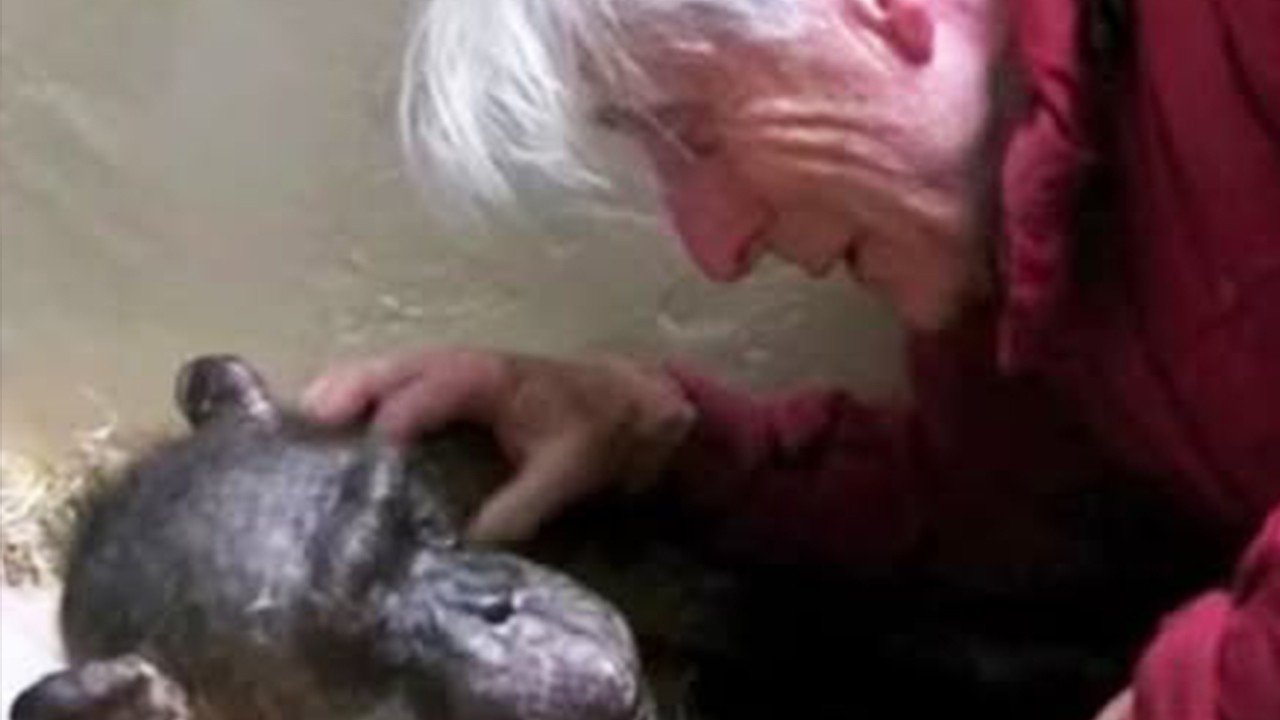
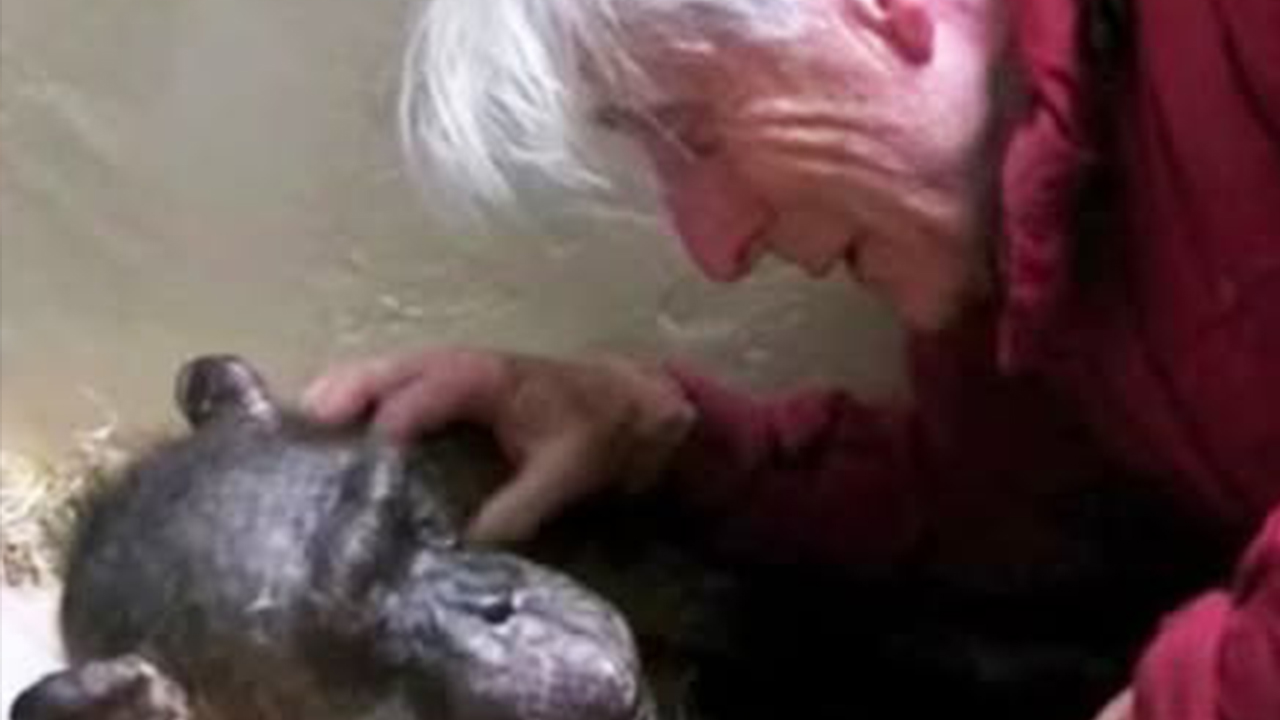
As Mama approached the end of her life, van Hooff came to see her and say goodbye. The visit was recorded and later published online. At the beginning of the video, Mama appears withdrawn and physically frail. When she becomes aware of van Hooff’s presence, however, she responds with visible movement and reaches toward him. She then accepts food during the interaction.
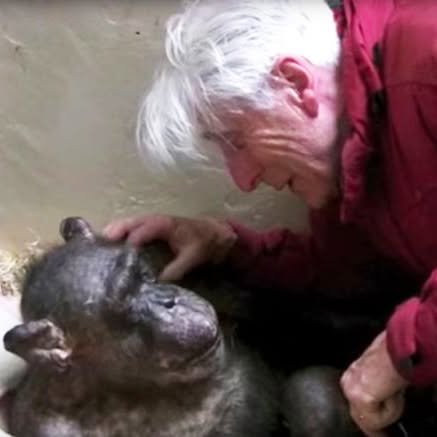
The footage is moving because it captures a rare and intimate moment involving an animal known to one human observer for more than four decades. Many viewers interpreted Mama’s reaction as joy, recognition, and affection. Such interpretations are understandable, but a scientific approach also requires caution. Researchers cannot directly measure an animal’s subjective emotional experience in the same way that humans describe their own feelings.
What can be said with confidence is that chimpanzees are highly social mammals capable of recognizing individuals, responding to familiar social partners, and displaying behavior that changes according to social context. Mama’s response to van Hooff was notable because it followed a long shared history, and it occurred at a time when she had shown little interest in her surroundings.
What Science Says About Chimpanzee Memory and Emotion
Chimpanzee research has repeatedly demonstrated advanced cognitive abilities. Studies have shown that chimpanzees can remember locations, learn from others, use tools, solve certain problems, and navigate complicated social relationships. They also communicate through a rich combination of facial expressions, body posture, gestures, calls, and touch.
Social memory is particularly important in chimpanzee communities. Wild chimpanzees may live in large groups whose members separate and reunite in smaller parties throughout the day. To function within this flexible social system, individuals must recognize others and remember prior interactions. They need to understand family ties, alliances, rivalries, and changes in status. This social knowledge can affect access to food, grooming partners, protection, and reproductive opportunities.
Scientists have also documented behaviors that suggest chimpanzees are sensitive to the emotional states of others. Grooming may reduce tension and strengthen relationships. Reconciliation after conflict has been observed in several primate species. Chimpanzees may offer contact or remain close to distressed group members. However, scientists generally avoid claiming that chimpanzees experience every emotion in exactly the same way humans do. The most responsible conclusion is that they have complex emotional and social capacities shaped by their own evolutionary history.
Mama’s reunion should therefore not be treated as proof that animals think or feel exactly like people. Instead, it offers a powerful reminder that chimpanzees are socially complex beings whose relationships and experiences deserve serious consideration. The video’s impact comes partly from its ability to make scientific knowledge feel immediate: a familiar person entered the room, and Mama responded in a way that clearly mattered within that moment.
Why the Video Reached a Global Audience
The recording of Mama and van Hooff spread widely across social media and international news platforms after it was shared online. Viewers from many countries responded to the quiet nature of the scene: there was no performance, no dramatic editing, and no attempt to turn Mama’s final days into entertainment. Instead, the clip showed a long relationship ending with a gentle farewell.
Public reactions often focused on the importance of treating animals with care and respect. For many people, the encounter also raised questions about how society understands intelligence and emotion beyond humans. These discussions can be valuable when they lead to better knowledge of animal welfare, conservation, and responsible behavior around wildlife.
At the same time, animal welfare organizations and conservation experts emphasize that viral animal videos should not encourage people to seek close contact with wild animals. Chimpanzees are powerful wild primates with complex needs. They belong in protected natural habitats whenever possible, or in professionally managed facilities that prioritize welfare, veterinary care, social housing, and conservation goals.
Chimpanzee Conservation and Welfare
Chimpanzees are listed as endangered by the International Union for Conservation of Nature (IUCN). Their populations face pressure from habitat loss, hunting, illegal wildlife trade, and infectious disease. Across parts of central and western Africa, forests that chimpanzees depend on are affected by agriculture, logging, roads, mining, and other development.
Conservation efforts involve protecting habitats, supporting local communities, enforcing wildlife laws, reducing demand for illegally traded animals, and funding research. Organizations working in chimpanzee range countries also stress the need to prevent disease transmission between humans and great apes. Because chimpanzees are genetically close to humans, they can be vulnerable to some human respiratory illnesses and other pathogens.
For chimpanzees living in human care, welfare standards increasingly recognize the need for stimulating environments and stable social opportunities. Enrichment can include climbing structures, nesting materials, problem-solving activities, and varied ways of finding food. These practices aim to support natural behaviors and reduce stress. The care of aging chimpanzees is another important area, as veterinary teams must adapt to mobility limitations, dental issues, chronic disease, and changing social needs.
A Lasting Legacy
Mama died shortly after her final meeting with Jan van Hooff. Her death marked the end of a long life that had been closely connected to the history of the chimpanzee colony at Royal Burgers’ Zoo. For van Hooff, the visit was a personal farewell to an animal he had known for much of his professional life. For the public, it became an introduction to the richness of chimpanzee social behavior.
The lasting value of Mama’s story is not simply that it is emotional. It is that it directs attention toward evidence-based understanding of great apes. Chimpanzees are not human, but they are neither simple nor interchangeable. They are individuals with distinct histories, social roles, learned behavior, and relationships.
When people watch Mama’s final reunion, they may see affection, recognition, comfort, or trust. Science cannot fully define the private experience behind every gesture. Yet decades of primate research provide strong grounds for respecting the importance of chimpanzee social lives. Mama’s story remains a meaningful example of why long-term observation, compassionate care, and wildlife conservation matter.
Sources
Disclaimer: This content is intended for entertainment purposes only and is not based on real events.