

The quiet hum of the Fort Myers courtroom was broken only by the soft rustle of papers and the heavy, collective breathing of those awaiting a final decision. At the center of the room stood eighteen-year-old Thomas Roy Stein, a young man whose choices on a single spring evening had irrevocably rewritten the lives of multiple families. As the judge prepared to hand down a sentence that would ensure Stein spent the rest of his natural life behind bars, the young defendant made one final, desperate appeal. He did not ask for a lighter sentence or a reduction in his prison years; instead, he made a deeply human request: to hug his family one last time before being led away in chains.
The judge’s swift and unyielding denial of that physical contact immediately sparked a massive wave of discussion across social media, instantly transforming a local judicial proceeding into a global conversation about justice, empathy, and the boundaries of legal punishment. For many observers, the moment crystallized a profound cultural and psychological tension. What happens when our natural desire for human connection collides with the rigid, uncompromising structures of criminal justice?
A Tragic Evening in Cape Coral
To understand the weight of that final exchange in the courtroom, one must look back to the events of March 17, 2024, in Cape Coral, Florida. Fifteen-year-old Kayla Rincon-Miller and two of her closest friends were enjoying a standard weekend ritual. They had just left a local movie theater and were walking down a nearby road toward a McDonald’s to grab some food. It was a walk that should have been entirely unremarkable, a simple transition from an evening of entertainment back to their normal teenage lives.
Instead, their path crossed with an SUV driven by Stein, who was then sixteen years old. Investigators revealed that Stein and a co-defendant, Christopher Horne Jr., had been searching the area with the intent to find robbery targets. When they spotted the three young girls walking along the road, Stein drove by, circled back, and eventually flashed his high beams directly into their faces. He brought the vehicle to a halt in front of them. Moments later, a confrontation ensued, a firearm was discharged, and Kayla was struck in the chest. Despite the immediate efforts of her friends and arriving police officers to administer aid, she passed away a short time later at a local hospital.
The Trial and the Verdict
As the legal system took hold of the case, the details of that night became the subject of intense courtroom debate. The State Attorney’s Office made the strategic decision to direct file the charges, transferring the case from juvenile court to adult court to ensure that adult sanctions could be applied. A grand jury subsequently returned indictments for first-degree felony murder against both teens. While Horne accepted a plea agreement to testify during the trial in exchange for a twenty-five-year sentence, Stein’s case proceeded to a full trial.
Throughout the proceedings, Stein maintained that his original intention that night had only been to break into unoccupied vehicles to steal valuables, rather than to engage in a armed confrontation. Taking the stand, he expressed regret, admitting that his decision to get behind the wheel was an act of complete selfishness. He conceded that his choice to flee the scene after the shot was fired played a major role in assisting the other participants.
Ultimately, the jury rejected the defense’s attempts to minimize his culpability, finding him guilty of first-degree felony murder and three counts of attempted robbery with a firearm. Under Florida’s felony murder laws, an individual who participates in an inherently dangerous felony that results in a loss of life can be held fully responsible for that outcome, regardless of who pulled the physical trigger.
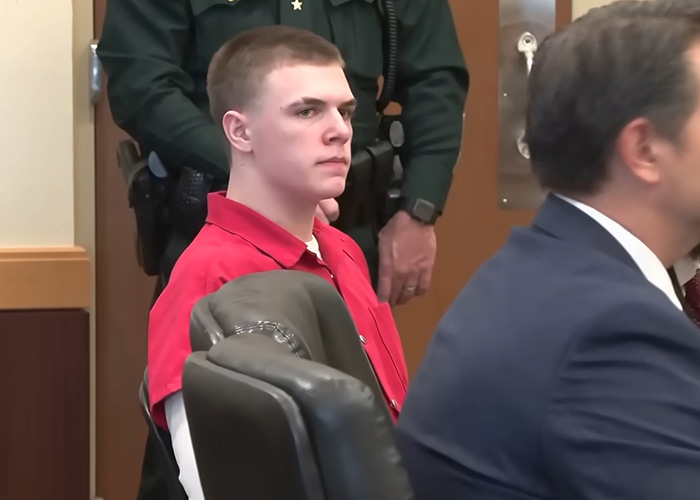
The Anatomy of the Courtroom Denial
On July 10, 2026, Judge Nick Thompson presided over the highly charged sentencing hearing. The courtroom was filled with raw emotion as Kayla’s loved ones detailed the ongoing, devastating impact of her absence. Her friends spoke of navigating a lingering trauma, describing their daily lives as feeling like a continuous state of shock.
The prosecution pushed for the maximum possible penalty, highlighting Stein’s past history of felony burglary and arguing that he had actively driven the vehicle and helped orchestrate the event. Conversely, Stein’s defense counsel advocated for a sentence of twenty-five years, hoping to mirror the deal given to his co-defendant.
Before the final determination was read, Stein made his quiet request for a physical hug from his family. Judge Thompson immediately declined, stating:
“I can’t grant that request in here. You can say goodbye, but you can’t have any physical contact.”
The judge then handed down a sentence of life in prison for the murder charge, alongside three consecutive fifteen-year sentences for the attempted robberies, effectively ensuring that Stein would remain incarcerated for decades even if a future court review of his juvenile status occurred.
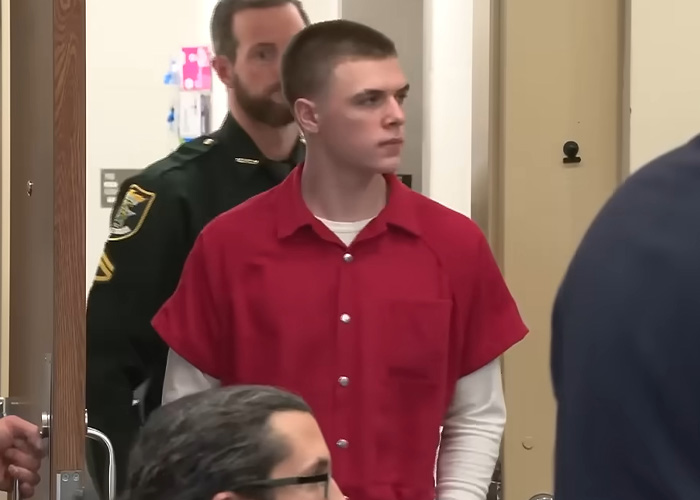
The Psychology of Remorse and Public Perception
In the digital space, the video of Stein’s plea and the subsequent judicial denial quickly divided the public. Some viewers viewed the exchange through a lens of empathy, arguing that denying a simple embrace to an eighteen-year-old before he is sent away forever represents an unnecessary level of institutional coldness. From this psychological perspective, the desire to touch loved ones when facing a massive life transition is a fundamental human instinct, and some felt that allowing a brief moment of connection would not have compromised the overall justice of a life sentence.
Conversely, a vast majority of public commentators supported the judge’s firm boundary, framing the decision as a necessary reflection of the accountability required for such actions. Proponents of this view noted that Kayla was permanently denied the ability to ever hug her own parents, friends, or family again. In their eyes, Stein’s emotional plea and tears were a calculated attempt to garner sympathy rather than a sign of genuine remorse.
Psychologists note that public reactions to such moments are often deeply tied to our personal philosophies of justice, with some prioritizing retributive punishment and others leaning toward restorative principles.
Institutional Protocols and Safety Regulations
From an operational standpoint, the judge’s decision was not merely a personal choice, but a strict adherence to standard courtroom security protocols. Executive protection and courthouse safety rules are designed to prevent any physical contact between custody defendants and members of the public gallery. Courtrooms are highly charged environments where sudden emotional outbursts can quickly escalate into volatile situations.
If a physical interaction is permitted, it introduces a significant security risk, including the potential transfer of contraband, weapons, or key physical items that could compromise the safety of the facility or the individuals within it.
Furthermore, deputies and bailiffs must maintain a clear physical barrier to ensure they can respond instantly to any sudden movement. By enforcing a strict “no physical contact” policy, the court ensures that the transition of a high-risk inmate from the courtroom to a secure holding cell is executed with the highest level of control and the lowest possible risk of incident.
Reflecting on Human Curiosity and the Nature of Justice
The global fascination with the Thomas Stein trial and its dramatic conclusion highlights a fundamental aspect of human curiosity. As social creatures, we are naturally drawn to stories that explore the boundaries of morality, law, and human emotion. We watch these intense real-life dramas unfold because they force us to confront our own values and ask difficult questions about accountability, forgiveness, and the role of the state in administering punishment.
The division over a simple courtroom request reveals that even in the face of profound tragedy, our collective search for meaning remains incredibly active. We look for signs of genuine change in those who have caused harm, and we seek structure in the systems we rely on to keep us safe. Ultimately, these moments of intense public focus serve as a mirror, reminding us of the delicate balance we must constantly maintain between upholding the strict, protective rules of our society and recognizing the complex, emotional human lives that exist within them.
Sources
-
The Eleventh Judicial Circuit Court of Florida Registry: Official trial records, witness transcripts, and sentencing orders for The State of Florida v. Thomas Roy Stein.
-
The Cape Coral Police Department Investigation Reports: Event logs, initial response documentation, and evidence compilations regarding the events of March 17, 2024.
-
Journal of Courtroom Security & Judicial Administration: Academic studies detailing the development of executive protection protocols and physical contact rules in modern municipal courtrooms.
-
Court TV Live Broadcast Archives: Live video footage, legal analysis, and post-trial interviews from the July 10, 2026, sentencing hearing
