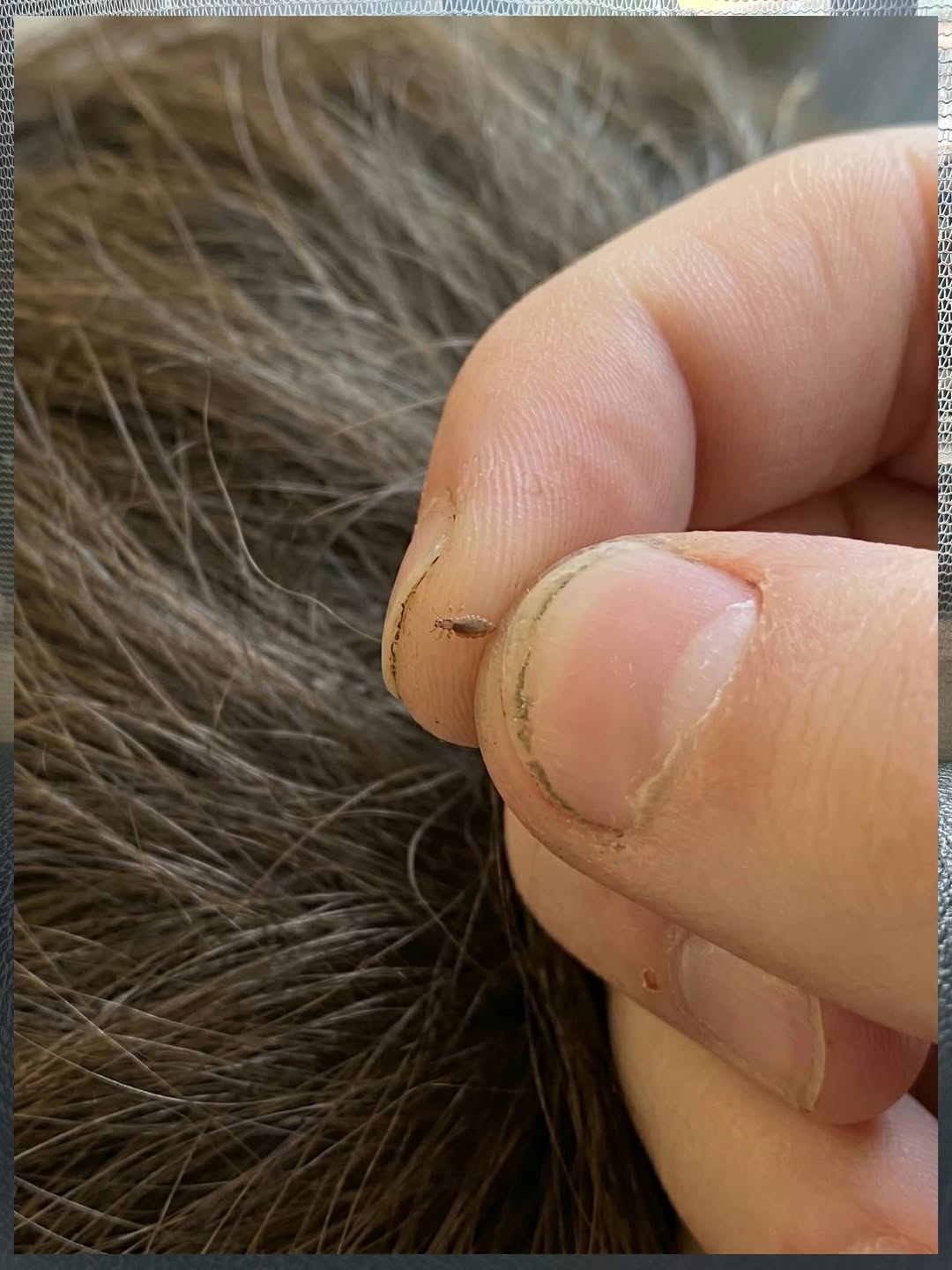

You see it move, and your stomach instantly drops. It is just one tiny speck, barely the size of a sesame seed, but suddenly your mind begins racing with shame, anxiety, and worst-case scenarios. Is this the start of an overwhelming household infestation? Is it a relationship crisis, or a social nightmare waiting to unfold? In a fraction of a second, you imagine every pillow, every cozy couch cushion, every affectionate hug, and every casual selfie transforming into a immediate threat.
What if this uninvited “hair hijacker” is far less of a horror story and more of a misunderstood biological inconvenience?
That single louse caught between your fingers is not a verdict on your cleanliness, your home hygiene, or the health of your relationship. It is simply a reminder that human beings live in a world of quiet, constant physical contact. Lice do not care if you are successful, remarkably attractive, or meticulously clean; they only care that you are warm, alive, and offer a suitable environment.
The real damage in these situations rarely stems from the insect itself—it comes from the sudden spiral of embarrassment, disgust, and secrecy that so often follows. When we mistake a routine biological hitchhiker for a moral or personal failure, we isolate ourselves at the exact moment when calm, practical connection matters most.
Understanding the Common Head Louse
Head lice (Pediculus humanus capitis) are wingless, parasitic insects that live on the human scalp. They are obligate parasites, meaning they cannot survive without a human host to provide warmth and shelter. Despite persistent myths, their presence has absolutely no correlation with poor personal hygiene, dirty living environments, or lower socioeconomic status.
In fact, head lice actually prefer clean, healthy hair because it makes it easier for them to navigate the shafts and attach their eggs (commonly known as nits). They do not fly or jump; their legs are specifically adapted to crawl along strands of human hair, transferring almost exclusively through direct head-to-head contact.
-
Transmission: Direct hair-to-hair contact is responsible for over 90% of cases. Shared hats, brushes, or pillows account for a negligible fraction of transfers because lice quickly weaken once separated from a human scalp.
-
Lifespan: An adult louse lives for about 30 days on a host but dies within 24 to 48 hours if detached from human warmth.
-
Reproduction: Female lice lay up to 6 to 8 eggs per day, cementing them firmly near the base of the hair shaft near the scalp for optimal warmth

Overcoming the Stigma and Social Embarrassment
The psychological impact of discovering a parasite often outweighs the physical discomfort. Society has long associated parasites with neglect or unhygienic conditions, leading to irrational feelings of guilt and embarrassment when an issue arises.
In relationships, discovering a hair hijacker on a partner can trigger unnecessary awkwardness. Partners may worry about sounding accusatory, feeling disgusted, or appearing overly dramatic. However, framing the situation through a biological lens rather than a emotional one helps normalize the experience. Millions of adults and children encounter head lice every year globally—it is a routine biological event, not a personal flaw.
Open, lighthearted communication diffuses tension. Addressing the situation together turns a moment of panic into an opportunity for mutual support and teamwork.
Step-by-Step Action Plan: Replacing Panic with Protocol
The shift from anxiety to control happens the moment you trade emotion for systematic protocol. Resolving a head lice encounter requires a methodical approach focused on gentle eradication and basic environmental cleaning.
-
Perform a Systematic Visual Inspection
Use a fine-toothed nit comb under bright, direct natural or artificial light. Part the hair into small sections, searching close to the scalp, particularly behind the ears and near the nape of the neck.
-
Apply an Over-the-Counter Treatment
Select an approved pediculicide shampoo or lotion available at local pharmacies. Many modern treatments utilize dimethicone—a silicone-based substance that coats and suffocates the insects mechanically rather than relying on chemical pesticides, reducing the risk of resistance.
-
Comb Out Nits Thoroughly
Applying treatment is only half the process; removing the eggs (nits) prevents re-infestation. Wet the hair, apply conditioner, and run a metal fine-toothed comb from the scalp to the ends of the hair, wiping the comb on a white paper towel after every stroke. Repeat this every 2 to 3 days for two weeks.
-
Execute Minimal Home Cleaning
Focus effort where it matters most. Wash bed sheets, pillowcases, and recently worn clothing in hot water (at least 130°F or 54°C) and dry them on high heat for 20 minutes. Soak combs and hair accessories in hot water for 10 minutes. Deep-cleaning entire houses or spraying chemical insecticides on furniture is unnecessary and ineffective.
Moving Forward Together
Nana’s old wisdom still holds true: anything you can see clearly in the light, you can handle. A louse is not a ghost, not a curse, and certainly not a sign that you or your partner are somehow unlovable or flawed.
It is a completely solvable physical problem—and quite often, simply a strange, memorable story that two partners will look back on and laugh about years later. In the end, it serves as proof that even in life’s unglamorous little crises, practical care and calm understanding matter far more than fear.
