
The Story Behind the Photo: Remembering Czesława Kwoka
When we study the history of World War II, the mind naturally tries to quantify the loss. We read of millions uprooted, displaced, and lost across occupied Europe. Yet, history is rarely understood through massive, abstract numbers alone. True historical understanding happens when we look closely at a single human face, learn a single name, and confront the personal story behind an archive photograph.
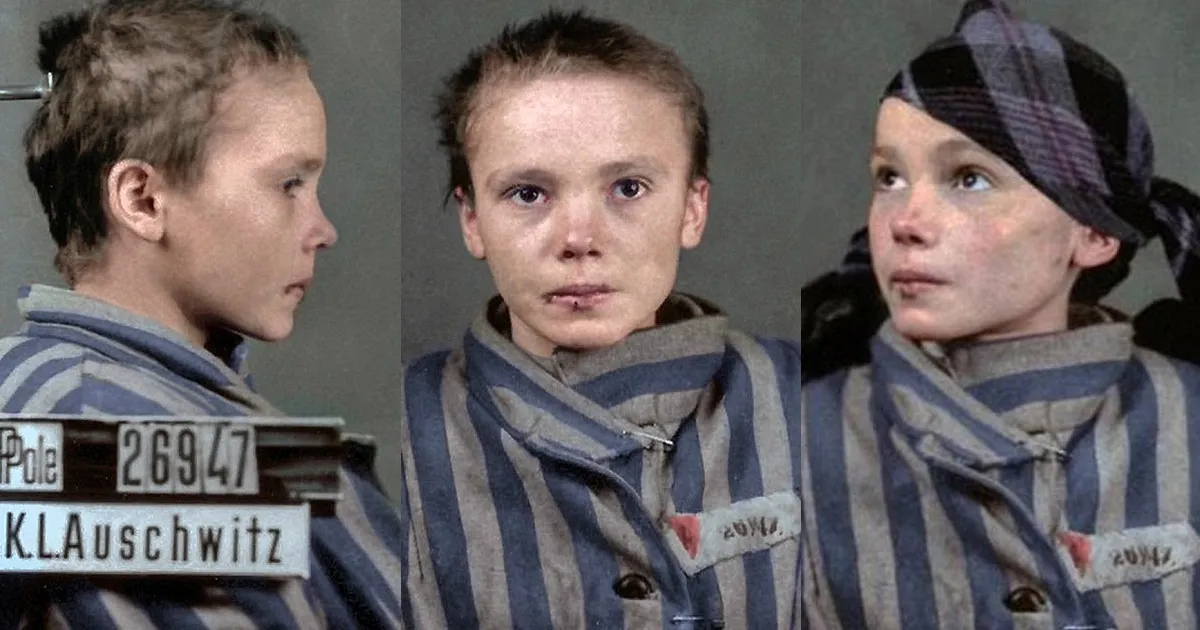
Among the millions of photographs preserved from the mid-twentieth century, few have left as profound an imprint on the world’s collective memory as the three intake portraits of Czesława Kwoka. Taken when she was just fourteen years old, her portrait captured the quiet horror of a child thrust into an incomprehensible system. By examining her life, her background, and the circumstances surrounding those famous photographs, we restore a measure of dignity to her memory and honor the hundreds of thousands of young lives cut short during the conflict.
Early Life in the Zamość Region
Czesława Kwoka was born on August 15, 1928, in Wólka Złojecka, a modest rural village located in the Zamość region of southeastern Poland. She grew up in a traditional Catholic family alongside her mother, Katarzyna. The Zamość region was an agricultural area characterized by close-knit village communities, rolling farmland, and family-centered traditions.
As a young girl, Czesława attended the local school, assisted her mother with daily household duties, and participated in the seasonal rhythms of rural Polish life. Those who knew her described her as a bright, quiet child with light blue eyes and auburn hair. Her childhood was grounded in the simple, everyday routines of farm work, family life, and school studies.
However, this peaceful upbringing was shattered following the invasion and occupation of Poland in September 1939. By late 1942, the occupational administration designated the Zamość region for a massive, forced demographic restructuring project known historically as Aktion Zamość. The plan called for the forced removal of hundreds of thousands of native Polish residents from their ancestral lands to make way for new agricultural settlements.
Forced Displacement and Deportation to Auschwitz
In late November and early December 1942, occupational forces surrounded dozens of villages across the Zamość district. Families were given mere minutes to gather a few personal belongings before being forcibly evicted from their homes. Whole communities were marched to regional transit camps, including those at Zamość and Zwierzyniec, where individuals were sorted into administrative categories.
Fourteen-year-old Czesława and her mother Katarzyna were among the thousands rounded up during these winter operations. Separated from their community and stripped of their property, they were placed on a crowded freight transport bound for the Auschwitz concentration camp in occupied southern Poland.
The transport arrived at the camp late in the evening on December 13, 1942. Upon arrival, the detainees were processed into the camp system under severe winter conditions:
-
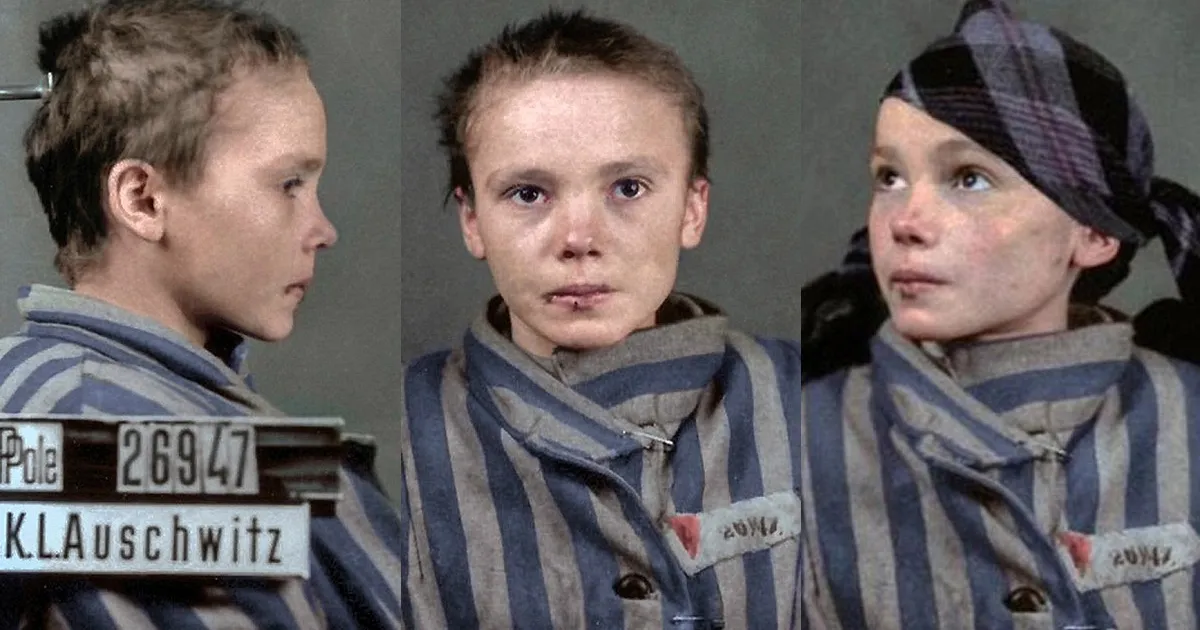
Administrative Registration: Czesława was assigned prisoner number 26947, while her mother Katarzyna was registered as prisoner number 26946.
-
Confiscation of Belongings: Civilian clothing and personal keepsakes were taken away, replaced by standardized inmate garments.
-
Separation and Assignment: The young girl was transferred to Block 6 within the women’s section at Birkenau to undergo formal intake procedures.
The Intake Photographs: A Moment Frozen in Time
During the intake process, new prisoners were brought to the Erkennungsdienst (the camp’s administrative identification service) to be photographed for official record-keeping. The inmate photographer assigned to take these identification portraits was Wilhelm Brasse, a professional photographer from Żywiec who had been imprisoned in Auschwitz as a political detainee.
Decades after the war, Brasse gave detailed historical testimonies describing the day Czesława Kwoka entered the studio in Block 6. He clearly recalled the arrival of the terrified fourteen-year-old girl, who spoke only Polish and could not understand the harsh commands barked at her in German.
Overwhelmed by fear, confusion, and the chaotic environment, Czesława struggled to follow the instructions to sit properly for the mandatory three-pose portrait—a profile view, a full-face view, and a three-quarter view wearing a headscarf. Frustrated by the delay, a female overseer in the block struck the young girl across the face with a heavy stick.
The blow split Czesława’s lower lip, causing blood to trickle down her chin and bringing tears to her eyes. Deeply moved by her distress, Brasse quietly asked the young girl in her native Polish to wipe her mouth before he took the photo. She used her sleeve to dab the blood from her lip, composed herself as best she could, and looked directly into the camera lens.
The resulting three images recorded a moment of absolute vulnerability and quiet defiance: a fourteen-year-old girl with a freshly shorn head, a visible cut on her lower lip, tears welling in her eyes, yet staring back at the camera with an undeniable, luminous humanity.
Tragedy in the Camp Network
The living conditions within the camp during the winter of 1942–1943 were extraordinarily severe. Overcrowding, extreme cold, meager rations, and widespread disease caused rapid physical deterioration among detainees, particularly young children and the elderly.
Czesława’s mother, Katarzyna Kwoka, succumbed to the harsh environment on February 18, 1943, just two months after their arrival. Left entirely alone in a terrifying environment, fourteen-year-old Czesława survived for less than a month following her mother’s passing.
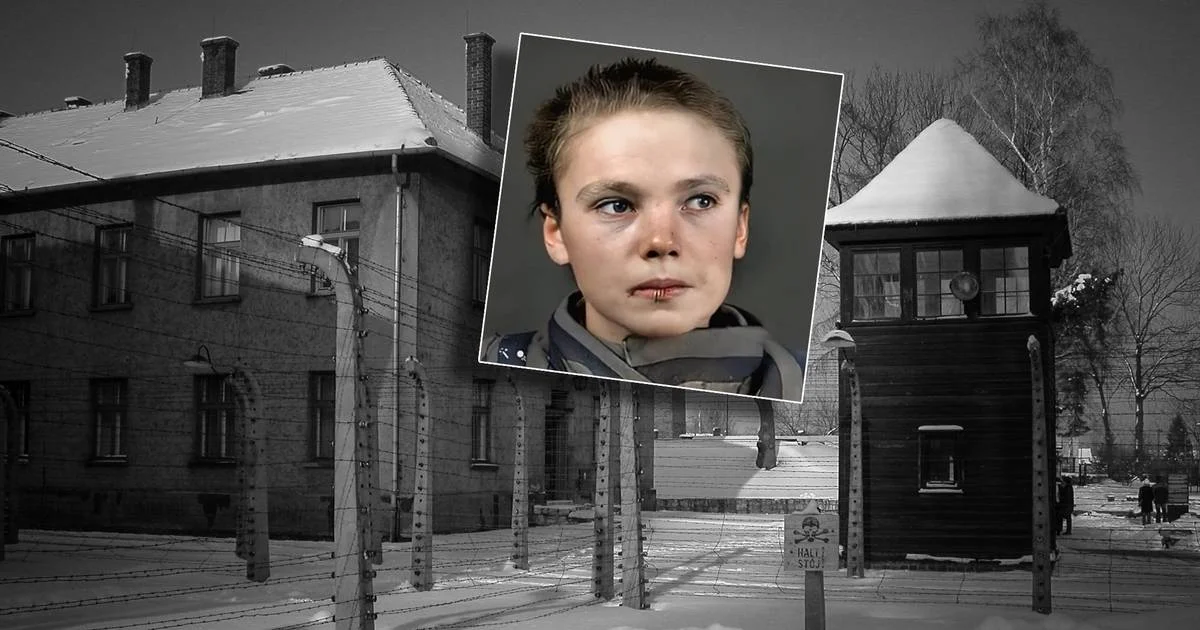
On March 12, 1943—exactly three months after her arrival at Auschwitz—Czesława Kwoka passed away in Block 20, a medical unit within the main camp. The official camp death registry recorded her cause of death as “cachexia” (extreme physical emaciation), a standard administrative entry used by staff to cover the routine termination of weakened prisoners.
Preservation of the Archival Negatives
When the camp administration began dismantling official records in early 1945 ahead of the advancing Allied forces, staff ordered Wilhelm Brasse and his fellow inmate workers to destroy all photographic negatives stored in the Erkennungsdienst archives.
Recognizing the crucial historical and legal value of these visual records, Brasse and his colleague Bronisław Jurecki deliberately disobeyed the order. At great personal risk, they jammed the incinerator doors, hid thousands of glass plate negatives beneath photographic paper, and covered them with wet canvas to prevent burning.
Following the liberation of the camp in January 1945, nearly 40,000 original identification photographs were recovered intact, including the three portraits of prisoner 26947. These images were eventually transferred to the permanent archives of the Auschwitz-Birkenau State Museum, where they remain among the most significant photographic evidence of wartime administrative practices ever preserved.
Primary Archival Sources
The life and tragic path of Czesława Kwoka are thoroughly documented through primary historical collections and verified survivor statements:
-
Auschwitz-Birkenau State Museum Archives: Preserves original prisoner card number 26947, transport lists dated December 13, 1942, and the original glass negatives from Block 6.
-
Testimony of Wilhelm Brasse (2005): Recorded oral histories and publication records featured in Photographer of Auschwitz, detailing his encounters with child detainees in the Erkennungsdienst.
-
Yad Vashem Central Database of Shoah Victims’ Names: Maintains biographical records and regional documentation regarding the civilian deportations from the Zamość region.
-
Permanent Exhibition at Block 6 (Auschwitz-Birkenau): Displays the identification photographs within the historical context of prisoner intake procedures and everyday life in the camp.
Educational Impact and the Duty of Remembrance
Why does the story of a fourteen-year-old girl from a small Polish village continue to resonate so deeply across the globe decades later?
When historical events are presented through grand political narratives or vast numerical totals, the individual human reality can easily become abstract. Historical research estimates that approximately 230,000 children were deported to Auschwitz, of whom fewer than 650 survived to see liberation. While that figure conveys the staggering scale of the tragedy, Czesława Kwoka’s photograph gives that statistic a human face.
Looking into her eyes through Wilhelm Brasse’s lens removes the distance of time. Her expression reminds us that every single unit in a historical total represents a child with a home, a mother, a school, and a future that was taken away.
Preserving Czesława’s memory serves several vital purposes in modern society:
-
Restoring Individual Dignity: Speaking her name and sharing her narrative ensures that her identity remains intact, defeating attempts to reduce her life to an anonymous administrative number.
-
Fostering Global Empathy: Her image serves as a universal symbol of youth caught in the machinery of conflict, inspiring modern generations to protect vulnerable children worldwide.
-
Guarding Historical Truth: Authentic visual evidence provides an unassailable shield against historical denial, revisionism, and distortion.
Czesława Kwoka’s physical life ended in March 1943, but her story endures as a permanent light against the darkness of the past. Her steady gaze from those 1942 identification photographs continues to call upon humanity to defend basic human rights, uphold the dignity of every individual, and ensure that such tragedies are never repeated.
