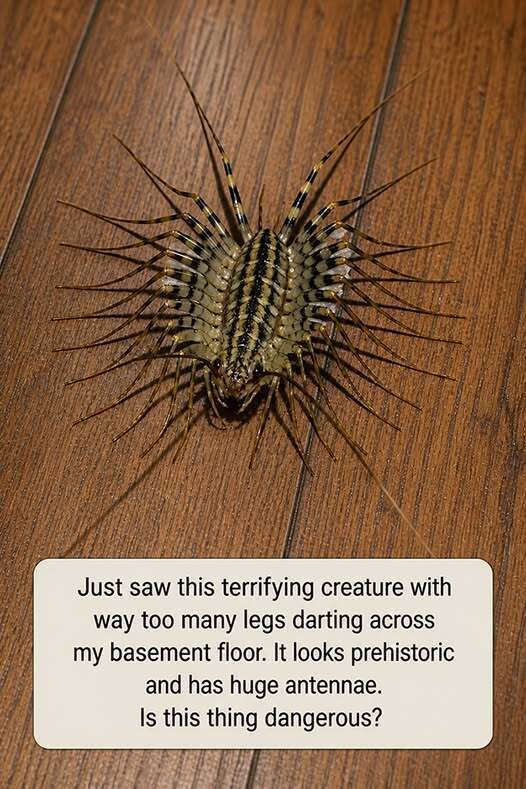

On a quiet Tuesday evening, a homeowner walked down the wooden stairs into a cool, dimly lit basement to retrieve a box of seasonal decorations. As the overhead light flickered on, a sudden movement along the baseboard caught their eye—a dark, feather-like blur darting across the concrete floor with startling speed. For a brief second, time seemed to freeze. The sheer number of long, delicate legs moving in fluid synchrony triggered an instinctive jump, a spiked heart rate, and an immediate search for the nearest shoe. Yet, as the creature paused beneath the shadow of a storage shelf, completely still and silent, a curious question replaced the initial wave of surprise: what is this strange, multi-legged visitor, and why is it sharing our home?
That fleeting moment of alarm is an experience shared by millions of people across the globe. Known scientifically as Scutigera coleoptrata, the common house centipede often evokes an immediate reaction due to its unusual appearance and rapid movement. However, looking past the initial surprise reveals a story of remarkable evolutionary adaptation, beneficial household behavior, and a deep cultural relationship with human dwellings.
The Science of Scutigera coleoptrata: Evolution, Speed, and Adaptation
From an entomological perspective, the house centipede is a masterpiece of natural engineering. Originating in the warm Mediterranean region, this arthropod has adapted over centuries to thrive in human structures, which offer stable temperatures, shelter, and a steady supply of food.
Unlike many slow-moving ground insects, Scutigera coleoptrata possesses fifteen pairs of long, extremely flexible legs anchored to a rigid body structure. The rear legs are significantly longer than the front legs, allowing them to move rapidly across floors, walls, and ceilings without tripping over their own limbs.
Biologists often highlight that house centipedes act as effective, natural pest managers. Their diet consists almost entirely of other household insects, including cockroaches, termites, spiders, ants, and silverfish. Possessing keen senses tuned to detect vibrations in dark corners, they hunt quietly during the night, keeping populations of unwanted indoor insects under control long before human residents ever notice a problem.
Cultural Beliefs and Folklore: From Historical Fears to Household Guardians
Throughout human history, creatures with numerous legs have held a unique place in folklore, myth, and traditional beliefs. In many ancient agricultural communities, finding multi-legged insects in homes or grain stores was viewed through various symbolic lenses, ranging from omens of seasonal shifts to signs of environmental balance.
In certain regional folklore traditions, house centipedes were viewed as quiet guardians of the home. Because their presence coincided with a noticeable absence of destructive pests like moths and beetles, observant householders recognized that these harmless visitors were actively protecting stored textiles and food supplies.
Speculatively, cultural historians note that human reactions to centipedes are deeply tied to evolutionary biology. Because our ancestors needed to stay cautious around unknown animals in dark environments, fast-moving creatures naturally triggered an immediate protective reflex. Over time, as scientific understanding replaced old superstitions, society began to view these helpful predators with appreciation rather than fear.
Peaceful Coexistence: Managing Your Home Environment Gracefully
While understanding the beneficial role of house centipedes helps ease initial worries, it is entirely natural for homeowners to prefer keeping their indoor spaces bug-free. Managing their presence does not require harsh measures; instead, it involves simple adjustments to household environment and moisture levels.
Centipedes rely on high humidity to keep their delicate bodies hydrated. Consequently, they are most frequently encountered in damp basements, bathrooms, and laundry areas. By lowering indoor humidity, householders naturally encourage centipedes to seek outdoor habitats.
For those who happen to spot a house centipede indoors, the most compassionate approach is gentle relocation. Using a cup and a piece of stiff paper, one can easily capture the insect and release it into a garden or near outdoor mulch beds, where it can continue its beneficial hunting work in its natural element.
Emotional Wellness: Overcoming Instinctive Fears Through Knowledge
Our initial reactions to sudden insect sightings demonstrate how quickly the human mind processes unexpected events. Transforming that momentary jump into calm curiosity is a rewarding exercise in emotional mindfulness and scientific understanding.
Child educators and psychologists often suggest that learning about the helpful habits of small creatures is a great way to build empathy and reduce fear. When parents and children learn together how centipedes help keep homes clean, a moment of alarm transforms into an engaging educational story about nature’s balance.
By approaching unexpected household encounters with a calm and informed perspective, we build a healthy respect for the natural world. Recognizing that even unusual-looking creatures serve a purpose fosters a peaceful atmosphere within our shared living spaces.
A Reflection on Human Curiosity and the Wonders of Nature
Our ongoing curiosity about the small creatures that share our homes reflects a fundamental aspect of human nature. When a homeowner pauses to learn more about a mysterious insect found in the basement rather than acting out of initial fear, they choose understanding over instinct. This same drive to explore the natural world has turned ancient fears into scientific knowledge, revealing the subtle connections that exist right beneath our roofs.
We study Entomology, observe animal behavior, and share educational stories because we possess an innate desire to understand our environment. This curiosity transforms unexpected moments into meaningful learning opportunities, proving that knowledge is our best guide for living harmoniously with nature.
Ultimately, encountering a house centipede offers a gentle lesson in perspective. Behind an intimidating appearance lies a quiet, hardworking ally that keeps our living spaces balanced. With a little scientific insight, gentle humor, and open curiosity, what begins as a midnight surprise becomes an inspiring story about the surprising harmony found in everyday life.
Sources
-
The Smithsonian Institution: Educational guides on arthropod biology, house centipede habits, and indoor ecosystems.
-
The Penn State Department of Entomology: Research overviews detailing the beneficial hunting behaviors of Scutigera coleoptrata.
-
The University of Maryland Extension: Integrated pest management advice and non-chemical strategies for indoor insect control.
-
The Journal of Insect Science: Peer-reviewed papers on the evolutionary speed, limb mechanics, and environmental adaptations of centipedes.
-
The National Wildlife Federation: Educational resources exploring the ecological roles of urban arthropods and beneficial home garden wildlife.
