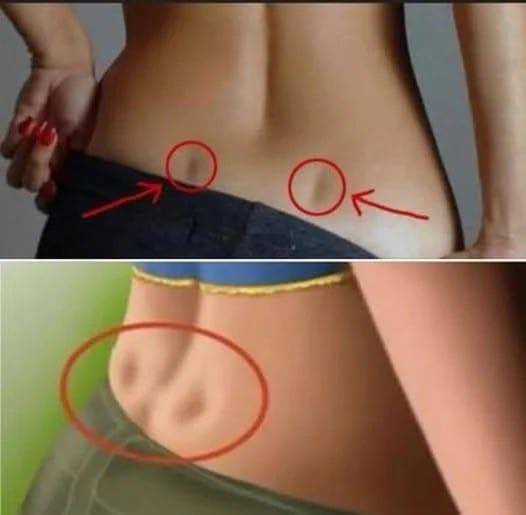

It often starts with a simple observation. You notice two small indentations on someone’s lower back, or perhaps on your own, and suddenly curiosity takes over. Social media, beauty trends, and casual conversations sometimes give these features a sense of mystery, even suggesting they hold deeper meaning.
But what are these dimples, really?
Are they a sign of something special, or simply a natural variation of the human body?

What Are Venus Dimples?
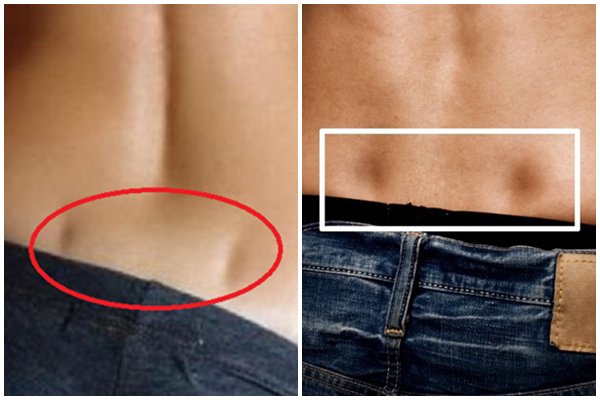
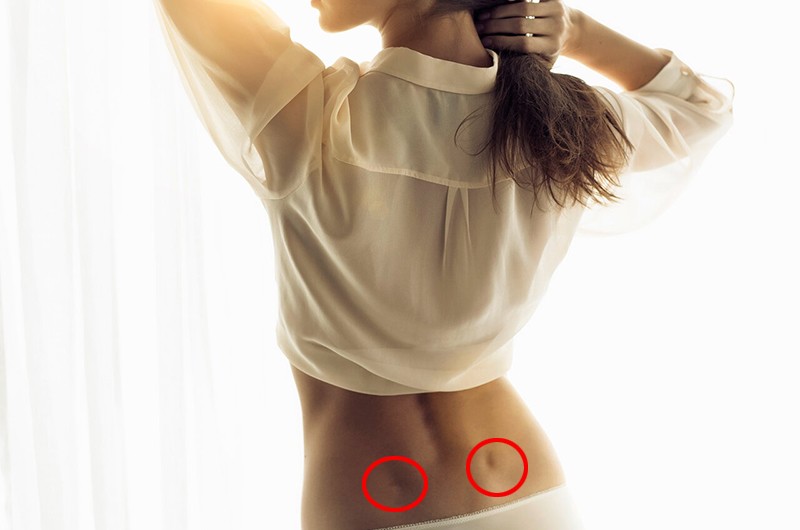
Those small indentations are commonly known as Venus dimples (or Apollo dimples in men). They are located on the lower back, just above where the pelvis meets the spine.
From a scientific standpoint, these dimples form at a point where the skin is more tightly connected to underlying structures, particularly around the posterior superior iliac spine, a bony landmark of the pelvis.
In simpler terms, they are a result of how your body is built beneath the surface.
The Science Behind Their Appearance
The visibility of these dimples depends on several biological factors:
Bone structure
Ligament placement
Fat distribution
These elements are largely determined by genetics. This means that whether or not someone has visible dimples is not something that can be fully controlled or changed.
Some people naturally have them.
Others do not.
And both are completely normal.
Can You Develop Them?
There is a common belief that certain exercises or routines can “create” these dimples. The reality is more nuanced.
While you cannot change your bone structure or ligament placement, lifestyle factors can influence how visible certain features appear.
For example:
Lower body fat levels may make natural contours more noticeable
Strengthening the lower back and glute muscles can enhance definition
However, these changes do not guarantee the appearance of dimples. They can only reveal what is already structurally present.
Cultural Interpretations and Beauty Trends
Throughout history, small physical traits have often been given symbolic meaning. Venus dimples are no exception.
In some cultures, they have been associated with beauty, symmetry, or physical attractiveness. The name itself, linked to Venus, the Roman goddess of love, reflects this perception.
However, it is important to recognize that these interpretations are cultural, not scientific.
Beauty standards shift over time and vary widely across regions. What is admired in one era or culture may not hold the same significance in another.
The Risk of Over-Interpreting Physical Traits
In the age of digital media, even the smallest physical details can become trends. Features like dimples, freckles, or body shapes are sometimes framed as goals to achieve.
This can lead to unrealistic expectations.
From a scientific and health perspective, such traits are neutral. They do not indicate superior fitness, health, or value.
Focusing too heavily on them can distract from what truly matters: how the body functions and feels.
A Health-Focused Perspective
Rather than aiming for specific aesthetic features, experts emphasize building strength and maintaining overall well-being.
Exercises that support the lower back and core can provide meaningful benefits, including:
Improved posture
Better spinal support
Enhanced mobility
Reduced risk of injury
Movements such as deadlifts, glute bridges, back extensions, and core training contribute to these outcomes.
If certain physical features become more noticeable as a result, that is simply a byproduct, not the objective.
The Body as a Functional System
The human body is designed for movement, adaptation, and resilience. Every structure, visible or not, plays a role in supporting daily life.
Small variations, like lower back dimples, are part of this diversity. They reflect the uniqueness of individual anatomy rather than a standard to measure against.
Understanding this can shift the focus from appearance to appreciation.
Why We Are Drawn to These Details
Human curiosity often gravitates toward patterns and differences. When something stands out visually, we naturally want to assign meaning to it.
This tendency is not new. It has shaped art, culture, and even early attempts to understand the human body.
However, modern science encourages a more grounded view. Not every visible feature carries deeper significance. Sometimes, it is simply a result of how the body is naturally formed.
A Reflection on Curiosity and Acceptance
In the end, the fascination with small details like Venus dimples says as much about us as it does about the body.
We look for meaning.
We search for patterns.
We try to understand what makes us unique.
But perhaps the most meaningful perspective is also the simplest.
The body does not need to meet a specific visual standard to be complete. It is already a complex, adaptable system designed to support life in countless ways.
Whether those small dimples are visible or not, they do not define strength, health, or worth.
Human curiosity will always explore the surface.
But understanding invites us to look deeper.
And sometimes, what we find is not a hidden meaning, but a reminder that natural variation is part of what makes us human.

Sources
National Institutes of Health. Human Anatomy and Skeletal Structure
Cleveland Clinic. Understanding Body Fat Distribution
Harvard Health Publishing. Benefits of Strength Training
American Council on Exercise. Core and Back Strengthening
Encyclopaedia Britannica. Venus in Roman Mythology
