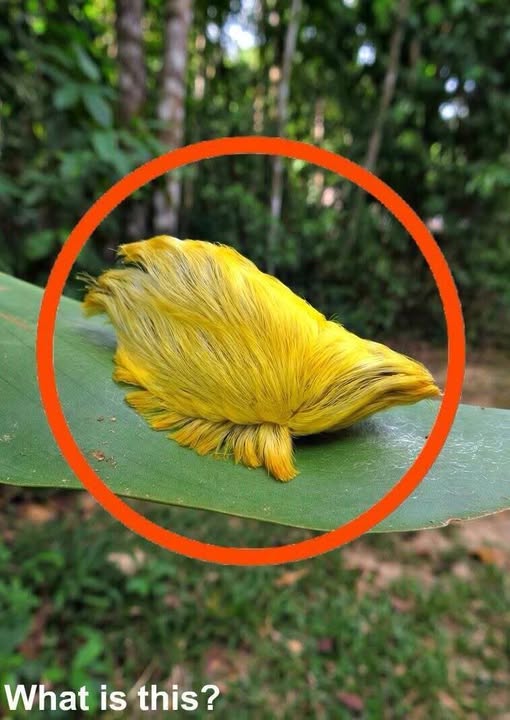

Imagine taking a peaceful walk through your garden on a warm afternoon. As you admire the leaves of an oak tree, you notice what looks like a tiny tuft of soft fur resting quietly on a branch. It resembles a small piece of cotton or perhaps a fuzzy toy left behind by chance.
Your first instinct might be to touch it.
Fortunately, learning a little about this remarkable insect can help prevent an unpleasant surprise.
That fluffy creature may be the puss caterpillar, the larval stage of the Southern flannel moth. Although it appears harmless, it possesses an effective natural defense that has made it one of the best-known stinging caterpillars in North America.
Rather than viewing this fascinating insect as something frightening, scientists encourage people to appreciate it from a safe distance and understand the important role it plays in nature
.
What Is a Puss Caterpillar?
The puss caterpillar is the immature form of the Southern flannel moth.
Unlike many caterpillars that display visible segments and legs, this species is covered almost entirely with dense, silky hairs that give it an unusually soft appearance.
Beneath those hairs lie tiny venomous spines connected to glands that produce a defensive venom.
These spines help protect the caterpillar from predators such as birds and small mammals.
Humans are not its target. Most contacts occur accidentally while gardening, trimming trees, or brushing against vegetation.
Why Does It Look So Soft?
Nature often surprises us with unexpected adaptations.
Some animals use bright warning colors.
Others rely on camouflage.
The puss caterpillar combines concealment with protection.
Its silky coat disguises the defensive spines underneath while helping it blend into leaves, bark, and twigs.
This deceptive appearance explains why people sometimes mistake it for:
A tuft of fur.
A seed pod.
Plant fuzz.
A harmless caterpillar.
Because the spines are hidden, accidental contact is easier than with many other stinging insects.
Where Is the Puss Caterpillar Found?
The species is primarily found in the southern and eastern United States, although its range can occasionally extend into neighboring regions.
It commonly lives on:
Oak trees.
Elm trees.
Citrus trees.
Pecan trees.
Sycamores.
Various ornamental shrubs.
Most encounters occur during warmer months when caterpillars are actively feeding.
How Do the Defensive Spines Work?
Unlike bees or wasps that actively sting, the puss caterpillar relies on passive defense.
When something brushes against the caterpillar, the hidden spines can penetrate the skin.
The spines may then release venom, producing localized reactions.
This defense evolved to discourage predators rather than to harm people.
It is an excellent example of how insects develop specialized survival strategies over millions of years of evolution.
Possible Symptoms After Contact
People respond differently depending on their sensitivity and the amount of contact.
Reported symptoms may include:
Immediate burning or stinging pain.
Redness.
Swelling.
Itching.
A rash around the affected area.
Occasionally, some individuals experience more widespread symptoms that warrant prompt medical evaluation.
Because reactions vary considerably, healthcare professionals recommend seeking medical attention if symptoms become severe, spread rapidly, or include difficulty breathing or other signs of a significant allergic reaction.
What Should You Do If You Touch One?
Medical experts generally recommend several basic first-aid measures.
Avoid rubbing the affected skin.
Wash the area gently with soap and water.
Use adhesive tape to help lift remaining tiny spines from the skin if appropriate.
Apply a cool compress to reduce discomfort.
Monitor symptoms carefully.
Seek medical care if pain is severe or symptoms worsen.
Healthcare providers can recommend additional treatment depending on the individual’s condition.
Why Scientists Study Venomous Caterpillars
Although they may seem unusual, venomous caterpillars are valuable subjects for scientific research.
Researchers study them to better understand:
Venom chemistry.
Insect evolution.
Predator-prey relationships.
Ecosystem biodiversity.
Natural defense mechanisms.
These studies contribute to broader knowledge of ecology while improving medical understanding of insect-related skin reactions.
The Ecological Role of the Southern Flannel Moth
Every species contributes to its ecosystem.
The Southern flannel moth and its caterpillar serve several ecological functions.
They provide food for predators that have adapted to avoid or tolerate their defenses.
They participate in forest food webs.
They contribute to overall insect diversity.
Like countless other insects, they form part of the complex balance that supports healthy ecosystems.
Safe Wildlife Observation
One of the best ways to enjoy nature is by observing rather than handling unfamiliar animals.
If you discover an unusual caterpillar:
Keep a respectful distance.
Take photographs instead of touching it.
Teach children not to pick up unfamiliar insects.
Wear gloves when working around trees and shrubs.
Leave wildlife undisturbed whenever possible.
These simple habits help protect both people and native species.
Why Curiosity Should Be Guided by Knowledge
The puss caterpillar demonstrates an important lesson found throughout nature.
Beautiful colors do not always indicate safety.
Soft textures do not always invite touch.
Unusual appearances often have fascinating biological explanations.
Rather than encouraging fear, understanding these adaptations allows us to appreciate wildlife more responsibly.
Knowledge transforms surprise into appreciation.
Conclusion
The puss caterpillar is one of nature’s most remarkable examples of how appearance can differ from reality. Beneath its soft, furry exterior lies an effective defense that protects it from predators while illustrating the incredible diversity of insect evolution.
Fortunately, accidental encounters are relatively uncommon, and simple awareness greatly reduces the likelihood of contact. By observing unfamiliar insects from a respectful distance and following basic outdoor safety practices, people can safely enjoy gardens, parks, and forests while respecting the wildlife that inhabits them.
Human curiosity has always inspired us to explore the natural world. When curiosity is paired with scientific understanding and thoughtful observation, even a tiny fuzzy caterpillar becomes an opportunity to discover the extraordinary complexity and beauty of nature.
Sources
- Centers for Disease Control and Prevention
- University of Florida Institute of Food and Agricultural Sciences
- Texas A&M AgriLife Extension Service
- American Association of Poison Centers
- Smithsonian Institution
- National Geographic Society
