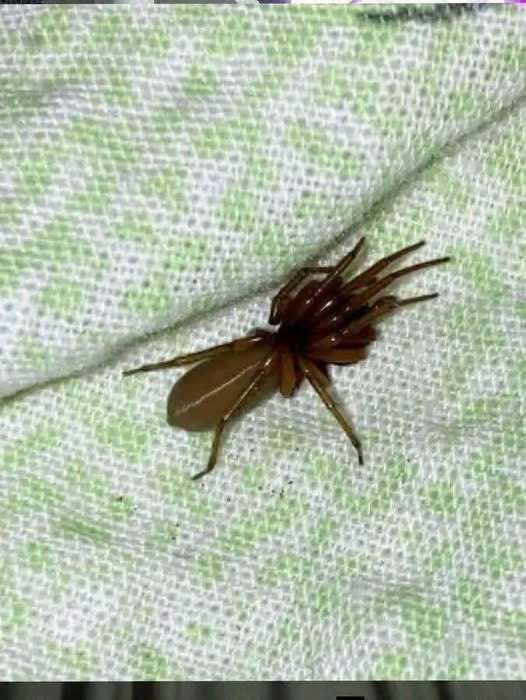

When twilight settles over a quiet forest, most people imagine a peaceful landscape where the day’s activity slowly fades away. Hidden beneath fallen leaves, loose bark, and scattered stones, however, another world begins to awaken. Tiny creatures emerge, insects start their nightly routines, and among them moves a silent hunter unlike the spiders many people picture.
For generations, spiders have been closely associated with beautifully woven webs glistening in the morning dew. Stories, artwork, and popular culture often portray these intricate silk traps as the defining characteristic of every spider. Yet nature is far more diverse than our assumptions. Some spiders have evolved a completely different strategy, abandoning webs almost entirely in favor of movement, precision, and remarkable sensory abilities.
One of the most intriguing examples is the red fanged wandering spider, an agile nocturnal hunter that relies on stealth instead of silk. Rather than patiently waiting for prey to arrive, it actively explores its surroundings, demonstrating that evolution can produce multiple successful paths to survival.
This extraordinary spider has fascinated scientists, inspired curiosity among wildlife enthusiasts, and even contributed to myths surrounding mysterious nighttime creatures. Understanding its behavior reveals not only the incredible diversity of spiders but also the remarkable adaptability of life itself.
What Is the Red Fanged Wandering Spider?
The term red fanged wandering spider refers to spiders recognized for their striking reddish mouthparts and highly active hunting behavior. Unlike orb-weaving spiders that construct elaborate silk webs, wandering spiders spend much of their lives moving through their habitats in search of food.
Their environments often include:
- Forest floors
- Leaf litter
- Fallen logs
- Tree bark
- Rocky crevices
- Dense vegetation
These locations provide ideal cover while allowing the spiders to patrol for insects and other small invertebrates during nighttime hours.
Although their appearance may seem intimidating at first glance, these spiders are generally adapted for avoiding unnecessary encounters with larger animals, including humans.

Why Doesn’t This Spider Build a Web?
One of the most interesting questions researchers ask is why some spiders stopped relying on webs altogether.
The answer lies in evolution.
Different spider families developed different survival strategies over millions of years. While silk remains useful for egg sacs, shelters, or safety lines, not every species depends on sticky capture webs.
For the red fanged wandering spider, mobility offers several advantages.
It can:
- Search larger hunting areas
- Follow moving prey
- Adapt to changing environments
- Exploit food sources unavailable to stationary web builders
Instead of waiting for insects to become trapped, it becomes the one actively searching for opportunity.
This alternative lifestyle demonstrates that successful evolution does not always follow a single pattern.
A Master of Nocturnal Hunting
Night transforms the forest into an entirely different ecosystem.
As temperatures become cooler and many insects become active, the wandering spider begins its patrol.
Unlike web-building spiders that remain in fixed locations, this hunter rarely stays still for long. It carefully explores every corner of its territory using slow, deliberate movements.
Its hunting process typically follows several stages.
First, it quietly investigates its surroundings.
Next, it identifies subtle signs of movement.
Then it slowly approaches its target while minimizing unnecessary motion.
Finally, it makes an extremely rapid strike when the opportunity is ideal.
This combination of patience and speed makes it one of nature’s most efficient arthropod hunters.
Extraordinary Sensory Abilities
Vision plays a role in spider behavior, but the red fanged wandering spider depends heavily on another remarkable system.
Its legs are covered with countless microscopic sensory hairs.
These tiny structures detect:
- Ground vibrations
- Air movement
- Surface disturbances
- Minute environmental changes
Even the slightest movement of an insect can create signals that these specialized hairs help the spider interpret.
Scientists often describe this sensory network as one of the most sophisticated natural detection systems among arthropods.
Rather than relying solely on eyesight, the spider effectively “feels” its environment, allowing it to react with impressive precision even under low-light conditions.

The Purpose of the Spider’s Red Fangs
Perhaps the spider’s most recognizable feature is its vivid reddish fangs.
Their coloration immediately captures attention and contributes to the species’ memorable appearance.
Functionally, these mouthparts serve an important purpose during feeding.
Like many spiders, wandering spiders use specialized fangs to deliver venom that helps subdue prey efficiently. This adaptation allows the spider to feed while minimizing prolonged struggles with captured insects.
Researchers emphasize that these structures evolved primarily for hunting rather than defense.
Although the bright coloration has inspired speculation in folklore, there is no scientific evidence suggesting the color itself provides unusual abilities beyond its natural biological function.
Speed and Precision Over Silk
Web-building spiders invest significant energy into constructing and maintaining silk structures.
The wandering spider invests that energy differently.
Its body is optimized for movement.
Long legs, strong muscles, and rapid reaction times allow it to pursue prey directly rather than depending on passive traps.
This active strategy resembles many other successful hunters found throughout nature.
Instead of waiting for opportunity, it creates opportunity through exploration.
Scientists studying spider evolution often compare these contrasting approaches to understand how different ecological niches encourage specialized adaptations.
Both strategies have proven highly successful, illustrating the remarkable flexibility of evolutionary processes.
The Spider’s Role in Nature
Despite their sometimes misunderstood reputation, spiders perform valuable ecological services.
The red fanged wandering spider contributes by naturally regulating populations of insects and other small invertebrates.
Healthy predator populations help maintain ecological balance by preventing certain prey species from becoming overly abundant.
This balance supports:
- Plant communities
- Soil ecosystems
- Food webs
- Biodiversity
Every predator occupies an important position within its ecosystem, and wandering spiders are no exception.
Rather than viewing them simply as unusual creatures, scientists increasingly recognize their significance in maintaining healthy natural environments.
Myths and Cultural Beliefs About Wandering Spiders
Throughout history, spiders have inspired stories across many cultures.
Some traditions portray spiders as symbols of creativity because of their remarkable silk production.
Others associate them with patience, intelligence, or transformation.
Active hunting spiders, however, often inspired different interpretations.
Because wandering spiders appear unexpectedly while moving across the ground at night, folklore occasionally portrayed them as mysterious forest guardians or silent travelers.
Some stories suggested these spiders possessed unusual awareness because they seemed capable of detecting movement from surprising distances.
Modern science offers a more practical explanation through their highly specialized sensory hairs.
While myths remain an important part of cultural heritage, researchers continue distinguishing symbolic traditions from observable biological evidence.
Doing so allows appreciation of both cultural storytelling and scientific discovery without confusing the two.

Scientific Research Continues to Reveal New Insights
Arachnologists continue studying wandering spiders to better understand their evolution, sensory biology, and hunting behavior.
Current research explores questions such as:
How did active hunting evolve independently in different spider groups?
How do sensory hairs process environmental information?
What advantages do wandering hunters gain in changing habitats?
Could studying spider movement inspire future robotic technologies?
Scientists are also interested in the biomechanics behind the spider’s remarkable speed and coordination.
Each new discovery contributes to a broader understanding of adaptation across the animal kingdom.
Rather than viewing spiders as simple web builders, researchers increasingly recognize the enormous diversity within the arachnid world.
Are Red Fanged Wandering Spiders Dangerous?
Their appearance often creates unnecessary concern.
In reality, these spiders generally prefer avoiding interactions with people.
Like many wild animals, they are primarily focused on finding food, conserving energy, and avoiding potential threats.
Observing wildlife respectfully from a distance remains the best approach.
Attempting to handle unfamiliar spiders is never recommended, both for personal safety and for the well-being of the animal.
Fortunately, encounters are relatively uncommon because these spiders spend much of their active periods hidden within natural habitats and are most active after dark.
Understanding their normal behavior helps replace unnecessary fear with informed appreciation.
Why This Spider Fascinates Scientists and Nature Lovers
The red fanged wandering spider challenges one of our strongest assumptions about spiders.
Many people instinctively associate spiders with webs.
Yet this remarkable hunter demonstrates that nature rarely limits itself to a single solution.
Its success comes from an impressive combination of:
- Exceptional sensory perception
- Agile movement
- Careful stalking behavior
- Rapid hunting responses
- Adaptability to diverse environments
These characteristics make it an excellent example of evolutionary innovation.
For wildlife photographers, naturalists, and researchers alike, observing such specialized behavior offers valuable insight into the incredible diversity of Earth’s ecosystems.
The Diversity of Spider Evolution
More than 50,000 spider species have been identified worldwide, and they display an astonishing variety of lifestyles.
Some construct elaborate orb-shaped webs.
Others hide beneath trapdoors.
Some mimic ants.
Others leap impressive distances.
The red fanged wandering spider represents yet another successful evolutionary pathway.
Its existence reminds us that evolution continually experiments with different survival strategies, refining them over countless generations.
Rather than following one universal blueprint, life develops countless creative solutions to similar challenges.
This diversity is one of biology’s greatest sources of wonder.

Conclusion
The red fanged wandering spider is a remarkable example of how nature rewards adaptability. By leaving behind the familiar strategy of web building and embracing active hunting, it has become one of the most efficient nocturnal predators in its ecological niche. Its sensitive legs, striking fangs, rapid movements, and carefully coordinated behavior illustrate the incredible variety found within the spider world.
Beyond its fascinating biology, the spider also highlights the relationship between scientific discovery and cultural storytelling. Folklore often transforms unusual animals into symbols of mystery, while scientific research seeks evidence-based explanations for their remarkable adaptations. Together, these perspectives enrich our understanding of the natural world without diminishing either tradition or observation.
Ultimately, creatures like the red fanged wandering spider remind us that curiosity is one of humanity’s greatest strengths. The more closely we observe nature, the more we discover that even familiar groups of animals can surprise us with unexpected strategies, inspiring both scientific exploration and a deeper appreciation for the diversity of life.
Sources
Brown, S. G. Biology of Spiders. Oxford University Press.
Foelix, R. F. Biology of Spiders. Third Edition. Oxford University Press.
American Arachnological Society. Educational resources on spider biology and behavior.
Smithsonian National Museum of Natural History. Resources on arachnid diversity and evolution.
Encyclopaedia Britannica. Articles on spiders, arachnids, and animal adaptation.
National Geographic. Wildlife features covering spider evolution, hunting strategies, and biodiversity.
