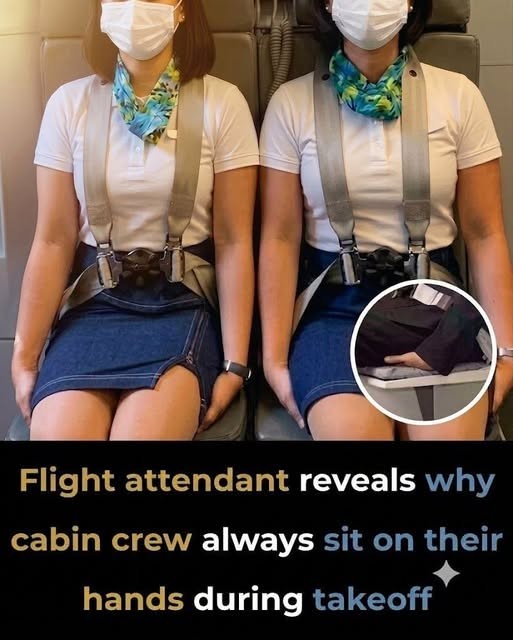

Why Flight Attendants Sit Upright During Takeoff and Landing
Passengers often notice that flight attendants adopt a very specific posture during takeoff and landing. They sit upright, place both feet firmly on the floor, and keep their hands in a controlled position, often on their thighs or, depending on airline procedures and seat design, beneath them. The position can look uncomfortable, especially compared with the relaxed way many passengers sit. However, it is not a matter of comfort, etiquette, or routine.
It is a deliberate aviation safety procedure. During the most safety-sensitive parts of a flight, cabin crew are expected to be physically protected, mentally focused, and ready to respond immediately to an unexpected event. Their seated posture is part of that preparation.
Although procedures differ between airlines and aircraft types, the underlying purpose is consistent: reduce the risk of injury to crew members and help them remain ready to carry out essential safety duties. Flight attendants are trained safety professionals whose responsibilities extend far beyond passenger service. During takeoff and landing, their primary role is to monitor the cabin, prepare for possible emergencies, and support a safe evacuation if one is needed.
Why Takeoff and Landing Matter So Much in Aviation Safety
Takeoff and landing are often described as critical phases of flight because they involve complex operations close to the ground. During these periods, pilots manage aircraft speed, altitude, configuration, weather conditions, runway conditions, air traffic instructions, and other operational factors. Cabin crew must also be especially attentive because the aircraft is either preparing to leave the ground or has just returned to it.
Aviation safety research has long shown that a substantial share of accidents and serious operational events occur during departure, approach, and landing rather than during cruise flight. This does not mean that commercial flying is unsafe. On the contrary, global commercial aviation remains one of the safest forms of transport, supported by extensive training, maintenance, regulation, and investigation systems. It does mean that airlines place particular emphasis on preparedness during the portions of a journey when conditions can change quickly.
For cabin crew, this emphasis begins before the aircraft leaves the gate. They conduct safety checks, verify that equipment is available, confirm that exits are clear, and ensure the cabin is secure. Before takeoff and landing, passengers are asked to fasten seat belts, return seats to the upright position, stow tray tables, and secure larger items. These familiar instructions help reduce obstacles and minimize the chance of injury if the aircraft stops suddenly or encounters unexpected movement.
Flight attendants follow their own carefully designed procedures at the same time. Once the cabin is secured, they take their assigned seats and adopt a braced, alert position.
The Cabin Crew Brace Position Explained
The posture used by flight attendants is often referred to as a brace position or brace posture. Its exact form can vary. A crew member may sit with their back against the seat, shoulders positioned correctly, feet flat and slightly apart, and hands placed on the thighs, seat belt area, or beneath the thighs. The instructions are established by the airline and may be influenced by the design of the jumpseat, the location of safety harnesses, and aviation authority requirements.
The central goal is to keep the body stable. A properly seated crew member is less likely to be thrown forward, twist unexpectedly, or strike parts of the cabin if there is sudden deceleration, turbulence, or another forceful movement. Positioning the feet securely also provides a more stable base and can help limit lower-body movement.
Hands are kept controlled for a practical reason. Loose arms may move suddenly if the aircraft experiences a sharp jolt or impact. Keeping hands on the thighs or otherwise secured reduces unnecessary movement and helps protect the arms, wrists, and hands. This is especially important because flight attendants may need to use their hands immediately after an event to release harnesses, assess exits, operate doors, direct passengers, or use emergency equipment.
The posture is not intended to eliminate all risk. No seating position can guarantee that injuries will never occur in every possible circumstance. Instead, it is a risk-reduction measure developed through aviation safety principles, training, and experience. Like wearing a seat belt, it is one layer in a broader safety system.
Why Some Flight Attendants Sit on Their Hands
The sight of a flight attendant sitting with hands tucked beneath their thighs has attracted considerable attention online. While it may look unusual, it should not be interpreted as a universal rule used in exactly the same way by every airline. Cabin crew seating procedures are not identical worldwide.
Some operators train crew members to place their hands on their thighs. Others may use a position that keeps the hands between the thighs or under them. In either case, the principle is similar: keep the arms close to the body and reduce the likelihood of uncontrolled movement.
This positioning can also help crew maintain a consistent, disciplined posture. In aviation, standardization matters. When every crew member follows a clearly defined procedure, actions can be performed more reliably under pressure. A standardized seating position helps ensure that a flight attendant is correctly aligned, securely restrained, and ready to release the harness quickly when required.
It is important not to confuse this practice with passenger brace instructions. Passenger brace positions are designed differently because passenger seats, restraints, body sizes, seating layouts, and the availability of a seat in front can vary. Airlines provide safety cards and crew demonstrations that explain the appropriate passenger position for a particular aircraft. Passengers should always follow the instructions provided by the operating airline and its crew rather than copying a cabin crew posture.
The Silent Review: Mental Preparation Before Takeoff and Landing
Physical readiness is only one part of the procedure. While seated for takeoff and landing, flight attendants commonly conduct a mental rehearsal often known informally as a silent review. This is a focused reminder of the actions they may need to take if an emergency occurs.
During this review, a crew member may mentally confirm which exit they are responsible for, how that exit operates, what conditions would make it unsafe to use, and which commands they may need to give passengers. They may also review the location of emergency equipment, possible evacuation routes, and communication procedures. The precise content depends on the airline’s training programme and the crew member’s assigned station.
This mental preparation is valuable because emergencies require quick, clear decisions. In a stressful situation, people can lose time trying to remember a sequence of actions. Rehearsal helps make key steps more familiar and accessible. The aim is not to predict that something will go wrong; it is to ensure that trained professionals can respond effectively if it does.
Human factors research, which examines how people perform in complex environments, is an important part of modern aviation safety. Checklists, standard calls, recurrent training, crew resource management, and mental reviews all support decision-making and teamwork. They reduce reliance on memory alone and encourage crews to use established procedures when time is limited.
How Flight Attendants Support Emergency Readiness
Flight attendants have a number of responsibilities during an abnormal or emergency event. They may need to assess conditions inside and outside the aircraft, determine whether an assigned exit can be used, communicate urgent instructions, assist passengers who need additional support, and help manage the flow of people through available exits.
The ability to act depends partly on the crew member being uninjured and able to move. That is why their own seated safety position is so important. Protecting cabin crew is not separate from protecting passengers; it supports the crew’s ability to carry out their safety role.
Cabin crew are trained in evacuation procedures, fire response, first aid, use of emergency equipment, communication, and passenger management. Training is repeated regularly under airline and aviation authority standards. Requirements differ by jurisdiction, but commercial operators must meet strict rules governing cabin crew training and emergency procedures.
International aviation safety is built on cooperation among airlines, manufacturers, regulators, airports, and investigators. Organizations such as the International Civil Aviation Organization help establish global standards and recommended practices. National regulators, including the United States Federal Aviation Administration and the United Kingdom Civil Aviation Authority, oversee airline operations and training within their jurisdictions.
Why Passengers Are Asked to Secure the Cabin
The instructions passengers hear before takeoff and landing are closely connected to cabin crew readiness. An upright seat can provide better support during a sudden stop and can make it easier for a person behind to move out if necessary. A stowed tray table reduces obstacles. Secured carry-on baggage is less likely to become a hazard or block an aisle. Window shades may be adjusted according to airline procedures to help passengers and crew observe outside conditions.
Fastening a seat belt is among the simplest and most effective safety actions passengers can take. Even when the seat belt sign is off, turbulence can occur with limited warning. Aviation authorities commonly recommend keeping the belt fastened while seated. This helps protect passengers from unexpected aircraft movement and allows cabin crew to focus on their own tasks if conditions become unstable.
Passengers can also support cabin safety by listening carefully to crew instructions, avoiding blocking aisles and exits, and leaving personal belongings behind if an evacuation is ordered. These actions may seem minor during an ordinary flight, but they are designed around lessons learned from decades of safety practice and accident investigation.
Common Misunderstandings About Cabin Crew Seating Positions
Social media posts sometimes present one explanation for the flight attendant posture as if it were the only reason or a hidden secret. In reality, aviation procedures are usually more practical and more nuanced. The position is not a special technique that guarantees safety, and it is not used because crew members are trying to appear formal.
It is also inaccurate to assume that every flight attendant follows identical hand placement. Airlines use approved procedures that can differ by aircraft, seat arrangement, and operational manual. What passengers see may therefore vary from one flight to another.
The most reliable explanation is straightforward: flight attendants use a secure seating posture because takeoff and landing demand heightened attention. The posture helps limit movement, supports physical protection, and enables a rapid response after the aircraft comes to a stop. At the same time, crew members review the safety actions connected with their assigned positions.
A Small Detail That Reflects a Larger Safety System
The upright posture of a flight attendant is a visible reminder of the careful planning behind commercial air travel. Most flights end routinely, with passengers arriving safely and crew continuing their normal service. Yet aviation safety depends on preparing consistently for unlikely events, not simply reacting once they occur.
From pre-flight inspections to maintenance programmes, pilot checklists, air traffic coordination, cabin checks, and emergency training, many systems work together to reduce risk. Cabin crew jumpseat procedures are one small but meaningful part of this larger framework.
So, when a flight attendant sits upright with feet planted and hands held in a controlled position, they are not merely waiting for the aircraft to take off or land. They are following a professional safety procedure designed to protect themselves and preserve their ability to assist others. Their posture reflects training, preparation, and the aviation industry’s continuing focus on making air travel as safe as possible.
Sources
- Federal Aviation Administration: Fly Safe
- Federal Aviation Administration: Handbooks and Guidance Materials
- International Civil Aviation Organization: Aviation Safety
- UK Civil Aviation Authority: Passenger Information and Aviation Safety
- International Air Transport Association: Safety Programmes
- National Transportation Safety Board: Aviation Safety Information
Disclaimer: This content is intended for entertainment purposes only and is not based on real events.