

This Innocent-Looking Boy Grew Up to Become One of America’s Most Feared Serial Killers — Until a 13-Year-Old Noticed One Crucial Detail
Richard Ramirez became one of the most notorious criminals in modern California history after a series of home-invasion attacks during 1984 and 1985. News coverage gave the unidentified suspect the name “Night Stalker,” a label that reflected the nighttime setting of many crimes but also risked turning a devastating case into a spectacle.
The human reality was far more important than the nickname. People were killed, injured, sexually assaulted, or left with lasting trauma. Families lost loved ones, survivors faced years of recovery, and communities across Southern California experienced fear in places normally associated with safety: their own homes.
One crucial break in the investigation came from an alert 13-year-old, James Romero III. In August 1985, Romero noticed a suspicious orange Toyota near his family’s Mission Viejo home and recalled part of its license plate. His observation helped authorities locate an abandoned vehicle, where fingerprint evidence led investigators to Ramirez. Within days, police released a photograph of the suspect, and the public helped bring the search to an end.
Richard Ramirez’s Early Life in El Paso, Texas
Richard Ramirez was born Ricardo Leyva Muñoz Ramirez on February 29, 1960, in El Paso, Texas. He was the youngest of five children in a Mexican American family. Later biographical reporting described a difficult childhood that included instability, alleged family violence, head injuries, and reported seizures.
These details are often mentioned in discussions of Ramirez’s background, but they need to be handled carefully. Childhood adversity, illness, exposure to violence, and family conflict do not predict that a person will commit crimes. Most people who experience trauma or instability do not become violent. Such circumstances cannot excuse the deliberate crimes for which Ramirez was convicted.
Accounts of his upbringing also frequently mention an older cousin, Miguel Ramirez, who had served in the Vietnam War. Biographical sources have reported that the cousin exposed the young Ramirez to disturbing stories and images connected to wartime violence. Ramirez was also reportedly present when his cousin killed his wife during a domestic dispute. While such experiences may provide historical context, no isolated event can fully explain later criminal behavior or reduce an offender’s responsibility for it.
From Early Offenses to a California Crime Spree
During his teenage years, Ramirez reportedly left school and became involved in drug use and property crimes. By the early 1980s, he had moved to California. He had prior contact with law enforcement, including arrests connected to vehicle-related offenses, before the crimes that made him nationally known.
In 1984 and 1985, investigators began linking a series of attacks across Los Angeles County, Orange County, and other parts of Southern California. The cases initially occurred in different jurisdictions and involved victims of varying ages and backgrounds. That geographical spread made the inquiry especially difficult. Detectives had to compare witness accounts, physical evidence, burglary patterns, ballistics evidence, and forensic findings from multiple scenes.
The lack of an obvious victim profile intensified public anxiety. Residents understood that the attacks did not appear limited to one neighborhood or household type. Many people took additional home-security precautions, checked doors and windows more carefully, and followed news reports closely for updates from police.
Why the “Night Stalker” Case Affected Southern California
The public fear surrounding the case grew because the crimes involved invasions of private homes. A home is typically understood as a refuge, and attacks in that setting can affect not only those directly harmed but also entire communities. The uncertainty surrounding the offender’s identity and movements added to the concern.
Media organizations began using the term “Night Stalker” to describe the suspect. The name became widely known, yet it could obscure the experiences of victims and survivors. Behind every case file were individuals with families, work, friendships, and ordinary routines interrupted by crime. For relatives of those killed and for people who survived, the story was never simply a major police investigation. It was a profoundly personal loss or trauma.
Modern reporting on such cases increasingly emphasizes the importance of victim-centered coverage. That approach avoids glorifying offenders and instead recognizes the long-term consequences of serious crime for survivors, families, first responders, investigators, and neighborhoods.
James Romero III and the Suspicious Orange Toyota
In the early hours of August 25, 1985, James Romero III was awake at his family’s home in Mission Viejo, California. Contemporary accounts reported that he had been working on his motorbike in the garage after his family returned from vacation. During the night, he saw suspicious activity near the property.
Romero noticed a man near the home and watched as the person left in an orange Toyota station wagon. Rather than dismissing the incident, he paid close attention to the vehicle. He remembered its color, its general description, and part of the license plate number.
His family contacted law enforcement, and a deputy recorded the information. At that point, the report appeared to involve a possible prowler. There was no reason for Romero to know that his careful recollection could become important in one of the region’s largest criminal investigations.
Later that night, Bill Carns and Inez Erickson were attacked at another Mission Viejo residence. Carns survived a gunshot wound, and Erickson survived a sexual assault. Their survival and the evidence collected during the investigation were important to the prosecution that followed. The proximity of the attack increased investigators’ interest in the vehicle Romero had described.
How a Partial License Plate Helped Investigators
Investigators used Romero’s description and partial license plate information to narrow their search for the orange Toyota. Authorities later located a vehicle believed to be connected to the case after it had been abandoned in Los Angeles.
Forensic examination of the car produced a key piece of evidence: a fingerprint. Fingerprint identification relies on comparisons between the friction-ridge patterns left by a person’s fingers and known records held by law enforcement. In this case, the print found in the vehicle was matched to Richard Ramirez, whose prior arrests meant that identifying records were available for comparison.
The breakthrough showed how major investigations often depend on several connected pieces of information rather than one dramatic clue alone. Romero’s alert observation helped locate the vehicle. Forensic specialists recovered and analyzed evidence from it. Investigators then connected the print to an existing record. Together, those steps transformed an unknown suspect into an identified manhunt target.
The case is also a reminder of the appropriate role of witnesses. Police agencies generally advise members of the public not to confront a person believed to be dangerous. A safer response is to move to safety, call emergency services when necessary, and share clear, accurate observations with authorities. Useful details may include a vehicle’s color, make, direction of travel, distinguishing features, and plate information when it can be observed safely.
Police Release a Photograph of Richard Ramirez
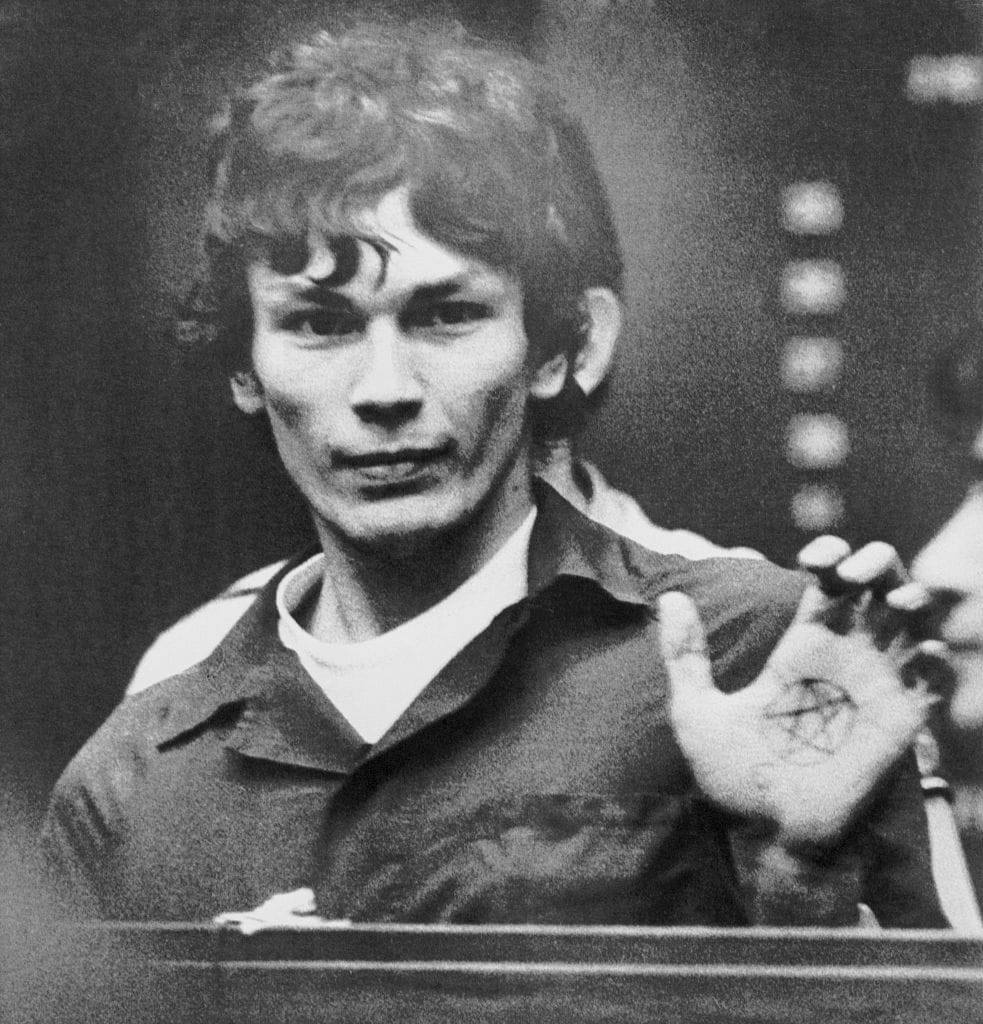
Once the fingerprint match identified Ramirez, authorities released his booking photograph to news organizations and the public. The image rapidly appeared in newspapers and television broadcasts throughout Southern California. The decision changed the dynamics of the search: residents now had a photograph rather than only general descriptions of an unidentified suspect.
On August 31, 1985, Ramirez was recognized in East Los Angeles after returning to the area. He attempted to flee, but local residents pursued and restrained him before police arrived and took him into custody. The arrest ended an urgent manhunt that had lasted for months.
The public’s role in the arrest received wide attention at the time. However, it is important not to portray physical confrontation with a suspected offender as a model for public safety. Such situations can be unpredictable and dangerous. Reporting information to police remains the safest and most responsible option for most witnesses.
The Trial and Convictions in the Night Stalker Case
Ramirez’s prosecution became one of California’s most closely watched criminal cases. Because the alleged offenses involved numerous victims, different crime scenes, multiple jurisdictions, and extensive forensic evidence, the legal process was lengthy. Pretrial proceedings took years before the case reached a jury in 1989.
On September 20, 1989, a jury convicted Ramirez on 43 counts, including 13 counts of murder, five attempted murders, 11 sexual assault offenses, and 14 burglaries. In November 1989, he was sentenced to death. He was held on California’s death row at San Quentin State Prison, although he was never executed.
Criminal convictions and sentencing can establish legal accountability, but they cannot reverse the losses experienced by victims and families. Courtroom totals may summarize charges, yet every count involved an individual person and a wider network of relatives, friends, colleagues, and community members affected by the crimes.
For survivors, the aftermath of serious violence can extend far beyond a trial verdict. Recovery may involve physical care, emotional support, financial challenges, changes in daily routines, and the gradual rebuilding of a sense of safety. Trauma affects people differently, and there is no single timetable for healing.
Richard Ramirez’s Death in Prison
Ramirez died on June 7, 2013, at age 53. He had been transferred from San Quentin to Marin General Hospital. The Marin County coroner identified complications from B-cell lymphoma as the cause of death, while also noting other significant medical conditions.
His death occurred nearly 28 years after his arrest. For people connected to the case, news coverage of his death revived memories of the fear and grief associated with the attacks. It also renewed public discussion of a case that remains a significant part of California criminal history.
Why a Childhood Photograph Does Not Explain Future Violence
Images of Ramirez as a child often attract attention because they contrast sharply with his later crimes. But an ordinary-looking childhood photograph cannot reveal a person’s future behavior, moral character, or capacity for wrongdoing. Facial appearance is not a credible indicator of future violence.
There is a broader lesson in that fact. Attempts to explain serious crimes through a person’s appearance, ethnicity, childhood image, or a single biographical detail are misleading. Responsible historical analysis can examine social circumstances, personal history, and the available evidence while maintaining a clear principle: Ramirez was accountable for actions he chose to commit as an adult.
Remembering the Victims and Survivors
Public interest in true-crime stories can sometimes center too heavily on the offender’s name, image, and reputation. A more respectful account begins with those harmed. The people targeted in the Night Stalker attacks were not plot points in a sensational story. They were members of families and communities whose lives had value beyond the crimes associated with their names.
Survivors also deserve recognition for their resilience. Their testimony and cooperation with investigators helped establish the factual record in court. Their experiences demonstrate why crime reporting should avoid unnecessary sensationalism and why support services for victims remain essential.
The case further illustrates the value of coordinated police work, forensic science, reliable witness reporting, and public communication. James Romero III did not solve the case alone, but his attention to detail became a meaningful part of the investigation. The orange Toyota, the partial plate number, the fingerprint comparison, the work of investigators, and the later public identification all contributed to Ramirez’s arrest.
The Lasting Lessons of the Richard Ramirez Investigation
The Richard Ramirez case remains widely discussed because it combined a large multi-jurisdiction investigation, public anxiety, forensic evidence, and a highly visible manhunt. Yet its enduring significance should not be reduced to the notoriety of one offender.
It is a case about victims whose lives were taken and survivors whose lives were changed. It is also about investigators who worked across communities to identify a suspect and assemble evidence for court. Finally, it is about the importance of paying attention to suspicious circumstances and reporting them responsibly.
James Romero III’s observation did not become meaningful because of luck alone. He noticed details, remembered them, and told authorities what he had seen. That responsible action helped move a difficult investigation forward. More than anything, the history of the case underscores the importance of accountability, evidence-based policing, support for survivors, and respectful remembrance of those harmed.
Sources
Disclaimer: This content is intended for entertainment purposes only and is not based on real events.