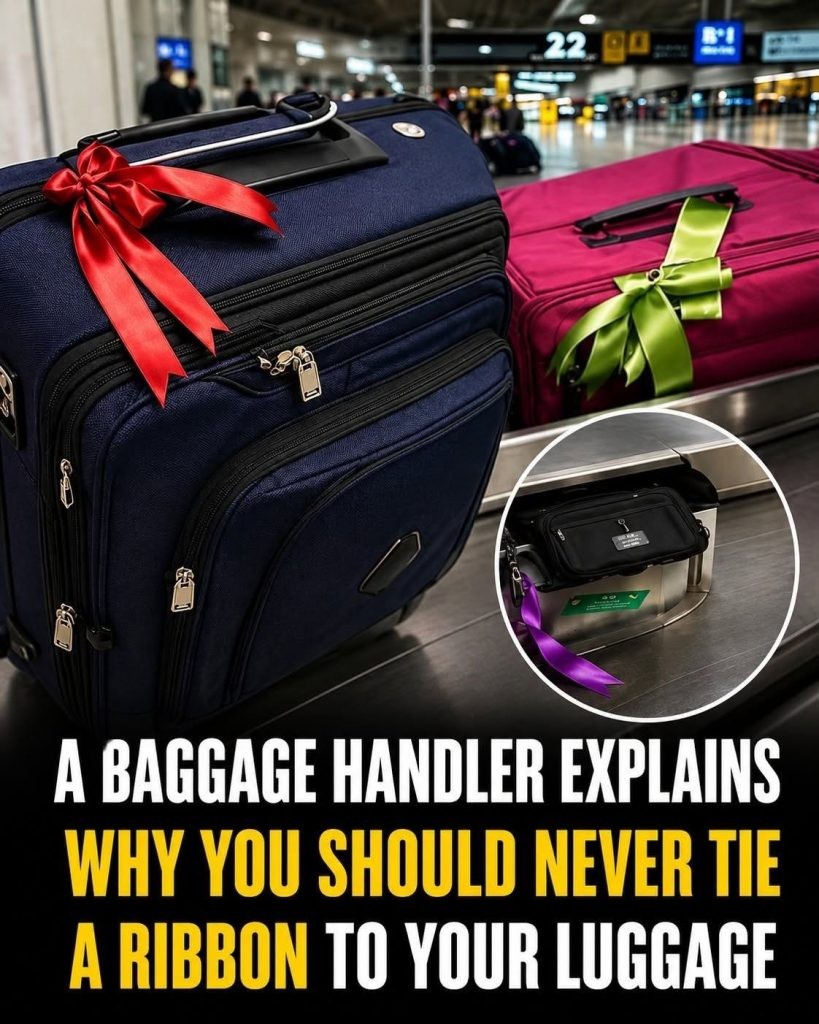

Why baggage handlers say you should never tie a ribbon to your suitcase
For many travelers, tying a brightly colored ribbon to a suitcase seems like a simple and practical way to recognize luggage at baggage claim. A ribbon can make an otherwise ordinary black, navy, or gray case easier to spot among dozens of similar bags. However, airport baggage-handling guidance and travel-industry advice often encourage passengers to avoid loose decorations, including ribbons, strings, or dangling accessories.
The concern is not that every ribbon will automatically cause a bag to be lost. Most checked bags travel without incident. Instead, the issue is that loose items can introduce avoidable complications in an airport system designed for speed, consistency, and machine-readable identification. Modern baggage networks rely on printed tags, barcode readers, conveyor belts, sorting equipment, and, at some airports, radio-frequency identification technology. Anything that obscures a tag or catches on equipment can make processing less efficient.
Travelers who want to make a suitcase recognizable have safer options. Choosing a distinctive case, using a secure luggage strap, applying a flat luggage label, or placing a personalized identifier inside the bag can help distinguish belongings without adding loose material that may interfere with handling.
How airport baggage systems identify checked luggage
When a passenger checks a bag, airline staff attach a baggage tag containing information that links the suitcase to the traveler’s itinerary. The tag generally includes a barcode and routing details, such as the destination airport, flight information, and a unique tracking number. This identification code is central to the baggage journey.
After check-in, luggage moves through a series of conveyor belts and screening areas before it is sorted for loading onto an aircraft. Automated systems scan the baggage tag and direct the suitcase toward the appropriate location. The exact process varies by airport, airline, terminal, and country, but the general principle is consistent: the tag, rather than a visual decoration, tells the system where a bag needs to go.
The International Air Transport Association has promoted baggage-tracking standards intended to improve visibility throughout the journey. Under IATA Resolution 753, airlines are expected to track baggage at key handover points, including acceptance, loading, transfer, and arrival. These measures are designed to reduce mishandling and give airlines better information when a bag is delayed.
Barcode scanning remains widely used, while RFID technology is increasingly deployed at some airports and by some airlines. RFID-enabled tags can be read without requiring the same line of sight as a conventional barcode. Even so, the baggage tag must remain attached, readable, and in good condition. A securely handled suitcase with a clear tag has the best chance of moving smoothly through the system.
Why loose ribbons can create avoidable problems
A ribbon tied to a handle may appear harmless, especially when it is short and tightly secured. Yet loose fabric can shift during handling. It may hang over the baggage tag, wrap around a handle, become caught beneath other bags, or move into an area where it makes the tag harder to see quickly. The likelihood of a problem depends on the ribbon’s size, material, placement, and how securely it is attached.
Automated baggage systems are built to process a large volume of luggage within limited time windows. At major airports, thousands of bags may move through belts and sorting equipment every hour. A bag that cannot be read properly or that requires additional attention may be diverted for manual processing. Manual handling does not mean that a bag will necessarily be lost, but it can add time to its journey.
This timing can matter most during a connection. Travelers with short layovers may already face limited time for checked luggage to be transferred between flights. If a tag is damaged, folded, hidden, or difficult for equipment to scan, the bag may require staff intervention. While airlines have procedures for these circumstances, reducing potential obstacles before check-in is a sensible precaution.
Loose accessories can also be a concern around moving airport equipment. Conveyor belts, rollers, chutes, and sorting systems are engineered to transport suitcases of many sizes, but dangling items may snag or become trapped. Airports have safety and maintenance procedures to deal with disruptions, yet preventing unnecessary obstructions helps keep the system operating efficiently for everyone.
It is important to be precise about the risk. There is no universal rule proving that a ribbon always causes a baggage failure, and individual airport policies may differ. However, the basic recommendation to avoid loose attachments is consistent with the broader travel principle of keeping the exterior of checked baggage simple, secure, and free from items that could detach or interfere with equipment.
Why visual markers do not help baggage-routing technology
Ribbons are intended for people, not airport systems. A passenger may quickly recognize a red, yellow, or patterned ribbon on the carousel, but the airline’s baggage-routing process does not use color or decorative features to determine a bag’s destination. It relies on the information encoded on the official baggage tag.
That distinction matters. A visually distinctive suitcase can be helpful after the bag reaches the correct carousel, but it does not replace the need for a clear, intact tag. The same applies to stickers, scarves, key rings, and other accessories. They may help a traveler identify a bag, but they do not improve airline tracking.
In fact, a suitcase with too many external decorations may create a different issue at baggage claim: it can be harder for another traveler to recognize that they have picked up the wrong bag. Similar luggage remains common, especially among popular hard-shell suitcase designs. The best solution is to use identifiers that are both visible to the owner and securely fixed to the case.
Safer ways to make your suitcase easy to recognize
Travelers do not need to rely on ribbons to avoid confusion at baggage claim. There are several practical alternatives that are less likely to dangle, obstruct a tag, or come loose during transit.
Choose a distinctive suitcase
Buying luggage in a recognizable color or pattern can be one of the simplest long-term choices. A suitcase with a unique finish, colored shell, or clear design is easy to identify without attaching anything extra. If purchasing new luggage is not practical, a durable, fitted suitcase cover may offer a similar visual benefit. Travelers should ensure that any cover leaves the airline baggage tag visible and does not interfere with handles, wheels, zippers, or security screening.
Use a properly fitted luggage strap
A strong luggage strap can add a visible feature while providing an extra layer of closure support. Unlike a loose ribbon, a strap is designed to sit firmly around the suitcase. It should be tightly fitted, in good condition, and positioned so that it does not cover the airline tag or the bag’s main handle. Travelers should avoid straps with long, unsecured ends.
Add a flat, durable identifier
A sturdy luggage tag with contact details can help airlines identify the owner if an exterior tag is damaged or removed. Many privacy-conscious travelers choose to list only a name, email address, and phone number rather than a full home address. A tag that lies flat and is attached securely is generally preferable to a long dangling accessory.
It is also wise to place contact details inside the suitcase. Airlines and airports may be able to inspect the interior when attempting to reunite delayed or unidentified luggage with its owner. An itinerary or a card containing current contact information can be useful, particularly on international trips.
Use digital tracking thoughtfully
Some travelers place a Bluetooth-based location tracker inside checked luggage. These devices can provide useful information to the owner through a smartphone app, although they do not replace the airline’s official baggage-tracking process. Travelers should check their airline’s current policy and ensure that any device complies with applicable battery and aviation safety requirements.
Digital trackers can offer reassurance when a bag is delayed, but they should be viewed as an additional personal tool rather than proof of a bag’s exact operational status. Airline agents rely on their own scanning and tracing systems to locate checked baggage and arrange delivery or collection when necessary.
Other baggage tips that can reduce travel stress
Keeping luggage simple is only one part of preparing for a smoother airport experience. Passengers can also take a few practical steps before checking a suitcase.
- Remove old airline baggage tags and destination stickers before each trip.
- Check that the newly issued baggage tag is attached securely and shows the correct destination.
- Take a photo of the suitcase and the baggage-tag receipt before heading to security.
- Keep medication, travel documents, valuables, and essential items in carry-on baggage whenever possible.
- Use secure zippers and avoid packing loose straps or items that could protrude from the case.
- Arrive early enough to meet the airline’s checked-baggage deadline, particularly for international flights or busy travel periods.
Removing outdated tags is especially helpful. Old labels can create confusion for people handling bags and may complicate the visual review of luggage, even when modern systems are designed to prioritize the current tag. A clean exterior allows the active airline label to remain easy to find and inspect.
What to do if a checked bag is delayed
Even with careful preparation, baggage delays can occur because of tight connections, weather disruptions, aircraft changes, operational constraints, or handling issues. If a bag does not arrive, travelers should report the problem to the airline’s baggage service desk before leaving the airport whenever possible.
Passengers should retain their baggage-tag receipt, boarding pass, and any documentation provided by the airline. They can provide a detailed description of the suitcase, including color, size, brand, and distinguishing features. A photograph taken before the trip may be particularly useful.
Airlines generally use tracing systems to search for delayed bags and coordinate delivery once they are located. Consumer rights and reimbursement rules vary by jurisdiction, airline, and itinerary. For international travel, the Montreal Convention may apply in many circumstances, while domestic travel may be covered by separate national regulations. Travelers should consult the airline and the relevant consumer-protection authority for current information.
The practical takeaway for travelers
A ribbon on a suitcase is usually intended as a helpful personal marker, not as a source of trouble. Nevertheless, loose fabric and hanging accessories can create an unnecessary risk in a highly automated baggage environment. They may shift over an airline tag, detach, or catch on equipment, potentially leading to extra handling time.
The most reliable approach is to keep the outside of checked luggage neat and secure. Let the official baggage tag remain visible, remove old labels, and select identification methods that are tightly fitted or built into the suitcase. A distinctive case, secure strap, durable flat tag, and internal contact card can make luggage easier to recognize while respecting the way airport handling systems work.
Ultimately, baggage technology depends on accurate information and readable identification, not decorative markers. Travelers can reduce avoidable complications by choosing practical luggage identifiers that support, rather than potentially obstruct, a bag’s journey from check-in to baggage claim.
Sources
- International Air Transport Association: Baggage
- International Air Transport Association: Resolution 753 baggage tracking
- U.S. Department of Transportation: Lost, delayed, or damaged baggage
- Federal Aviation Administration: PackSafe for airline passengers
- International Civil Aviation Organization: Baggage tracking information
Disclaimer: This content is intended for entertainment purposes only and is not based on real events.
