
What Does One Upside-Down Baluster Mean? The Story Behind an Old House Mystery
Walk into an older house and you may notice something that seems slightly out of place.
The staircase looks carefully crafted. The wooden railing follows a neat pattern. Every spindle appears to line up perfectly.
Except for one.
One baluster seems to be upside down.
At first, it is easy to assume that a carpenter simply made a mistake. Perhaps one piece was installed incorrectly, or a later repair changed the original arrangement.
But architectural folklore offers a much more interesting explanation.
According to a popular tradition, some craftsmen deliberately placed one upside-down baluster in an otherwise carefully constructed staircase. The unusual detail was sometimes said to represent human imperfection, while another piece of folklore claimed that the reversed piece could confuse an unwanted supernatural visitor.
There is no strong evidence that every upside-down baluster was created for such a purpose. In many cases, the explanation may simply be a construction error, a later alteration or a misunderstanding.
Yet the tradition remains fascinating because it reveals how people have used architecture to express beliefs, values and stories.
So what exactly is a baluster, and why has one unusual piece of wood become the subject of so much folklore?

What Is a Baluster?
Before exploring the mystery, it helps to understand the architectural term.
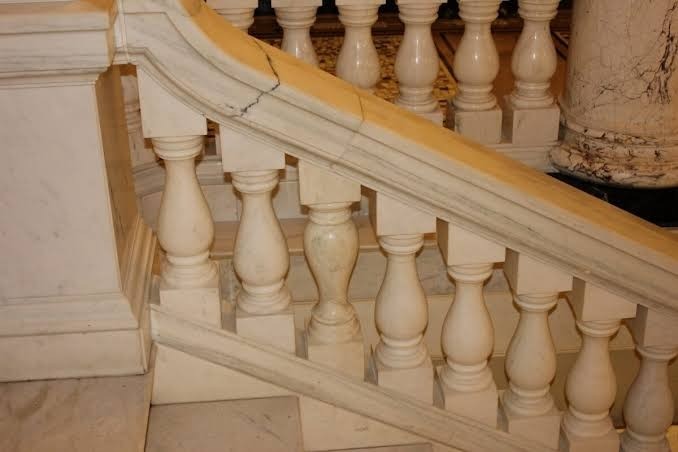
A baluster is one of the individual vertical supports found beneath a handrail or railing.
You might see them along staircases, balconies, terraces or other architectural features.
A group of balusters supporting a railing is commonly called a balustrade.
Balusters can be extremely simple or highly decorative.
Traditional wooden staircases may feature turned balusters with rounded sections, while other designs use square, rectangular or intricately carved forms.
Because they are normally arranged in a repeating pattern, even a small difference can immediately attract attention.
That is why an upside-down baluster can be so noticeable.
Once someone points it out, the eye tends to go directly toward it.
Why Would One Baluster Be Upside Down?
There are several possible explanations.
The simplest is also the least mysterious.
It may have been installed incorrectly.
Woodworking projects involve numerous individual components, and mistakes can happen. Older houses can also undergo renovations, repairs and modifications over many years.
A staircase that looks original may actually contain pieces from different periods.
A replacement baluster may have been installed in a slightly different orientation.
Someone working on the staircase may have removed a piece and put it back incorrectly.
Or the original craftsman may simply have made an error.
These practical explanations should always be considered before assuming that an unusual architectural detail has a hidden meaning.
But folklore gives us another possibility.
The Tradition of Deliberate Imperfection
One of the most appealing explanations connects the upside-down baluster with a simple philosophical idea: humans are imperfect.
According to the tradition, a craftsman might intentionally include one small flaw in an otherwise beautiful piece of work as a reminder that only divine creation could be considered perfect.
The idea is sometimes described as an architectural expression of humility.
A staircase could be carefully measured and constructed.
Its wood could be shaped and polished.
Its decorative elements could be aligned with great care.
Yet one small detail would remain different.
The purpose would not necessarily be to make the staircase unattractive.
Instead, the imperfection itself would carry meaning.
It would quietly remind people that craftsmanship, no matter how impressive, is still a human achievement.
The “Only God Is Perfect” Tradition
The concept of deliberate imperfection appears in various forms within cultural and religious traditions.
People have long used handmade objects to express humility.
A deliberately imperfect detail can communicate the idea that human beings should not attempt to imitate absolute perfection.
The upside-down baluster fits neatly into that type of story.
However, there is an important distinction between a tradition and documented historical evidence.
Finding an unusual baluster in an old house does not prove that a craftsman intentionally installed it as a religious reminder.
Without records from the builder or period documentation, the original reason may simply be impossible to determine.
That uncertainty is part of what makes old architecture so interesting.
A small physical detail can survive long after the person who created it is gone.
The story explaining that detail may then evolve over generations.
The Folklore About the Devil
Another version of the tradition has a more supernatural explanation.
According to folklore, a single upside-down baluster could somehow confuse or discourage the devil from navigating the staircase.
The exact explanation varies.
In some versions, the unusual piece supposedly disrupted the otherwise orderly pattern.
In others, it was described as a symbolic form of protection.
These stories are best understood as folklore rather than established architectural history.
There is no reliable evidence that reversing one piece of a staircase creates a supernatural barrier.
Still, the idea reflects something interesting about traditional culture.
Before modern science and building documentation became widespread, people often created stories to explain unusual features in their surroundings.
A strange mark on a wall, an unusual stone or an unexpected architectural detail could acquire a story that made it memorable.

Why Old Houses Inspire So Many Stories
Old buildings naturally encourage curiosity.
They contain layers of history.
A house may have belonged to several generations of the same family. Its staircase may have been repaired several times. Rooms may have been added or remodeled.
The original builder may have left behind no plans.
As decades pass, the people who knew the history of the building disappear.
What remains are physical clues.
A slightly different piece of wood.
An unusual doorway.
A carved symbol.
A staircase that does not quite match the rest of the house.
These details can become the foundation for local stories.
Sometimes the story is historically accurate.
Sometimes it is partly accurate.
And sometimes it is simply a memorable explanation that became part of the building’s identity.
Could It Simply Be a Carpenter’s Mistake?
Absolutely.
This is probably the most important practical explanation to remember.
Woodworkers are highly skilled, but skilled professionals can still make mistakes.
Staircases contain many individual components, and balusters can sometimes look similar from different orientations.
An installation error may not be noticed immediately.
If the staircase is eventually painted or finished, the mistake may become even harder to recognize.
Years later, a homeowner may notice the reversed piece and wonder whether it was intentional.
Without historical evidence, there is no reliable way to know.
This is why architectural historians generally need more than a visual oddity to establish the original purpose of a building feature.
Construction documents, photographs, restoration records, period descriptions and evidence from similar buildings can all provide useful clues.
Why Imperfections Stand Out So Strongly
There is also a psychological reason why one unusual baluster can capture our attention.
Humans are highly sensitive to patterns.
When we see a row of objects arranged in the same way, our brains quickly identify the repeating structure.
If one object differs, it becomes visually prominent.
This principle appears throughout everyday life.
A single different tile on a floor can catch the eye.
One oddly positioned picture frame can make a wall look uneven.
A different-colored chair can immediately attract attention in a row of identical seats.
The same thing happens with a staircase.
If nine balusters appear identical and one is reversed, the unusual object becomes a visual interruption.
That does not necessarily mean it has symbolic meaning.
It simply means our brains are designed to notice deviations from patterns.
The Science of Pattern Recognition
Pattern recognition is an important part of human perception.
It allows people to identify familiar objects quickly and detect changes in their environment.
This ability is useful for countless everyday tasks.
It helps us recognize faces, read words, navigate spaces and identify potential hazards.
But pattern recognition can also encourage people to search for meaning where none was intended.
Once someone notices an unusual baluster, it is natural to ask why it is different.
If a traditional explanation is available, the explanation can become attached to the object.
Over time, the story may feel like an established fact simply because generations of people have repeated it.
This is one reason folklore can be so persistent.
A compelling story can survive even when its original evidence has disappeared.
Could the Baluster Have Been Symbolic?
It is possible that individual craftsmen sometimes used small imperfections symbolically.
Human-made objects have frequently carried personal marks, signatures and subtle design choices.
A craftsman might incorporate an unusual detail simply because they liked it.
Another might use a particular carving associated with local traditions.
Someone else might intentionally leave a small imperfection for philosophical or religious reasons.
But it would be risky to assume that every unusual baluster has a hidden message.
Architecture is rarely that simple.
Different regions developed different woodworking traditions.
Different builders had different techniques.
And individual houses were modified over time.
The safest approach is to treat the folklore as an interesting possibility rather than a universal rule.
Why the Story Continues to Fascinate People
The upside-down baluster is a perfect example of a tiny mystery.
It is small enough to overlook but unusual enough to inspire questions.
Why is it different?
Was it intentional?
Did someone make a mistake?
Was it part of a tradition?
Could the original carpenter have left it as a personal message?
Those questions are more interesting because there may be no simple answer.
The physical object exists.
The original explanation may not.
That gap between evidence and interpretation creates room for stories.
And people have always been fascinated by unexplained details in old places.
Architecture Is More Than Construction
Buildings are often treated as functional objects.
A staircase helps people move between floors.
A railing provides support.
A baluster contributes to the structure and appearance of the railing.
But architecture can also reflect the values of the people who created and used it.
Materials, craftsmanship, decoration and design choices can reveal something about a particular period.
Even an ordinary staircase can therefore become a small historical document.
Whether an upside-down baluster was deliberate or accidental, it can still tell us something about how people interact with old buildings.
It encourages observation.
It makes visitors look more closely.
And sometimes, that curiosity leads to questions about craftsmanship, history and local traditions.
How to Investigate an Unusual Baluster
If you discover one in an old house, there are several practical ways to investigate it.
Start by looking at the rest of the staircase.
Are the other balusters identical?
Does the unusual piece have different wear patterns?
Does its wood appear to come from the same period?
Was the staircase likely renovated?
Old photographs can be particularly useful.
If an image from decades earlier shows the same baluster in the same orientation, that provides evidence that the feature has been there for a long time.
Renovation records may also help.
If the staircase was restored, the unusual piece could have been replaced or repositioned.
Local historical societies can sometimes provide additional information, particularly for older homes with documented histories.
These forms of evidence are much more reliable than folklore alone.
Final Thoughts: The Mystery Hidden in a Small Piece of Wood
An upside-down baluster may be nothing more than a carpenter’s mistake.
It may be the result of a renovation.
It may be an intentional decorative choice.
Or, according to an old tradition, it may have been deliberately placed as a reminder of human imperfection.
The more supernatural stories about the feature belong to the world of folklore rather than established architectural fact.
But perhaps that is what makes the mystery enjoyable.
The little piece of wood does not need to have a supernatural purpose to be interesting.
It reminds us that old houses contain countless details whose stories have been forgotten.
A staircase is not simply a way to move from one floor to another.
It may also be a record of craftsmanship, renovation, family history and changing traditions.
And that single unusual baluster invites us to slow down and look more carefully.
Maybe it was intentional.
Maybe it was an accident.
Maybe the truth is permanently lost.
But the fact that one small imperfection can inspire so much curiosity says something important about us.
Humans naturally want to know why things are the way they are.
We notice patterns.
We notice what does not fit.
And when we find something unusual, we create questions around it.
Sometimes those questions lead to documented history.
Sometimes they lead to folklore.
And sometimes, the mystery itself becomes the most interesting part of the story.
Sources and Further Reading
The supplied source for the architectural folklore discussed in this article: Cooking Secrets / Ouskino
Encyclopaedia Britannica, architectural terminology and historical context: Britannica
National Park Service, resources on historic buildings, preservation and architectural history: National Park Service
Library of Congress, historical architecture and cultural collections: Library of Congress
