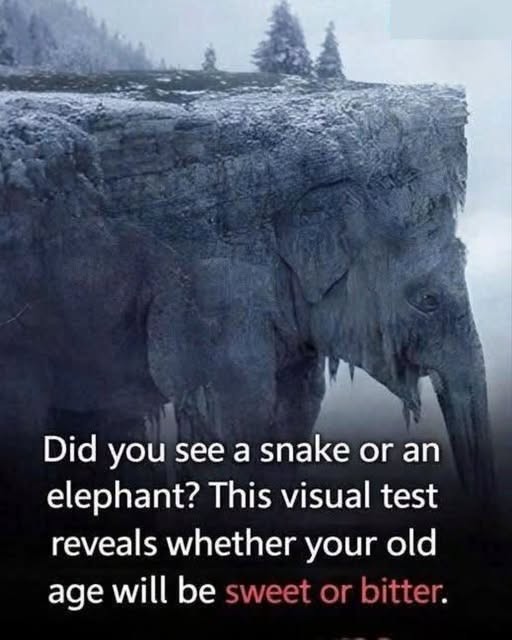

Snake or Elephant? Understanding Optical Illusions and Visual Perception
Millions of people encounter optical illusions while scrolling through social media, often pausing over a single image that seems to contain more than one possible subject. One viewer may immediately see a snake moving across ice or rock, while another may interpret the same shapes as part of a large elephant. These images can inspire lively conversations because they reveal a basic fact about human vision: seeing is not a simple process of recording the world exactly as it is.
The brain continuously interprets incomplete visual information. It uses contrast, shadows, edges, color, previous experience, attention, and context to decide what an image is likely to represent. When a picture is deliberately ambiguous, different viewers may settle on different interpretations. That does not mean one person is more intelligent, more observant, or has a particular personality trait. It means the visual system is doing what it normally does—making a fast and useful best guess.
Understanding why a “snake or elephant” image can divide viewers offers a useful introduction to visual perception, optical illusions, and the difference between entertaining online claims and established psychological research.
Why Ambiguous Images Capture Attention
Images with two possible interpretations are often called ambiguous figures. They are designed, photographed, or edited in ways that allow the brain to organize the same visual details into more than one meaningful object. A curve can resemble a trunk, a tail, or the outline of a snake. A dark patch may appear to be a shadow, an eye, or a gap between rocks. Once the brain chooses an interpretation, it can become difficult to see the alternative immediately.
This effect is particularly compelling because human vision is strongly oriented toward recognizing familiar patterns. People are highly skilled at quickly detecting animals, faces, objects, and movement in complicated scenes. That ability has practical value in everyday life: it helps people navigate environments, identify hazards, recognize others, and make decisions efficiently. However, rapid pattern recognition can also create uncertainty when a scene contains limited detail or misleading visual cues.
Online optical illusions are especially shareable because they invite participation. A short question such as “What did you see first?” gives viewers an immediate reason to comment, compare answers, and revisit the image. The social appeal is real, but the scientific explanation is usually more nuanced than viral captions suggest.
How the Brain Builds a Visual Scene
Vision begins when light enters the eye and reaches the retina, a layer of tissue at the back of the eye containing cells that respond to light. Information from the retina travels through the optic nerve and is processed by several regions of the brain. But the brain does not receive a fully labeled picture saying “this is a snake” or “this is an elephant.” It receives patterns of light, color, contrast, orientation, and movement that must be interpreted.
Scientists often describe perception as a combination of information coming from the senses and expectations based on past knowledge. In visual perception, this means the brain combines what is physically present in the image with what it has learned from previous encounters. If a viewer has recently seen pictures of elephants, for example, certain broad gray shapes may be more readily interpreted as an elephant. If the image contains a narrow, curved line, another viewer may focus first on features commonly associated with a snake.
Attention also matters. People do not process every part of an image equally at the same moment. One person may first notice a dark contour near the center, while another notices the larger outline around it. Small differences in where viewers look, how long they look, and what they expect to find can influence the first interpretation.
Figure-Ground Perception and Visual Organization
A major principle behind many optical illusions is figure-ground perception. The visual system must determine which parts of a scene belong to the main object, or “figure,” and which parts form the background. In a clear photograph, that decision is usually easy. In an ambiguous image, the border between object and background may be unclear, allowing the brain to switch between possible interpretations.
Psychologists have also studied how people naturally group visual details. The Gestalt principles of perception describe several common tendencies, including grouping nearby elements together, following continuous lines, and preferring complete forms rather than disconnected fragments. These tendencies are useful because real-world scenes are often cluttered or partially obscured. Yet they can make an image look different depending on which shapes a viewer groups together.
For example, the brain may connect a series of curved shadows into the body of an animal, even if those shadows come from unrelated features in a landscape. It may also mentally complete an outline that is not fully visible. This process is not a mistake in the ordinary sense. It is an efficient feature of perception, helping people recognize objects when they are partly hidden, distant, or viewed in poor lighting.
Why Seeing One Object First Does Not Define Personality
Social media posts frequently claim that the first object someone sees reveals hidden traits, such as intelligence, confidence, emotional state, creativity, or relationship preferences. These statements can be entertaining, but they should not be treated as psychological assessments. There is no reliable scientific basis for determining a person’s character or mental health from whether they first see a snake, an elephant, a face, or another image in a visual puzzle.
Personality assessment is a specialized area of psychology that requires carefully designed and validated tools, consistent methods, and evidence from research. A single ambiguous image cannot account for the many factors that shape a person’s behavior, including culture, life experience, mood, attention, education, and context. Even the same individual may see different things first when looking at an image again on another day.
It is also important to avoid framing optical illusions as medical or diagnostic tests. If an image appears blurry or difficult to interpret, that alone does not establish a vision problem or a neurological condition. Anyone with ongoing concerns about eyesight, headaches, sudden visual changes, or other symptoms should seek guidance from a qualified healthcare professional rather than relying on online visual challenges.
Context Can Change What People See
The words surrounding an image can significantly influence perception. If a post asks, “Can you find the snake?” viewers may begin scanning for a long, narrow shape. If the same image is introduced as a hidden elephant, they may focus on larger forms, a possible trunk, ears, or body contours. This is an example of top-down processing, where expectations and knowledge guide the interpretation of sensory information.
Context is not limited to captions. Screen size, brightness, viewing angle, image compression, and surrounding colors can all affect what details stand out. A phone display viewed outdoors may make subtle shadows harder to distinguish. A larger screen may reveal textures or contours that are less obvious on a small device. These ordinary differences can explain why people sincerely disagree about an illusion.
Cultural familiarity can matter as well. People tend to recognize objects more quickly when they have seen them often in daily life, media, books, or travel. This does not mean that perception is entirely subjective; the physical image remains the same. Instead, it means people bring different learned associations to the process of interpreting uncertain visual information.
Classic Optical Illusions and What They Teach
The fascination with double images did not begin with social media. For generations, researchers, artists, and educators have used optical illusions to explore how perception works. One famous example is the Rubin vase, an image that can appear either as a vase in the center or as two faces looking at each other. Another is the Necker cube, a line drawing that seems to flip between two possible three-dimensional orientations.
These images demonstrate that perception is active. The brain is not merely receiving information; it is selecting, organizing, and interpreting it. In many cases, viewers can intentionally shift their perception after being told what else to look for. Once someone sees an alternative image, it may become easier to switch back and forth between the two possibilities.
Other illusions explore motion, color, size, depth, and brightness. Some can make stationary patterns appear to move because of eye movements and contrast effects. Others show that a color can look different depending on nearby colors or lighting conditions. Together, these examples help scientists study the rules and shortcuts the visual system uses to produce a stable understanding of the world.
The Role of Attention, Experience, and Individual Differences
People often ask why friends looking at the same image can have completely different first impressions. The answer usually involves attention and experience rather than a fixed difference in ability. Someone who notices outlines may identify a large animal shape first. Someone who focuses on texture might notice a narrow, winding form. A person familiar with wildlife photography may use different visual cues from someone who regularly looks at abstract art or puzzle games.
There can also be normal differences in visual acuity, color perception, and sensitivity to contrast. These factors may influence how easily a person notices subtle details, especially on screens. Lighting and tiredness can affect visual comfort too. However, an isolated result from an optical illusion should not be used to draw broad conclusions about an individual’s health or cognitive skills.
The best way to approach these images is with curiosity. Instead of asking which answer proves something about a person, viewers can ask what features led them to their interpretation. Did they notice a contour first? Did the caption influence their expectation? Can they now identify the alternative image? These questions encourage media literacy and a more accurate understanding of perception.
How to View Online Optical Illusions Responsibly
Optical illusions can be enjoyable educational tools when shared with clear expectations. A responsible post should identify whether an image has been digitally altered, explain that multiple interpretations may be possible, and avoid unsupported claims about personality, intelligence, or health. Creators should also remember that highly compressed or low-resolution images may not produce the same effect for every viewer.
For viewers, it can be helpful to pause before accepting dramatic captions. Claims that an illusion can reveal trauma, diagnose a disorder, measure IQ, or expose a secret personality type should be treated skeptically unless they are supported by credible research and qualified experts. Reliable health information should come from recognized public health agencies, medical institutions, or licensed professionals.
Parents and educators can use visual puzzles to discuss how the brain processes information. A classroom activity might ask students to describe what they saw first, compare their observations, and identify the visual clues behind each interpretation. This approach supports scientific thinking without turning a playful image into an unfounded test.
What a Snake or Elephant Illusion Really Reveals
An ambiguous “snake or elephant” image does not reveal a hidden truth about someone’s identity. What it can reveal is something broadly human: the visual system works quickly, creatively, and efficiently under uncertainty. The brain uses patterns, memory, expectation, and attention to transform light and shadow into meaningful objects.
That is why two people can look at the same frozen image and confidently report different things. Their disagreement is not necessarily a failure of vision. It is evidence that perception is an active interpretation of the world rather than a perfect copy of it.
When approached thoughtfully, optical illusions offer more than a brief online distraction. They provide a window into visual science, encourage careful observation, and remind us that first impressions—whether of an image or a situation—can change when new information comes into view.
Sources
Disclaimer: This content is intended for entertainment purposes only and is not based on real events.
