
The Ancient Origins of Blue Eyes: From Legend to Science
On a warm evening thousands of years ago, a small tribe gathered near the edge of a wild river, marveling at the appearance of a child whose eyes shone with a color the group had never seen before. While most members had deep brown eyes, this child’s gaze reflected the sky—a vivid blue. In the centuries that followed, those luminous eyes would spark stories, inspire myths, and ignite curiosity. Today, blue eyes have become a symbol of both mystery and scientific revelation, connecting millions of people to a single event deep within human history. This article explores the journey of blue eyes: their genetic origins, cultural significance, and what they reveal about our past.
The Hidden Mystery: Blue Eyes and Their Rarity
Blue eyes are often described through their appearance, rarity, and sensitivity to bright light. Historically, their rarity has made them the subject of fascination, speculation, and sometimes awe. Many cultures have crafted stories around blue-eyed individuals, noting their difference and giving meaning to their gaze. Legends portrayed blue eyes as a sign of wisdom or otherworldly connection, while others believed the eye color brought luck or mystical protection. But beneath these stories lies a scientific reality, revealing that their most remarkable feature may be the genetic history shared by those who possess them.

The Scientific Discovery: One Ancestor, One Mutation
Modern genetics has traced blue eyes to a single event—a mutation connected to the HERC2 gene that altered the body’s ability to produce brown pigment in the iris. Research suggests that every blue-eyed person shares a common ancestor who lived between 6,000 and 10,000 years ago. Before this mutation, humans are believed to have all had brown eyes, the result of high melanin content. The change did not create blue pigment, but rather reduced melanin, producing the appearance we now recognize as blue.
How Genetics Creates the Illusion of Blue
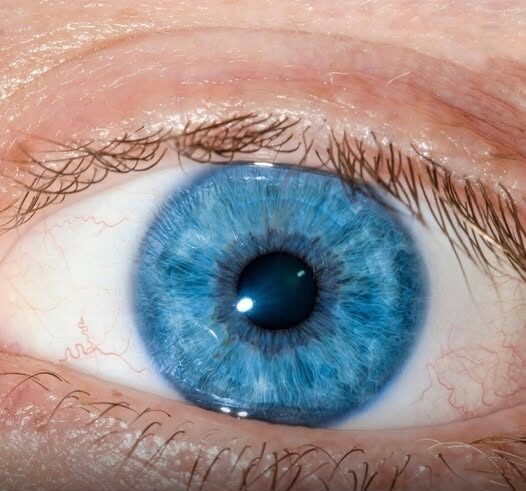
The color of blue eyes can create the impression that the iris contains a blue substance. In reality, the visible shade is an optical illusion. Because blue eyes have a relatively small amount of melanin, light interacts with the eye differently. This scattering of light within the iris produces the blue appearance—a phenomenon known as Rayleigh scattering, similar to how the sky looks blue. The precise shade can appear to change depending on lighting, surroundings, and other visual conditions. A person’s eyes may look bright blue in daylight and appear gray or darker indoors, but the pigment amount remains generally consistent.

The Power of a Single Mutation: HERC2 and Melanin Production
The shared history of blue eyes begins with a genetic mutation involving HERC2. This change affected the process responsible for producing brown pigment. It did not eliminate melanin everywhere in the body—just the iris. The mutation was passed from the original carrier to descendants, and as generations continued, the trait spread across populations worldwide. Today, people with blue eyes may live in different regions and speak distinct languages. At a distant genetic level, however, the shared mutation connects them to the same ancient origin.
The Timeline: From Ancient Origins to Modern Populations
The mutation is believed to have first appeared between 6,000 and 10,000 years ago, deep within human history, long before written records. The first person carrying the mutation could not have imagined their genetic change would continue through thousands of years and countless generations. As descendants formed families and communities, the characteristic passed onward, eventually reaching millions of people today. Every blue-eyed person carries the visible result of an event that occurred in one distant ancestor—a powerful reminder of human connection across time.
Cultural Legends and the Meaning of Blue Eyes
Throughout history, blue eyes have inspired myth and speculation. Ancient civilizations sometimes associated blue eyes with supernatural power, wisdom, or rarity. In some Nordic and European traditions, blue eyes symbolized honesty, clarity, or beauty. Artists and writers have referenced them as the “windows to the soul” or a sign of divine favor. These stories illustrate how visible traits can become embedded in cultural memory and folklore, shaping how societies interpret their meaning. Despite their mythical context, the true cause is a simple scientific event—a single genetic variation.

How Scientific Research Unfolded
The scientific story behind blue eyes unfolded with advances in genetic research. Techniques such as genome mapping and population studies allowed researchers to trace the mutation back to the HERC2 gene. By examining DNA across large groups, scientists discovered that blue-eyed individuals share a unique genetic marker, pointing to a single ancient origin. While the mutation itself was not dramatic, its effect on melanin production made the appearance of blue eyes possible. This discovery has not only answered longstanding questions but also highlighted how easily one mutation can spread across millions of people.
The Journey of a Genetic Trait
Genes pass biological information from parents to children. A genetic variation can therefore move through hundreds of family lines and remain hidden for generations. The original blue-eye mutation began in one individual, whose descendants inherited and passed it onward. Migration, intermarriage, and the formation of new communities carried the trait into different regions. Even when people were unaware of the biological process, the genetic information continued to move. Modern research has made it possible to trace this shared pattern, linking blue-eyed people worldwide.
Eye Color Complexity and Diversity
Eye color is commonly categorized as brown, blue, or green, but the underlying biology is more complex. The visible result depends on pigmentation and how light interacts with the iris. Blue eyes look blue because of reduced brown pigment, not the presence of blue pigment itself. Some blue eyes appear pale and bright; others seem deeper or gray-blue. Lighting and surroundings also affect how the eyes are perceived, further adding to their visual diversity. Despite these differences, all blue-eyed people share the same genetic origin.
Sensitivity to Light and Everyday Effects
People with blue eyes typically have lower melanin in their irises, which can lead to increased sensitivity in bright environments. Melanin helps manage how light enters the eye, and with less pigment, intense light may feel more uncomfortable. The degree of sensitivity differs among individuals, and not every blue-eyed person experiences this effect in the same way. Nevertheless, the low melanin that creates the blue appearance can also influence how the eye responds to brightness.
A Legacy of Visual Variation
Although blue eyes share a common genetic origin, they are not identical in appearance. The visible blue can be bright or subdued, sometimes mixed with hints of gray or green. Lighting and surrounding colors play a major role in these differences. The original mutation changed pigment production, but environmental factors and individual genetics contribute to the diversity seen today. This makes blue eyes genetically connected yet visually unique—a testament to human variation.
What Blue Eyes Reveal About Human Heritage
Blue eyes are a visible reminder of the unexpected ways human history is carried forward. Most genetic mutations are not visible, but blue eyes connect people across geography, culture, and time. The trait survived changes in population, migrations, and cultural shifts. People have formed families and passed the trait onward, often unaware of its ancient origin. Today, millions of people share a biological link to one individual, reflecting the intricate journey of human genetics.
Shared Ancestry, Distant Connection
The idea that all blue-eyed people share one ancestor can sound like a recent familial connection. In reality, thousands of years and countless generations separate them. Blue-eyed individuals may have entirely different backgrounds, but their eye color links them to the same original genetic development. It’s a shared genetic starting point, rather than evidence of modern closeness, that makes the discovery remarkable. A visible trait found among people around the world still leads back to one ancient change.
Science, Speculation, and Human Curiosity
Science continues to explore how mutations arise and spread through populations. While there is strong evidence linking blue eyes to the HERC2 gene mutation, the full story of its spread remains a subject of speculation. Did the original carrier belong to a small community? Did migration patterns or societal preferences influence its adoption? These questions remain open, reflecting the ongoing nature of scientific investigation. The fact that one small change can transform appearance across millions points to the power of genetic variation and human adaptability.
A Reflection on the Power of Human Curiosity
The study of blue eyes combines elements of myth, cultural storytelling, and rigorous science. Legends emphasize the meanings people have assigned to them, while genetics reveals their true origin. This discovery reminds us how much can be revealed through curiosity and investigation. It is proof that even the features we consider ordinary—like eye color—carry histories stretching back to ancient times. As we continue to explore genetics and the narratives we build around physical traits, we uncover new ways to understand ourselves and each other. The remarkable journey of blue eyes illustrates the endless drive to explore, connect, and reflect on the mysteries of humanity.
Disclaimer: This content is intended for entertainment purposes only and is not based on real events.
