

The Secret Language of the Feline Headbutt: What Your Cat Is Really Saying
Many cat owners know the exact moment the atmosphere in a room changes. You might be reading a book, staring at a screen, or simply resting after a long day when a quiet presence approaches. Out of nowhere, your cat steps into your peripheral vision, walks right up to you, and presses its forehead firmly against your cheek, chin, or hand. Some felines execute this maneuver with the soft grace of a passing breeze, barely grazing your skin. Others commit entirely, launching themselves with the surprising force of a tiny, furry ram, demanding your immediate attention. At first glance, this eccentric behavior might seem entirely random, a playful quirk born from an unpredictable animal. Yet, this sudden, physical gesture is far more meaningful than most people realize. That small, deliberate headbutt is not merely a demand for affection or an invitation to play. It is a vital syllable in a deep, instinctive language that cats use to communicate with the beings they trust most in the world.
To truly understand this behavior, one must look backward through the centuries and view the cat not just as a pet, but as an ancient observer of human life. Throughout history, cats have occupied a unique space in our collective imagination, walking the fine line between the wild forest and the domestic hearth. In ancient Egyptian folklore, felines were revered as guardians of the underworld and protectors of the home, creatures capable of seeing spirits and warding off unseen dangers. European sailors believed that a ship’s cat possessed a mystical connection to the weather, able to predict storms with a flick of its tail. Across these diverse cultures, the cat has always been viewed as an enigmatic animal, one that keeps its secrets close and its loyalties closely guarded. When viewed through this historical lens, the sudden act of a cat approaching a human and pressing its head against them takes on a profound, almost ritualistic significance. It is a rare moment where this traditionally aloof creature crosses the boundary of its own independence to initiate a direct, physical bond.
In the intricate and deeply complex feline world, sight and sound are important, but scent is absolute. While humans navigate their daily lives primarily through a visual landscape, cats experience reality through an invisible, ever-shifting symphony of smells. Felines are equipped with highly specialized scent glands located strategically across their bodies, with a high concentration clustered around their cheeks, their forehead, their lips, and the base of their ears. When your cat presses its head against your skin, it is not merely asking for a scratch. It is quietly and deliberately releasing a complex cocktail of pheromones onto your skin and your clothing. To the limited human olfactory system, this scent is entirely undetectable, leaving no trace behind. But to a cat, this invisible transfer of oils carries powerful, enduring information. By rubbing its facial glands against you, the cat is effectively painting you with its unique chemical signature. It is a gentle act of claiming, a way of marking you as a permanent and recognized fixture within its safe territory. In the simplest of terms, your cat is laying a territorial and emotional claim, loudly declaring to the invisible world that you belong to them and that you are an irreplaceable part of their trusted environment.
Behaviorists and veterinarians refer to this specific action as “bunting,” and it remains one of the clearest, most undeniable signs of profound trust a feline can offer. To appreciate the gravity of this gesture, one must understand the evolutionary psychology of the cat. Despite their formidable skills as hunters, domestic cats are relatively small animals that, in the wild, occupy the middle of the food chain. They are both predator and prey. Because of this dual nature, cats are inherently cautious creatures, wired for hyper-vigilance. They do not easily close their eyes, lower their defenses, or expose their most vulnerable areas—especially their face and head—unless they feel entirely secure in their surroundings. When a cat actively leans in, closes its eyes, and pushes its head blindly against your hand or face, it is abandoning its evolutionary caution. It is lowering its guard completely and willingly. That brief moment of contact demonstrates that the animal views you not as an unpredictable threat, but as a trusted member of its innermost social circle.
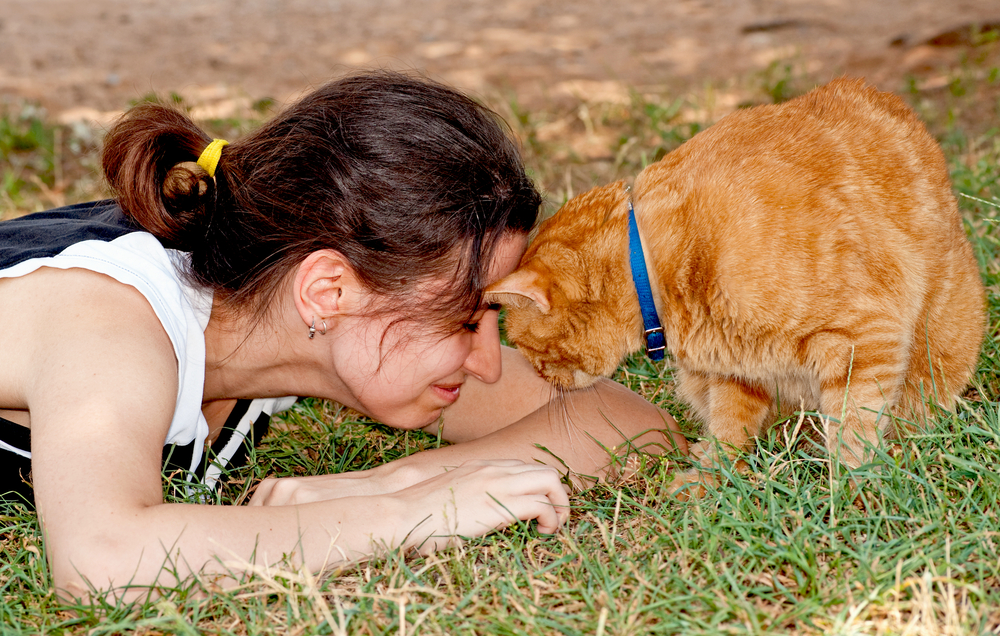
Beyond the concepts of territory and trust, there is an even deeper sociological reason behind the act of bunting. Headbutting serves as a powerful, community-building ritual that traces its roots back to the untamed wilderness. When felines live together in cohesive social structures—whether it is a pride of lions on the African savanna or a tightly knit colony of feral cats in an urban alleyway—they frequently engage in a behavior known as allo-rubbing. Members of the group will continuously rub their heads and bodies against one another, physically weaving through each other’s legs and sharing their personal scents. This continuous exchange creates a unified “group scent,” a communal invisible badge that identifies every member of the family. When your cat executes a firm headbutt against your shin or your chin, it is essentially bringing this wild, ancient ritual into your living room. Your cat is treating you as if you were another, albeit much larger, feline within its family group. This ongoing exchange of scent builds a deep sense of familiarity and psychological comfort, continuously reinforcing the emotional connection between you and the animal. It is their way of continuously renewing your membership in their exclusive tribe.

This intertwining of human and animal lives through such subtle gestures highlights the profound beauty of our relationship with pets. For the modern human, surrounded by the noise, screens, and relentless pace of contemporary life, the quiet intimacy of a cat’s headbutt offers a sudden, grounding moment of pure connection. It is an invitation to step out of the complicated human world and into the simpler, sensory-driven reality of the animal. When a cat bunts against you, they are demanding that you be present in that exact second. This physical interaction bridges the vast biological gap between two entirely different species. We cannot speak their language of pheromones, and they cannot comprehend our spoken words, yet in the space of that single, tactile gesture, a perfect and complete understanding is reached. It is a shared acknowledgment of safety, warmth, and mutual reliance that requires no translation.
However, while celebrating this rich language of feline affection, responsible caretakers must also learn to differentiate between a loving headbutt and a distinctly different behavior known as “head pressing.” Understanding this distinction is an essential part of learning your animal’s physical vocabulary. Head pressing occurs when a cat walks up to a solid, immovable object—such as a blank wall, a heavy piece of furniture, or a door—and pushes its head rigidly against it, holding that uncomfortable posture for extended periods of time. Unlike bunting, this is not a social or communicative gesture. Head pressing is a recognized clinical sign that can sometimes indicate an underlying neurological or medical issue that requires professional veterinary attention. The context and the physical execution of the two behaviors are entirely different. The friendly bunting that cats initiate with their chosen humans is fluid, dynamic, and usually quite brief. It is almost always accompanied by a suite of relaxed, positive body language signals, such as deep, rhythmic purring, the slow blinking of the eyes, a gently twitching tail, or the kneading of their paws. Head pressing, conversely, is static, tense, and entirely devoid of those joyful social cues.
By paying attention to these nuances, we become better companions to the animals that share our homes. We learn to read their silent poetry, interpreting the subtle shifts in their posture and the invisible trails of scent they leave behind. The domestic cat may have abandoned the wild centuries ago to sleep on our sofas and bask in the squares of sunlight on our rugs, but they have never forgotten the ancient rituals of their ancestors. They have simply adapted those wild behaviors to include us. They have taken the complex social dynamics of the feline colony and applied them to the human family, granting us the honor of being included in their deeply guarded world.
So, the next time your cat materializes from the shadows of the hallway, walks up to your chair, and firmly bumps its small forehead against you, take a moment to appreciate the magnitude of the gesture. Remember that this is not just an animal being playful, nor is it a random accident of movement. In the quiet, intricate, and deeply profound language of cats, that small physical impact carries a powerful, historical message of absolute trust, territorial belonging, and unwavering affection. Your cat is actively marking you as a vital pillar of its world, a safe companion standing firm inside the boundaries of its territory. In a beautifully silent way, every soft headbutt is your cat’s way of ensuring that, against all the odds of nature, the two of you belong together.
