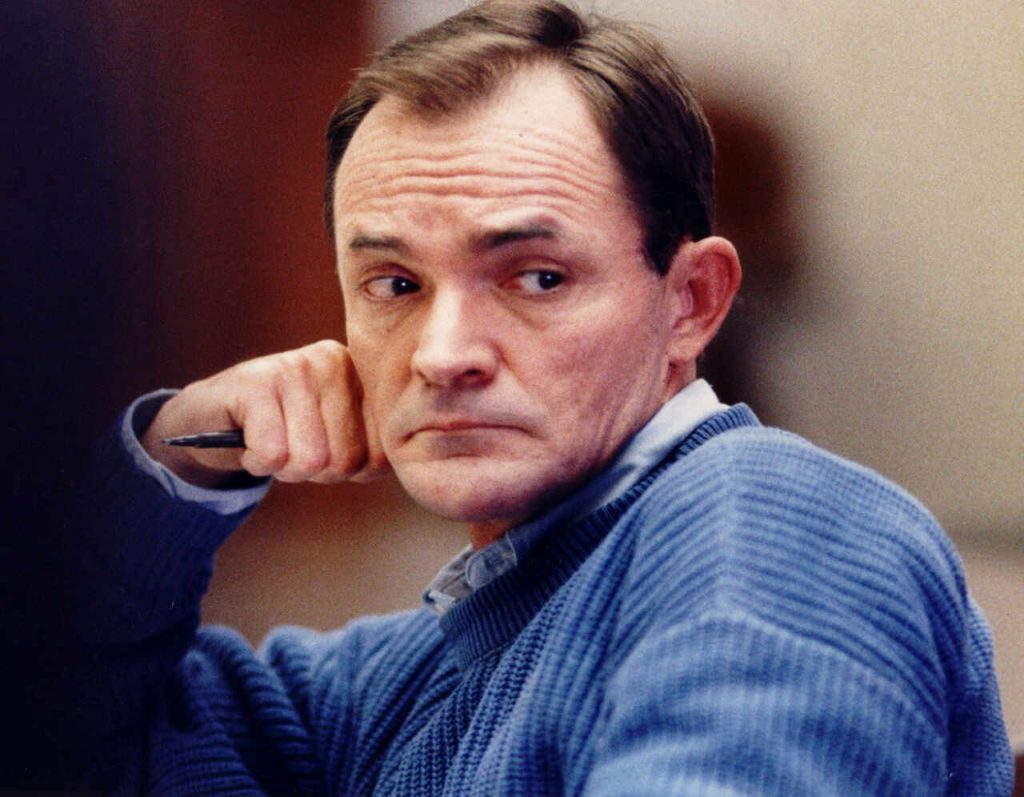

It’s unsettling to think that even the most infamous killers in history — dictators, mass murderers, and serial predators — were once innocent children.
The boy we are about to discuss would eventually become one of California’s most feared murderers, believed to have claimed the lives of 51 young boys.
Between 1971 and 1983, he instilled fear across an entire state, and even years later, the memories of his horrific crimes remain vividly etched in the minds of those who experienced the terror and those forever connected.
Born on March 19, 1945, in Long Beach, California, this boy was the sole son in a humble, working-class family that had relocated from Wyoming in search of stability and sunshine.
From an outsider’s perspective, everything seemed normal, a family pursuing the American dream in the new suburbs of postwar Southern California.
However, within that small, pale-blue house, an unusual quietness always lingered.
As he grew up, the boy was an intelligent and observant child. He was polite, reserved, and almost painfully meticulous. He had a passion for puzzles, math, and order. His teachers described him as bright and obedient. His mother, Opal, showered him with affection; his father, Harold, worked long hours at a factory and expected discipline.
Neighbors would later remember how tidy his room was, how his toys were always arranged just right.
Even as a child, he craved control, a trait that would darken as he matured.
A model student
When his family relocated to the expanding suburb of Westminster in Orange County, the young man seamlessly blended into the conservative atmosphere of the 1950s. During high school, his peers remembered him as “intelligent, well-groomed, and reserved.”
He thrived academically and was characterized as “somewhere right of Attila the Hun” in his political views, a passionate advocate for traditional values, the military, and societal order.
He became involved in student government, participated in the debate team, and appeared to be on a path to a respectable future. After graduating in 1963, he enrolled at Claremont Men’s College, focusing on economics. He immersed himself in campus politics, campaigning for Barry Goldwater and endorsing the Vietnam War.
However, by his junior year, a transformation began to take place.
He grew a beard. His political views became more moderate. He started attending anti-war demonstrations and, quietly, began to accept a part of himself he had long kept hidden.
By 1969, he had come out as gay, a revelation that stunned his family and resulted in the loss of his position in the Air Force Reserve, where he had been training. Officially, he was discharged due to “medical reasons.”
Unofficially, it was because of his sexual orientation.
The drift begins
After leaving the service, he remained in Southern California, taking on various jobs — bartender, computer programmer, waiter.
He was articulate, well-dressed, and consistently polite. To those who knew him, he appeared to be a mild, sophisticated young man with an IQ of 129 and a passion for conversation.
Yet beneath that composed surface, something was churning.
He started using drugs, primarily amphetamines and barbiturates. He also developed a liking for alcohol. His friends began to notice unpredictable behavior: periods of solitude, sudden outbursts of anger, and long disappearances without any explanation.
The vibrant nightlife of Long Beach and Sunset Beach was thriving, and the young man found himself captivated by its allure, particularly the gay bars that served as refuges for those still in hiding. He worked at one called The Stables, where he served drinks and easily conversed with the regulars.
However, he was also lurking. Observing. Pushing boundaries.
The initial victim
In March 1970, a terrified and confused 13-year-old runaway named Joseph Fancher walked barefoot into a bar in Long Beach, shaking and unable to speak clearly. Authorities quickly discovered that he had been drugged and assaulted by an older man who had promised him shelter.
Eventually, the police identified the suspect, and when they searched his apartment, they found the boy’s shoes along with a cabinet filled with sedatives and prescription medications. However, because they had entered without a warrant, the evidence was deemed inadmissible, allowing the man to go free.
At that time, no one realized that the Fancher case would mark the beginning of a series of horrific events that would unfold over the next decade.
Bodies found along the highway
In the following years, a disturbing trend started to take shape throughout Southern California. Young men, primarily teenagers or those in their early twenties, often Marines or hitchhikers, began to disappear.
Their remains would eventually be discovered along highways, in ravines, and in isolated fields.
The murders were vicious. The victims were drugged, bound, and killed with chilling accuracy. Many showed signs of having been tortured. Investigators from Orange County, Los Angeles, and San Bernardino came to the realization that they were facing a single predator, a man who seemed to glide through the freeway system like a ghost.
By 1975, law enforcement had connected several of the cases but had yet to identify a suspect.
They were unaware that the murderer was living a comfortable life in Long Beach, working as a computer programmer, and spending his weekends searching for victims.
For years, he successfully evaded capture, even as the bodies continued to appear. Between 1971 and 1983, he kidnapped, tortured, and killed at least sixteen men and boys.
A twist of fate
Then, on a warm spring evening in May 1983, fate stepped in.
Around 1:00 a.m., two California Highway Patrol officers stopped a Toyota Celica on the 405 Freeway near Mission Viejo. The driver seemed to be under the influence. A half-empty beer bottle was next to him.
When one officer glanced at the passenger seat, he was taken aback.
There, slumped against the window, was the lifeless body of a young Marine named Terry Gambrel. His belt was wrapped around his neck.
The driver’s license revealed a name that would soon gain notoriety: Randy Kraft. The media would later label him “The Scorecard Killer.”
Inside the vehicle, officers discovered a briefcase filled with drugs, alcohol, and a notebook.
At his residence, investigators found a disturbing assortment — photographs, personal items of victims, and evidence linking him to a series of murders from California to Oregon. However, the most chilling discovery was a neatly written list: over sixty cryptic entries, each serving as a clue.
Each line indicated a victim
The brief, coded terms like “Stable,” “Marine Drum,” “Iowa,” and “Parking Lot” initially seemed to lack significance. However, detectives quickly understood what they were examining: a grim tally of fatalities. They believed that every line corresponded to a victim.
One entry, “Stable,” seemed to point to the bar where Kraft had previously been employed. Another, “Airplane Hill,” aligned with the site where a body was found close to an airfield. The list covered over ten years — a detailed account of terror.
He recorded everything, as if each life lost was merely a number, each murder yet another demonstration of dominance.
All of his victims were young white men, primarily in their late teens or early twenties — many discovered with drugs or alcohol in their systems.
Kraft’s approach seldom varied: he would pick up his victims, offer them drinks mixed with sedatives, and once they were unconscious, he would carry out horrific acts. Many were found without clothing, their bodies displaying signs of systematic torture.
Then came the photographs.
The victims were arranged with chilling accuracy, some appearing to be asleep, while others were clearly lifeless. The Polaroids, which were found in his possession, would turn out to be some of the most disturbing pieces of evidence in the case.
Randy Steven Kraft shocked his friends and colleagues. One of his closest friends remembered him as “a normal kid, just like everyone else.” To the outside world, he was a dependable friend, a caring family member, and a skilled computer professional.
“Everyone liked Randy,” said Kay Frazell, a former classmate who mentioned she once had a crush on him, to the LA Times.
Trial and Responses
In 1989, after one of the most prolonged and costly trials in Orange County’s history, Randy Steven Kraft was found guilty of sixteen murders, along with several counts of sodomy and torture.
In his defense, Kraft provided just one statement:
“I have not murdered anyone. I believe any reasonable review of the record will show that,” he remarked before calmly taking a seat and pouring himself a glass of water.
When the judge announced the verdict of death, Kraft remained still, displaying no signs of emotion.
He was subsequently sent to death row at San Quentin.

Several relatives of Kraft’s victims expressed their relief as the sentence was delivered. Some cried, while others smiled. One grieving father yelled, “Burn in hell, Kraft. Burn in hell,” as the convicted murderer was escorted out of the courtroom.
“Even after he’s executed, the anger is still going to be there,” said Rodger DeVaul Sr, the father of victim Rodger James DeVaul, who was 20 at the time.
The shocking news of Kraft’s arrest forced his family to retreat from the media. They were just ordinary, private individuals suddenly caught in a whirlwind of headlines and flashing cameras.
“It has been devastating for them,” stated Kraft’s attorney, C. Thomas McDonald, in 1989.
“But they love Randy, and they have been very devoted to him since his arrest.”
“Looked like everyone else”
Throughout his more than forty years in prison, he has never confessed to a single murder.
Detectives still suspect there are many more victims who will remain unidentified.
In 2012, retired homicide detective Dan Salcedo confronted Kraft inside San Quentin.
“It’s strange — when you see him, there’s nothing remarkable,” Salcedo shared with Police1. “He doesn’t fit the typical media image of a killer. If you placed him in a crowd, he’d be the last person you’d choose.”
Salcedo had hoped for a confession or at least some insight into the cases that continue to haunt California’s records. But Kraft remained silent.
“When I gazed into his eyes,” Salcedo remembered, “I felt nothing. No sense of evil. Just a bitter old man.”
When the interview concluded, Kraft calmly signaled for the guard and was taken away.
Death penalty confirmed
To Salcedo, Kraft embodied the most genuine type of “subtle malevolence.”
“The ordinariness of evil,” he later referred to it. “He appeared like a friend, a colleague. There was nothing about him that shouted threat. And perhaps that’s the most frightening aspect.”
Even now, detectives go back to unresolved homicides, looking for connections to the enigmatic names on Kraft’s list. Some families have at last discovered answers through DNA analysis; others continue to hope for closure that might never arrive.

Kraft now spends his days locked away in a tiny cell, growing older, quiet, and unrepentant. He was a man who once had everything under control, except for his own soul.
His conviction and death sentence were confirmed by the California Supreme Court on August 9, 2000. As of 2025, he is still on death row at the California Institution for Men in San Bernardino County, continuing to deny any connection to the murders he was convicted of, as well as the numerous others he is believed to have committed.
