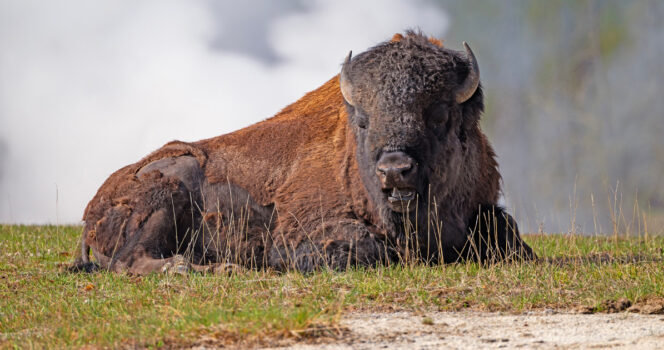

As twilight began to blanket the towering lodgepole pines of Yellowstone National Park, the crisp evening air was filled with the gentle sounds of Bridge Bay Campground. Campfires crackled, families shared dinners, and children giggled while snapping photos from afar. But the peaceful atmosphere shattered in an instant when a massive, 2,000-pound bull bison entered the loop, visibly agitated and ready to challenge anything in its path.
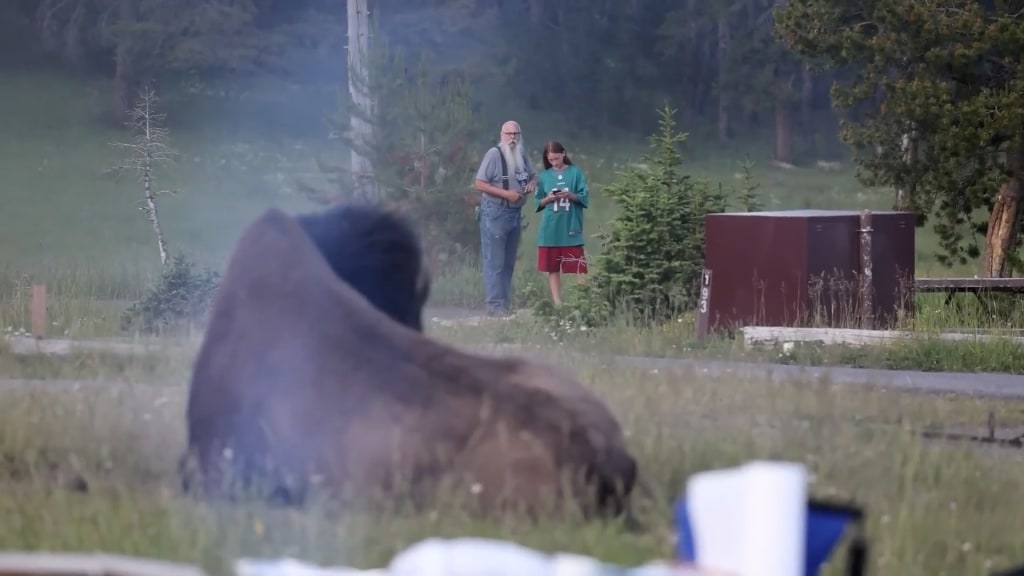
Among the campers was Carl Isom-McDaniel, a 65-year-old grandfather from Washington state, walking alongside his 13-year-old grandson. They were maintaining what observers and park regulations generally consider a respectful distance, standing about 100 yards away. Yet, as the giant animal rolled in the dust and suddenly rose to its feet, the grandfather sensed an immediate shift in the air. Instinctively, he motioned to his grandson that it was time to leave.
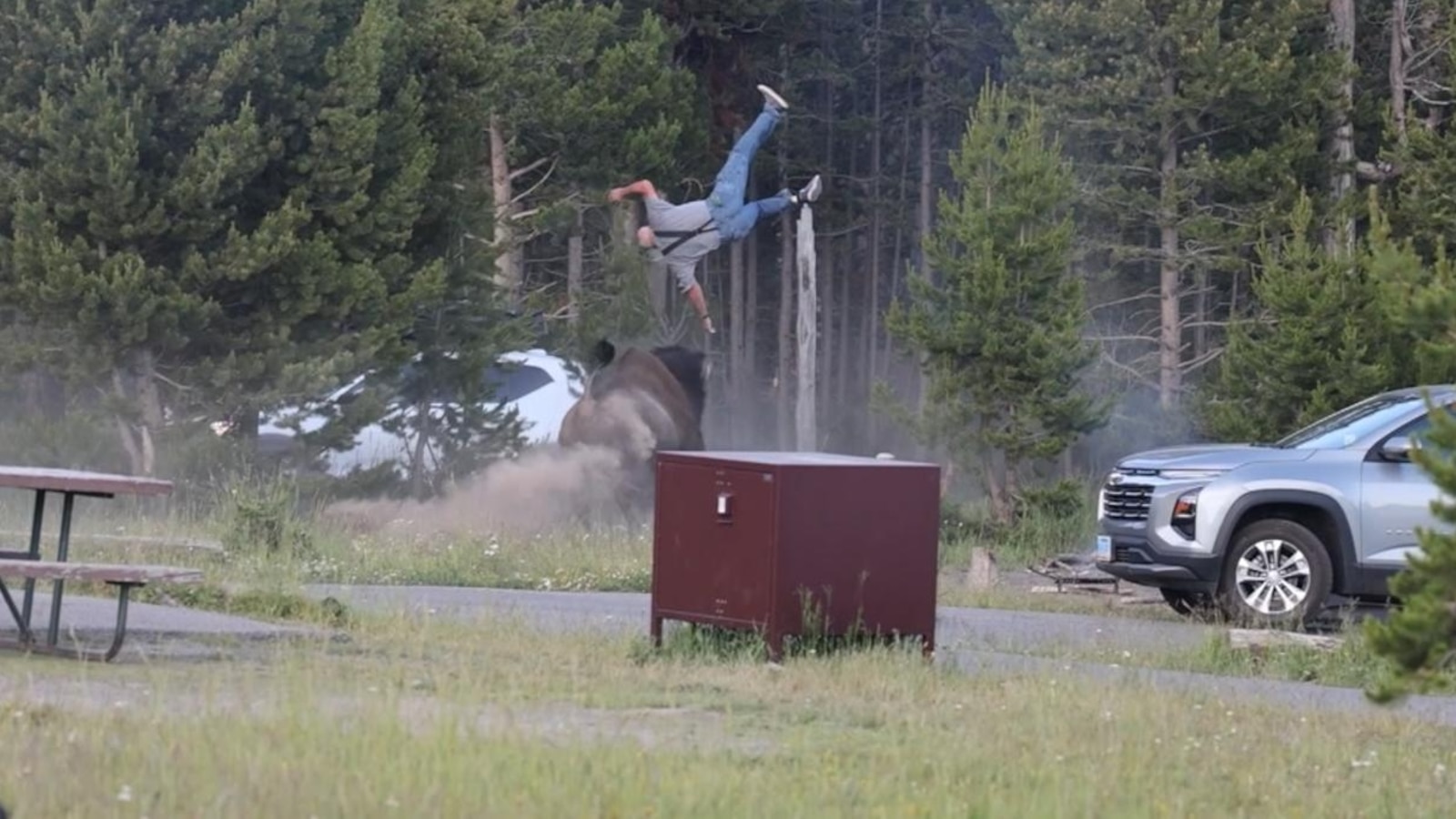
They retreated toward a grove of trees, but the bull bison charged. In a split-second decision to protect his grandson, Carl ran in the opposite direction to draw the animal’s focus. The bison pursued him through the timber, caught up, and hooked him with its left horn, launching him several feet into the air in a dramatic, gravity-defying flip.
The heroic intervention of nearby campers and photographer Mike MacLeod, who shouted and waved their arms to distract the animal, ultimately drove the bison away. While Carl survived the encounter and is recovering from orthopedic surgery to reset a severely broken leg, the incident serves as a striking reminder of the raw, unpredictable power of North America’s largest land mammal.
The Magnificence and Might of the American Bison
To understand why an animal would charge without apparent provocation, one must first appreciate the sheer scale and evolutionary history of Bison bison. Often referred to interchangeably as buffalo, these magnificent creatures are ice-age survivors. A mature bull can weigh up to 2,000 pounds and stand six feet tall at the hump. Despite their lumbering appearance and massive frame, they are surprisingly agile, capable of running at speeds up to 35 miles per hour and leaping over obstacles with ease.
For thousands of years, these giants ruled the Great Plains, their herds numbering in the tens of millions. They shaped the geography, influenced the vegetation, and served as a foundational pillar for the ecosystems of North America. Today, Yellowstone National Park is one of the very few places where wild, genetically pure herds still roam freely, allowing millions of visitors to catch a glimpse of prehistoric America.
Myth, Legend, and the Cultural Spirit of the White Buffalo
Beyond their biological grandeur, bison hold a sacred place in the tapestry of Indigenous cultures. For many Native American nations, particularly the Plains tribes, the bison is not merely wildlife; it is a relative, a provider, and a symbol of abundance and renewal. Every part of the animal was used, from the hide for shelter and clothing to the bones for tools, reflecting a deep spiritual connection rooted in gratitude and reciprocity.
Perhaps the most enduring legend is that of the White Buffalo Calf Woman, a sacred figure in Lakota mythology. According to spiritual tradition, she presented the people with the sacred calf pipe and taught them how to live in harmony with the earth. She promised to return during a time of great need, a prophecy tied closely to the birth of rare white buffalo calves. In cultural lore, the bison represents strength, endurance, and the ultimate spirit of the wilderness—a force that demands absolute respect and humility from those who cross its path.
The Science Behind the Rage: Understanding the Summer Rut
While cultural narratives highlight the spiritual majesty of the animal, wildlife biologists point to a very concrete, seasonal phenomenon to explain the heightened aggression seen in July and August: the annual mating season, commonly known as the rut.
During the summer, male hormones spike dramatically. Bull bison, which normally live in separate bachelor groups, rejoin the main herds to compete for the attention of receptive females. This period is characterized by intense, energy-consuming displays of dominance.
Biologists explain that during the rut, a bull’s nervous system is primed for conflict. When a bison wallows in the dust, it is not simply resting; it is distributing pheromones to assert its dominance to nearby rivals. If an external stimulus—such as a passing vehicle or a sudden movement—startles an already agitated bull, its threat-response mechanism can trigger an instantaneous charge. In the case of the Bridge Bay Campground incident, witnesses noted that the bull had been wallowing and thrashing saplings shortly before the encounter, signaling that its adrenaline was already peaking.
Navigating the Wild: Safe Practices in Animal Territory
The National Park Service emphasizes that wild animals are unpredictable and must be given a wide berth, especially during mating seasons. To ensure safe and respectful coexistence, wildlife experts recommend adhering to strict safety protocols when exploring natural habitats.
-
Maintain Distance: Always stay at least 25 yards (75 feet) away from bison and elk, and at least 100 yards away from bears and wolves. During the summer rut, doubling or tripling this distance is highly recommended.
-
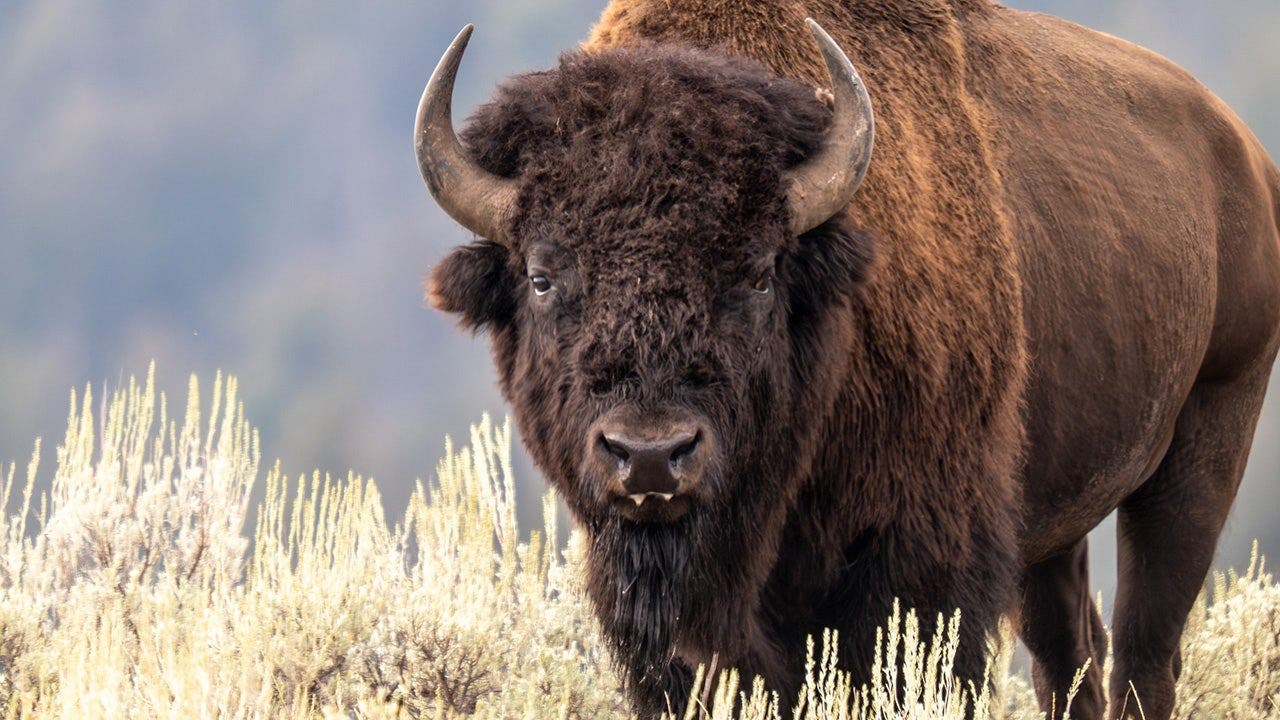
Read the Warning Signs: Pay close attention to animal body language. If a bison stops what it is doing to stare at you, shakes its head, paws the ground, or raises its tail, it is warning you that you are too close.
-
Never Corner an Animal: Ensure wildlife always has a clear, unblocked path to move away. If an animal approaches a campsite or path, slowly back away to give it space.
-
Avoid Sudden Movements: If you find yourself closer than intended, remain calm. Speak in low, quiet tones and retreat slowly without running, as running can trigger a chase instinct in large mammals.
Reflections on Human Curiosity and the Call of the Wild
The dramatic encounter at Bridge Bay Campground highlights a deeper, enduring truth about the human relationship with the natural world. We are drawn to wild spaces by an innate, ancient curiosity—a desire to witness the untamed beauty of the earth and reconnect with something larger than ourselves. National parks like Yellowstone offer a rare portal into a world where humans are observers rather than rulers.
Yet, this curiosity must always be tempered with reverence. The boundaries of the wilderness are kept secure not by fences, but by our own willingness to respect the wildness of its inhabitants. Carl Isom-McDaniel’s story is a powerful testament to survival, quick-thinking protection, and community heroism. It also serves as a humble reminder that when we step into the territory of the great bison, we are guests in a ancient kingdom where nature still writes the rules.
Sources
-
The National Park Service (NPS): Official wildlife safety guidelines and bison ecology profiles.
-
The Guardian: Reporting on the Bridge Bay Campground incident and interviews with witnesses.
-
Cowboy State Daily: Eyewitness accounts and photographic details from photographer Mike MacLeod.
-
East Idaho News / KSL TV: Medical updates and detailed campground sequence reports.
