
Cleaning under a child’s bed often reveals forgotten toys, dust, and the occasional missing sock. Every now and then, however, you might discover something that seems completely out of place.
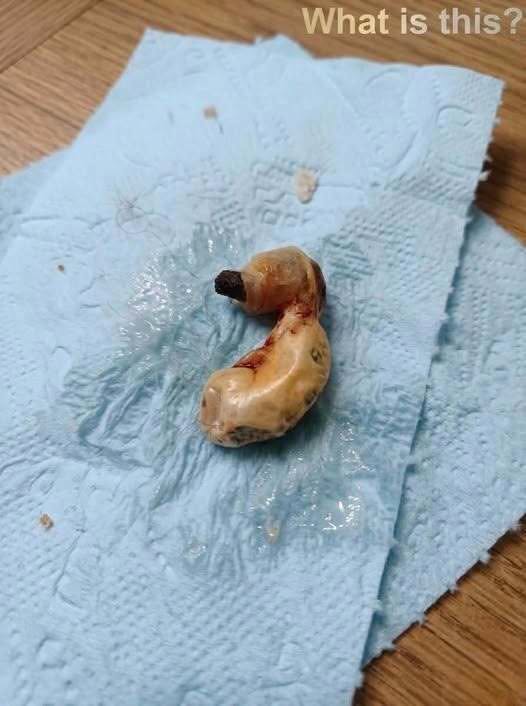
Imagine finding a small, brown, segmented object tucked beneath the bed. It looks unusual, almost like a tiny armored creature curled into a ball. One end even has a long, pointed extension that resembles a stinger. It’s easy to understand why many people would immediately assume they’ve found something dangerous.
Fortunately, appearances can be deceiving. In one family’s case, the mysterious object turned out to be something far more fascinating than frightening: an empty hawk moth chrysalis.
This article explains what a hawk moth chrysalis is, why it looks so unusual, and what you should do if you find one in or around your home.
A Startling Discovery
At first glance, the object seemed almost lifelike.
Its features included:
A hard, segmented shell
A curved body
A pointed extension
A dry, lightweight texture
Because it didn’t resemble common household insects, it naturally sparked concern.
Questions quickly came to mind:
Was it an insect?
Could it be dangerous?
Was it alive?
Should pest control be called?
Fortunately, careful observation provided a much simpler explanation.
What Was It?
The mysterious object was identified as the empty chrysalis (also called a pupa) of a hawk moth, sometimes known as a sphinx moth.
Rather than being a dangerous creature, it was simply the protective shell left behind after the adult moth had already emerged.
The empty casing had remained unnoticed beneath the bed.
What Is a Hawk Moth?
Hawk moth belongs to the family Sphingidae, a group known for their:
Large wingspans
Powerful flight
Excellent hovering ability
Long feeding tube (proboscis)
Many species are active during dusk or nighttime, while some fly during daylight hours.
Their streamlined bodies often resemble those of hummingbirds when feeding from flowers.
Understanding the Hawk Moth Life Cycle
Like all moths, hawk moths undergo complete metamorphosis.
The four stages include:
Egg
Caterpillar
Pupa (chrysalis)
Adult moth
During the pupal stage, the caterpillar transforms into an adult moth inside a protective casing.
Once development is complete, the moth emerges, leaving behind the empty shell.
Why Does the Chrysalis Have a “Spike”?
The pointed extension often causes the greatest concern.
Fortunately, it is not a stinger.
Instead, the projection protects the developing proboscis, the long tube the adult moth later uses to drink nectar from flowers.
This natural structure simply provides space for that feeding organ while the moth develops inside the chrysalis.
Is It Dangerous?
No.
An empty hawk moth chrysalis is completely harmless.
It:
Does not bite
Does not sting
Does not spread disease
Cannot reproduce
Cannot move once empty
Finding one indoors generally does not indicate an infestation.
How Could It End Up Inside a House?
There are several possible explanations.
A caterpillar may have:
Entered through an open door.
Crawled in through a garage.
Hidden inside a potted plant.
Been accidentally brought indoors with garden items.
After completing its transformation, the adult moth simply flew away, leaving the empty shell behind.
What Should You Do If You Find One?
If you discover a similar object:
Remain calm.
Inspect it carefully.
Avoid crushing it immediately.
Compare it with reputable wildlife identification resources.
If it is empty, it can simply be discarded or kept for educational purposes.
If you are uncertain whether the object is an insect or something else, consider contacting a local extension office or nature center for identification.
Why Hawk Moths Are Important
Hawk moths play valuable roles in nature.
Many species are important pollinators.
As they feed on nectar, they transfer pollen between flowers, helping many plants reproduce.
Their caterpillars also become part of natural food webs, supporting birds and other wildlife.
Healthy insect populations contribute to balanced ecosystems.
Appreciating Nature’s Transformation
One of the most remarkable aspects of moths is their complete transformation.
Inside the chrysalis, the caterpillar undergoes extraordinary biological changes before emerging as a winged adult.
The empty shell represents the completion of one of nature’s most fascinating life cycles.
What initially appears strange or even alarming often turns out to be an example of remarkable natural adaptation.
When Should You Be Concerned?
Most single insect pupae found indoors are harmless.
However, you may wish to seek professional advice if you notice:
Large numbers of unknown insects.
Repeated pest activity.
Damage to food storage.
Structural damage from insects.
Signs of rodents or termites.
In those situations, a licensed pest management professional can identify the source.
Conclusion
Finding an unfamiliar object beneath a bed can easily trigger concern, especially when it resembles an unusual creature. Yet, in this case, the mysterious discovery proved to be nothing more than an empty hawk moth chrysalis—a harmless reminder of one of nature’s most impressive transformations.
Rather than representing danger, the shell tells the story of a caterpillar completing its life cycle and emerging as a beautiful adult moth. Sometimes the most surprising discoveries become opportunities to learn something new about the natural world.
Human curiosity often begins with uncertainty. By taking time to observe carefully and seek reliable information, even the most mysterious objects can reveal fascinating stories hidden in plain sight.
Sources
Smithsonian National Museum of Natural History. Moths and butterflies.
National Wildlife Federation. Hawk moths and pollinators.
University of Florida IFAS Extension. Hawk moth biology.
Royal Entomological Society. Lepidoptera identification resources.
Butterfly Conservation. Moth life cycles and identification.
Disclaimer: This article is intended for educational purposes only. If you discover an unfamiliar organism in your home and cannot identify it safely, consult a local wildlife expert, extension service, or licensed pest professional.
