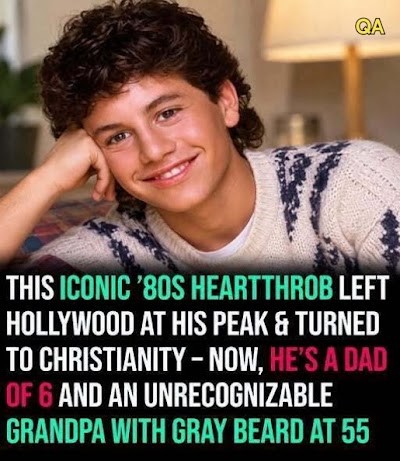

Kirk Cameron’s Career, Faith, Family, and Life Beyond Hollywood
Kirk Cameron became one of the most recognizable young television actors of the 1980s through his role as Mike Seaver on the long-running sitcom Growing Pains. The series made him a teen idol at a remarkably young age, placing him at the center of American popular culture during a period when network television still had an enormous reach. His public image was built around humor, celebrity, and professional success, but Cameron’s life and career later took a different direction.
Over several decades, Cameron has become known not only for acting but also for Christian media, family-focused projects, public speaking, and advocacy connected to his religious convictions. His story is often presented as an example of a performer whose personal beliefs reshaped his professional choices. Rather than fully leaving entertainment, he redirected much of his work toward projects that aligned with his values.
This shift has made Cameron a notable figure in conversations about faith, celebrity, family, and the role of personal conviction in the entertainment industry. Supporters see his career as an example of consistency and purpose, while critics and observers have sometimes questioned his public positions. Whatever one’s perspective, his path illustrates how a highly visible entertainer can redefine success beyond conventional Hollywood measures.
Kirk Cameron’s Rise to Fame on Growing Pains
Kirk Cameron was born in Panorama City, California, in 1970. He began acting as a child and appeared in commercials and television productions before landing the role that would make him widely known. In 1985, he was cast as Mike Seaver in ABC’s Growing Pains, a family sitcom centered on the Seaver household.
Mike Seaver was written as a confident, mischievous teenager whose humor and occasional irresponsibility drove many of the show’s storylines. Cameron’s performance helped make the character a defining part of the series. Growing Pains ran for seven seasons, from 1985 to 1992, and became one of the era’s familiar family sitcoms.
At the height of the show’s popularity, Cameron appeared on magazine covers, received intense attention from fans, and was widely described by entertainment outlets as one of television’s leading teen stars. Such early fame can create unusual pressure. Young actors often work under demanding schedules while navigating public scrutiny, professional expectations, and the normal challenges of adolescence.
Cameron has spoken publicly about being an atheist during his early teenage years and about feeling disconnected from the religious beliefs that would later become central to his identity. His experiences during this period are significant because they provide context for the changes that followed. He was not a performer who entered Hollywood already associated with faith-based entertainment; that association emerged later through a personal and professional transformation.
A Personal Conversion and Changing Priorities
According to Cameron’s own public accounts, he began attending church as a teenager after an invitation connected to a young woman he wanted to impress. What began as a social decision developed into a serious interest in Christianity. He has said that he became a Christian at age 17 and that his faith changed the way he viewed life, relationships, and his work.
Religious conversion is a personal experience, and accounts of it are necessarily rooted in an individual’s beliefs. In Cameron’s case, his conversion became increasingly visible because it happened while he was starring in a major television series. He has described becoming more concerned with questions of morality, spiritual purpose, and the influence of entertainment on audiences.
As his beliefs developed, Cameron began to make professional decisions based on those convictions. Reports from the period have noted that he sought greater input regarding material he considered inconsistent with his faith. This created public discussion about creative control, workplace expectations, and the difficulty of balancing personal beliefs with the collaborative nature of television production.
His experience also reflects a broader reality within entertainment: actors and creators do not necessarily share the same political, religious, or cultural perspectives as the industries in which they work. For some public figures, those differences remain private. For others, including Cameron, they become a defining part of a public identity.
Marriage, Family, and Adoption
In 1991, Cameron married Chelsea Noble, his co-star from Growing Pains. Noble played Kate MacDonald, a love interest for Mike Seaver during the later seasons of the program. Their marriage became an important part of the family-centered life Cameron has discussed in interviews and public appearances.
The couple have six children, including four adopted children. Cameron and Noble have frequently spoken about adoption as a meaningful part of their family’s story and have supported organizations and events focused on adoption, foster care, and family services. Their public advocacy has drawn attention to the needs of children who require stable homes and long-term support.
Adoption is an area that involves complex emotional, legal, and social considerations. Child-welfare organizations emphasize that successful adoption depends on careful preparation, access to services, and ongoing support for children and families. Public awareness can help encourage prospective parents to learn more, but experts also stress the importance of listening to adopted people and respecting the privacy of individual families.
For Cameron, family life has been closely connected to his public message. He has frequently argued that lasting relationships, parenting, and community should be valued alongside professional ambition. This emphasis has appealed to many faith-based audiences seeking entertainment and public figures whose work reflects traditional family themes.
From Mainstream Television to Faith-Based Media
After Growing Pains, Cameron continued to act, but his career became more closely associated with Christian and family-oriented productions. One of his best-known later roles was Buck Williams in the Left Behind film series, based on the bestselling novels by Tim LaHaye and Jerry B. Jenkins. The films were aimed primarily at evangelical Christian audiences and demonstrated the growing market for faith-centered entertainment.
He also starred in Fireproof, a 2008 independent drama produced by Sherwood Pictures, the filmmaking ministry connected to Sherwood Baptist Church in Georgia. The film focused on a troubled marriage and reconciliation. Despite a modest production budget, it performed strongly with its target audience and became a notable example of the commercial potential of independently produced faith-based films.
Faith-based filmmaking has expanded substantially in the United States over the past two decades. These projects vary widely in style and subject matter, but they often focus on themes such as forgiveness, family, grief, community, hope, and religious belief. Their growth has encouraged studios, streaming platforms, and independent producers to recognize audiences that want stories aligned with their spiritual or moral outlook.
Cameron has also worked with evangelist Ray Comfort through The Way of the Master, an evangelism-focused ministry and media platform. Their work has included television programs, books, educational materials, and public outreach. As with many religious organizations, the ministry’s goals and methods have generated both support and criticism, reflecting wider differences in how people understand faith, public dialogue, and cultural change.
Public Advocacy and Cultural Debate
In addition to acting, Cameron has become a public speaker and commentator on issues related to Christianity, parenting, education, and American culture. His appearances often emphasize the importance of religious freedom, family involvement, and faith in public life. He has participated in events, publishing initiatives, and media campaigns intended to encourage families to discuss values and civic participation.
His advocacy has also made him a controversial figure in some settings. Public figures who address religion and social issues often receive sharply different responses depending on the audience. Supporters may view their comments as a defense of conscience and traditional beliefs, while critics may argue that certain messages do not fully reflect the diversity of modern families, faiths, and identities.
These debates are not unique to Cameron. They are part of a broader international discussion about freedom of expression, religious liberty, inclusion, and the responsibilities that come with having a large public platform. Civil discussion on these subjects benefits from accuracy, respect, and an acknowledgment that people can hold deeply held beliefs while disagreeing about public policy and cultural values.
Cameron’s career therefore cannot be understood only through the lens of television nostalgia. It is also connected to the rise of values-based media and the increasing visibility of celebrities who use their platforms to promote religious or social causes.
A Different Definition of Career Success
It would be inaccurate to describe Cameron’s post-sitcom career simply as a disappearance from public life. Although he stepped away from the type of mainstream Hollywood career that many former teen stars pursue, he remained active in acting, speaking, publishing, ministry-related work, and family-focused media. His audience changed, but his public presence continued.
The distinction matters because success in entertainment can take many forms. Box-office totals, ratings, awards, and media visibility are familiar measures, but they are not the only ones. Some performers prioritize artistic experimentation, business independence, activism, privacy, family time, or work that serves a particular community. Cameron has consistently framed his choices around faith and family rather than industry status.
That approach has resonated with audiences who feel that mainstream entertainment does not always reflect their beliefs or experiences. At the same time, it demonstrates the practical role of niche audiences in modern media. Digital distribution, direct marketing, independent production, and community networks have made it more possible for creators to build careers outside the traditional studio system.
His story also offers a reminder that public narratives about celebrity can be overly simple. Leaving one kind of spotlight does not necessarily mean abandoning a career. It can mean choosing a different audience, a different purpose, or a different definition of achievement.
Kirk Cameron’s Lasting Place in Popular Culture
For many viewers, Kirk Cameron remains closely associated with the television memories of the 1980s and early 1990s. Growing Pains continues to be remembered as part of a generation of family sitcoms that shaped American television culture. For others, he is best known for his later work in Christian media and his outspoken public advocacy.
Both parts of his career are essential to understanding his cultural impact. His early fame gave him a platform, while his later decisions gave that platform a more specific direction. Whether audiences agree with his views or not, Cameron’s career shows how personal belief can influence creative choices, public communication, and the communities an entertainer chooses to serve.
His journey from teen television star to faith-based media figure is ultimately a story about changing priorities. It is not simply about rejecting fame, nor is it a straightforward departure from entertainment. Instead, it is about redirecting a public career toward a set of values he has said are more important than celebrity recognition.
Sources
Disclaimer: This content is intended for entertainment purposes only and is not based on real events.