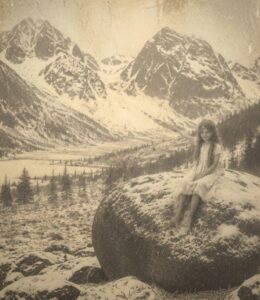

On the 9th of December, in the winter of 1,876, a trapper named Aldous Finch came down off the north face of Starvation Ridge and found a girl sitting in the snow at the foot of the trail. She was perhaps 9 years old and she was not crying. Nor was she cold, though the temperature that morning had fallen well below anything a child in a thin cotton dress should have survived.
She looked up at Finch and asked him a question. The question was when the rest of them were coming down. Finch turned and looked back up the ridge. There was nothing up there. No smoke, no tracks, no voices, only the white slope and the black tree line and the long silence that had swallowed everything above it. And the girl kept asking.
All the way down the mountain, she kept asking when the rest were coming down. Starvation Ridge did not always carry that name. On the oldest survey maps of the territory, the ones drawn before the war, the slope is marked with a different word entirely. A word in a language the surveyors could not identify and did not care to.
The families who lived in the valley below avoided the high ground. They had reasons they did not like to say out loud. But in the autumn of 1,876, a group of 41 settlers, most of them from a failed colony further east, made the decision to winter up on the ridge anyway. They had been promised land. They had been promised shelter already built and standing and waiting for them.
And when their guide led them up the north trail in the last week of October, that promise turned out to be true because there were buildings up on Starvation Ridge. And there were far more of them than anyone in the party had been told to expect. The oldest people in the valley had a name for the ridge, though they used it only among themselves and never in front of children.
They said that once in a generation, the high ground called somebody up and that the ones it called were never the wanderers or the lost. They were always people who had been promised something. People carrying a paper that told them a home was waiting. The valley families had watched it happen before, or their parents had, and the shape of it never changed.
A wagon of hopeful strangers would pass through in the autumn, ask the way to the north trail, and be gone by the first snow. And every time, one of the elders would go quiet and turn to the youngest person in the room and tell them never to answer if the mountain ever seemed to be asking them a question. The party of 41 had been warned.
A man at the last supply post below the ridge tried to talk them out of the climb, telling them that shelter left standing empty in a country this hard was never luck at all. It was bait. The settlers thanked him for his concern, paid for their flour and lamp oil, and went up the trail anyway, because they had come a very long way on the strength of a promise, and a stranger’s warning weighed almost nothing against it.
The buildings were not new. That was the first thing the settlers noticed, and the first thing they chose to ignore. The stone was old in a way that did not match anything else in the territory, sunk into the ground as though the mountain had been closing over it for a long time. Its joints were cut too clean.
The doorways were tall, taller than any door needs to be, tall enough that a grown man passed through them without ever raising his hand to the frame, as if they had been built for a people who stood a full head above the settlers now standing inside them. At the center of the settlement was a long structure the party began calling the hall, though not one of them could say what it had first been built to be.
And there was no record anywhere, in any county office, of who had raised it or when or why a whole finished settlement had been left standing empty and swept and waiting on a ridge that every local family refused to climb. And before we go further, I need to pause for a second, because what I’m about to tell you gets significantly darker.
And I realized a while ago that some of this cannot be fully explained in a video format. The complete reconstruction of the settlement that stood on Starvation Ridge, the names of the 41 people who climbed up to occupy it, the surveyor’s original map that was later ordered destroyed, the county clerk’s own written account of the page he was told to burn out of the ledger.
I put it all into a written document. It’s linked below and the QR code is on your screen. Now, let’s continue. They moved in before the first heavy snow, 41 of them, men, women, and the children among them. The guide who had brought them up did not stay a single night. He collected his pay down at the tree line and he walked back down alone.
And later, when investigators tried to trace him, they found that no guide by that name had ever been licensed anywhere in the territory. He had simply appeared out of nothing, led 41 people up a mountain, and dissolved back out of the record as though he had never existed at all. Six weeks after that, nothing came down off the ridge.
In itself, that was not strange. Winter settlements went dark every year. Supplies were laid in, the trails closed behind the snow, and families held out in silence until the spring thaw reopened the passes. Nobody in the valley gave much thought to the 41 souls up on Starvation Ridge. Not until the gray morning Aldous Finch came down the trail with a girl walking beside him, a girl who was not on any list, asking a question that nobody could answer.
They carried the girl to the nearest way station, a small cluster of buildings barely large enough to be called a town at all. A woman there took her in, fed her, warmed her by the stove, and gently tried to get her to speak about what had happened up on the ridge. And the girl answered, that was the part that unsettled everyone who was in the room.
She was not silent. Nor was she locked in the frozen shock you would expect from a child who had walked out of some disaster. She spoke clearly and calmly and without fear, and almost everything she said was wrong. The rest of them, she said, were still up in the hall. She said they were waiting for the others to arrive before they came down together, and that she had been sent ahead to watch the trail and count them in.
When the woman asked who the others were, the girl looked puzzled that anyone would need to ask. She said the others were the ones the hall had been built for. She said they had been on their way for a very long time, and that the 41 had gone up only to make the place ready, and that soon there would not be room for anyone left at the bottom of the mountain at all.
The woman asked the girl her name, and the girl gave one. But when the way station keeper checked that name against the manifest of the 41 settlers who had gone up in October, it was not there. The girl was not one of the 41. There was no record of any child by that name entering the territory, no family that had reported her, no colony that had listed her.
And when they pressed her on where she had truly come from, if not from the settlement, she gave the same answer she gave to everything else. She said she had come down from the hall. She said she had always been in the hall. And then she asked, once more, when the rest of them were coming down. A search party finally went up in the second week of January, the moment the weather broke enough to let them climb.
11 men took the north trail to bring the 41 settlers home, or to recover whatever the winter had left of them. What those 11 men found on Starvation Ridge is the part of this story that was removed. It is the part the girl had been describing to them all along, and it is the reason a county clerk would later be instructed, in his own words, in writing, to burn a single page out of the official ledger, and swear on his position that it had never once been filled in.
There were other things about the girl that the woman at the way station never wrote down until years afterward, when she was old and it no longer seemed to matter who believed her. The girl never grew hungry the way a starved child should have. She would eat what was put in front of her politely, but she ate the way a guest eats to be courteous, not the way someone eats who has been without food on a mountain for 6 weeks in December.
She did not sleep so much as lie still and wait for the morning with her eyes closed. And she knew things she had no way of knowing. The names of people who had died in that town before she was born and a well that had been filled in and forgotten two generations back. Once and only once the woman asked her directly what the hall was.
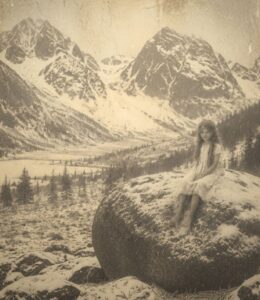
The girl thought about it for a while, the way a child thinks about how to explain something obvious to a slow adult. Then she said that the hall was the place where everyone was kept until there were enough of them. She said it very simply, the way you would describe a barn or a church. And when the woman asked her enough of them for for the girl only smiled and did not answer and asked instead when the rest of them were coming down.
There was one last thing the woman noticed and could never fully explain. On the nights when the wind came down off the high ground and rattled the shutters, the girl would go very still and turn her face toward the sound as though she had heard her own name called from a great way off. On the still nights when the ridge gave nothing back at all, she would sit up in the dark and watch the north window until the light came, the way a person waits for a lamp to appear on a road they already know someone is walking down. Before we move on to what the 11
men found on the ridge, stop for a second. What you just heard about the girl’s account is the part that changes everything. But it only makes sense when you see it written out next to the original settlement manifest, the 41 names, the extra child. It’s all in the document linked below. Take 5 seconds right now, grab it and then come back.
Because what comes next builds directly on it. The link is in the description. QR code is on your screen. The 11 men reach the settlement on the 14th of January. The buildings stood exactly as the vanished guide had described them back in October, sound, whole, and ready as though the owners had stepped out for an hour.
Fires had been laid in the hearths but never lit. Tables were set for meals nobody had eaten. In the smaller houses, beds were made and clothing was folded and small personal things were arranged on the shelves, the careful way people arrange what they fully intend to come back to. Nothing had been ransacked. Nothing had burned.
There was no sign of any struggle. No blood in the snow. No bodies frozen in the drifts the way every man in that party had braced himself to find. The settlement of 41 people was simply and completely empty. And in the great hall at the center of it, the 11 men found the one thing that none of them would ever agree to describe the same way twice. The hall was warm.
That was the detail every man held to months later, even under oath. The fire in the great hearth had gone down to cold ash long before. Yet the stone floor still held a low heat as though something below it was quietly working. Along both walls, the settlers had left their coats hanging on iron hooks.
All 41 coats in one long and orderly row as if their owners had stepped out of them and walked deeper into the building without them. At the far end of the hall, behind a low raised platform, there was a doorway that none of the settlers letters home had ever once mentioned. It opened onto a stone stair that went down into the body of the ridge.
The men lit their lamps and started down and they counted the steps as they went and somewhere past 200 steps beneath the frozen mountain they stopped counting and they turned back. Not one of them would ever say plainly what made them turn. A man named Corwin wrote only this. He wrote that the stair kept going and that from somewhere far below it he could hear people.
They were talking, he wrote, and they sounded happy. And not a single one of the voices belonged to a child. Though the girl at the bottom of the mountain had told them again and again that the hall was exactly where she had come from. There was one more account from that January climb and it did not come from Corwin. A younger man in the party, barely out of his teens, gave a statement to the county before he left the territory for good and was never heard from again.
He said that while the others were bent over the top of the stone stair arguing about how far down to go, he had walked the length of the empty hall alone and that he had counted the coats on the iron hooks twice. And that both times he had counted 42. 42 coats on a manifest of 41 settlers. He said he did not mention it to the others at the time because he could not think of a single way to say it out loud that did not sound insane and because the extra coat was small.
It was the size that would fit a child of about 9 years old. It hung at the very end of the row, still faintly warm to the touch as though its owner had slipped out of it only a moment before and stepped through the low doorway at the back of the hall and started down the long stair to wait with all the rest.
The 11 men came down off Starvation Ridge and they could not agree on what to do next. Some wanted to bring the territorial militia up the trail. Some wanted to seal the mouth of that hall with stone and never speak of any of it again. What they did instead was report the whole thing to the county. And the county did something that only makes sense once you understand what this story is actually about.
The county did nothing. There was no militia. There was no second expedition. No notice posted. No families back east told that 41 of their own had gone up a mountain and never come down. Within a month, the settlement on the ridge had been struck clean out of the survey. The surveyor who had first mapped it was reassigned to a post 400 miles away.
The map itself was recalled and by the county clerk’s own later account, it was ordered destroyed. A finished settlement of old stone, older than the territory that contained it, had been erased from the record faster and far more thoroughly than any ordinary disaster would ever warrant. Because Starvation Ridge was not the first place this had happened.
If you go back through the territorial records, back past the war, back to those oldest surveys drawn in the language nobody could read, the same shape appears again and again. A structure that was already standing before any settler laid a single stone. Then a group of people who climb up to occupy it.
Then a silence that closes in behind them. And then, every single time, the quiet and deliberate removal of the whole event from the record. As if the men who governed that territory already knew exactly what the ridge was and understood that their one real duty was to make certain nobody else ever found out. The buildings were never abandoned.
That was the mistake the 41 settlers made and it was very nearly the mistake the search party made on that long stone stair. The buildings were not ruins left behind by some people who had died out and gone. They were waiting. They had been raised by someone or something that fully intended to come back to them.
And the empty settlements scattered the length of that territory were never graves at all. What they were was prepared rooms. And every so often a group of the living would climb up into one of them and make it ready. And then they would go down the stair to wait below with the rest. And the record of them would close over their heads as softly and completely as fresh snow settling over a footprint.
There is one settlement in the record that was almost erased and not quite. A place 40 years earlier in the same range of mountains where a survey crew reported a village of empty stone houses that appeared on no earlier map and belonged to no known people. The report survives only because the man who filed it kept a private copy out of pure stubbornness and it was found among his papers after his death.
His official version had been recalled and destroyed in exactly the way the starvation ridge map would later be. In his private copy, he had added a single line the county never saw. He wrote that the doors of the empty houses were all built too tall and that the whole time he walked among them he had felt like a small animal that has wandered into a trap left standing open and patient waiting for something far larger than himself.
Which brings us back down to the girl at the bottom of the trail. She stayed on at the way station through the whole of that spring. She never once stopped asking her question though she asked it a little less often as the weeks wore on. The way a person stops asking about a thing they have simply decided is going to happen on its own no matter what.
The people who cared for her said she was gentle and quiet and deeply strange and that she never behaved for one moment like a child who had lost her family. Because as far as she understood it, she had lost no one. They were all still up in the hall. They were only waiting for the rest to arrive. In the last week of April, a woman at the way station woke before dawn and found the girl’s narrow bed empty and cold.
The front door of the house stood open to the night. There were small barefoot prints pressed into the mud leading out of the town and turning north toward the trail toward starvation ridge. The woman followed them as far as the black edge of the tree line before her nerve failed her and she turned back.
The tracks went up. They did not come down. And that is the very last that anyone ever set down on paper about the girl who was found alone in the snow in the winter of 1876 still asking all the way to the end of the record when the rest of them were coming down. Every year or two now, a hiker or a hunter put something online about a place in those mountains where the compass turns lazy and the phone finds no signal and the trees give way high up to a clearing that feels swept clean. They never find stone houses.
They find nothing at all and they come back down puzzled and a little colder than the weather accounts for and they get on with their lives. The survey is gone. The trail has grown over, but the ridge has not moved. The hall is still up there. The survey that would tell you precisely where has been gone for 150 years, but the ridge has not moved an inch and the old stone does not fall.
And the coats, if anyone ever climbed high enough to look, are almost certainly still hanging in their neat and patient row. Nobody has counted the steps below the hall since the winter of 1876. Nobody has needed to. Whatever waits at the bottom of them is in no hurry whatsoever. It holds the one thing the 41 settlers ran out of and the one thing the girl seemed to understand far better than any of the grown men who sat her down and questioned her.
It has time and it is still down there very quietly and patiently waiting for the rest of us to come down.
