

A major legal battle currently unfolding before the United States Supreme Court has the potential to reshape the balance of political power in the House of Representatives in ways that could prove significant heading into the 2026 midterm elections. At stake are at least nineteen and possibly more congressional districts currently held by Democratic representatives — seats that analysts say could shift toward Republican control depending on how the Court ultimately decides the case before it.
The case, known as Louisiana v. Callais, was reargued before the justices this week and has drawn intense attention from political observers, civil rights advocates, legal scholars, and elected officials across the country. Its outcome is expected to carry consequences that extend well beyond the borders of Louisiana, potentially affecting the way legislatures in every state draw and redraw their congressional maps for years to come.
The Heart of the Legal Dispute

At its core, the case examines whether Louisiana’s decision to create a second congressional district with a majority Black population runs afoul of either the Fourteenth or Fifteenth Amendments to the Constitution. The Fourteenth Amendment is the provision that guarantees equal protection under the law to all citizens, as well as birthright citizenship. The Fifteenth Amendment addresses voting rights specifically, prohibiting the denial or restriction of the right to vote on the basis of a person’s race.
Attorneys representing the state of Louisiana argued before the Court this week that the legislature was effectively left without meaningful alternatives. Their position is that the choice to create the second majority-Black district was not made freely or independently, but rather under direct pressure from the federal government — specifically, that the Justice Department had made clear it would intervene and impose such a district if the state did not act on its own. In that framing, Louisiana’s legislators were not drawing a racially motivated map out of preference but responding to what they understood as a legal obligation.
The challenge to that map was brought by a man named Phillip Callais along with a group of other non-Black voters from the state. Their argument is straightforward: by drawing district lines with race as the predominant factor, the legislature engaged in an unconstitutional racial gerrymander — a practice in which district boundaries are manipulated based primarily on the racial composition of the population rather than on neutral geographic or community-based considerations.
The Voting Rights Act and What It Requires
To understand why this case carries such sweeping national implications, it is necessary to understand the role that Section 2 of the Voting Rights Act plays in shaping how congressional maps are drawn across the United States. This provision of federal law explicitly prohibits redistricting plans that have the effect of diminishing the political power of minority voters — that is, drawing maps in ways that dilute or weaken the ability of racial or ethnic minority communities to elect representatives of their choice.
Louisiana’s congressional map was redrawn specifically in response to legal challenges arguing that the previous version of the map violated this provision by weakening the collective voting power of the state’s Black residents. A federal court agreed with those arguments, and the revised map — the one now being challenged before the Supreme Court — was drawn to address that concern by creating a second district in which Black voters make up a majority of the population.
The tension at the center of this case, then, is a genuine and legally complex one: the state followed the requirements of the Voting Rights Act as they were understood and enforced, but in doing so may have crossed a different constitutional line by relying too heavily on racial classifications in the drawing of district boundaries. How the Court resolves that tension will determine not just the shape of Louisiana’s congressional map but the framework within which redistricting decisions are made nationwide.
The Stakes for Democrats
Democrats are watching the proceedings with considerable anxiety. The Court’s current composition — six justices appointed by Republican presidents and three appointed by Democratic presidents — creates a mathematical reality that weighs on progressive legal strategists when cases of this kind come before it.
According to an analysis produced by two left-leaning nonprofit organizations, Fair Fight Action and the Black Voters Matter Fund, a ruling that significantly limits or effectively overturns Section 2 of the Voting Rights Act could trigger the redrawing of as many as nineteen congressional districts currently held by Democratic members of Congress. Each of those districts was drawn, at least in part, to comply with the Voting Rights Act’s protections for minority voters. If those protections are weakened or removed, the districts themselves could be redrawn in ways that make them considerably more competitive — or outright favorable to Republican candidates.
Nineteen seats is not a trivial number in the context of the House of Representatives, where majorities are often narrow and the balance of power can shift on the outcomes of a relatively small number of closely contested races. A change of that magnitude, if it were to materialize, would represent one of the most consequential shifts in the congressional map in recent decades.
President Donald Trump has publicly indicated his interest in maintaining and strengthening Republican control of the House heading into the 2026 midterm elections and has suggested a willingness to encourage state officials to pursue redistricting efforts outside the normal electoral cycle in pursuit of that objective.
A Closer Look at the Districts in Question
Several specific districts have been identified as potentially vulnerable to redrawing if the Supreme Court’s decision significantly curtails Section 2 protections, and examining them in detail helps illustrate just how substantial the practical stakes of this case are.
Alabama’s 2nd Congressional District, which covers the city of Mobile and most of the Montgomery metropolitan area, is currently represented by Democrat Shomari Figures. Figures, a former attorney, built his career in public service — working on a presidential campaign before later serving as deputy chief of staff to a former Attorney General. The district’s population of approximately 703,000 is nearly evenly divided, with Black residents making up close to 50 percent and white residents accounting for roughly 41 percent. The seat has been held by a Democrat only since early 2025, following the redrawing of the district the previous year.
Alabama’s 7th Congressional District encompasses parts of the Birmingham, Montgomery, and Tuscaloosa metropolitan areas, as well as the entire city of Selma — a city whose name carries deep historical resonance in the story of American civil rights. The district is represented by Democrat Terri Sewell, who has held the seat continuously since 2011. Of the district’s approximately 718,000 residents, more than half are Black and roughly 39 percent are white. Perhaps most remarkably, the district has been represented by a Democrat since 1967 — nearly six consecutive decades without a Republican representative.
Louisiana’s 2nd Congressional District covers nearly all of the city of New Orleans and extends northward toward Baton Rouge. Under current conditions, the district is considered safely Democratic, but redistricting could transform it into a genuinely competitive battleground. Representative Troy Carter has held the seat since 2021, having previously served as minority leader in the Louisiana State Senate and in several other elected positions at the local and state level. The district’s population of roughly 736,000 is approximately half Black and about a third white. The last time a Republican represented this district was in 2011.
At the very center of the Supreme Court case is Louisiana’s newly drawn 6th Congressional District, the creation of which is the specific action being challenged in Louisiana v. Callais. The district stretches from the Shreveport area in the state’s northwest down toward the Baton Rouge region in the southwest — a geographic configuration that itself reflects the demographic and political calculations involved in creating a majority-Black district that connected communities separated by considerable distance. The seat is currently held by Representative Cleo Fields, who previously served in Congress representing a different district from 1993 to 1997. Black residents make up approximately 52 percent of the district’s population of roughly 753,000. A Republican represented this district as recently as January 2025, meaning its current partisan composition is the direct product of the redistricting that is now under legal challenge.
Looking Ahead
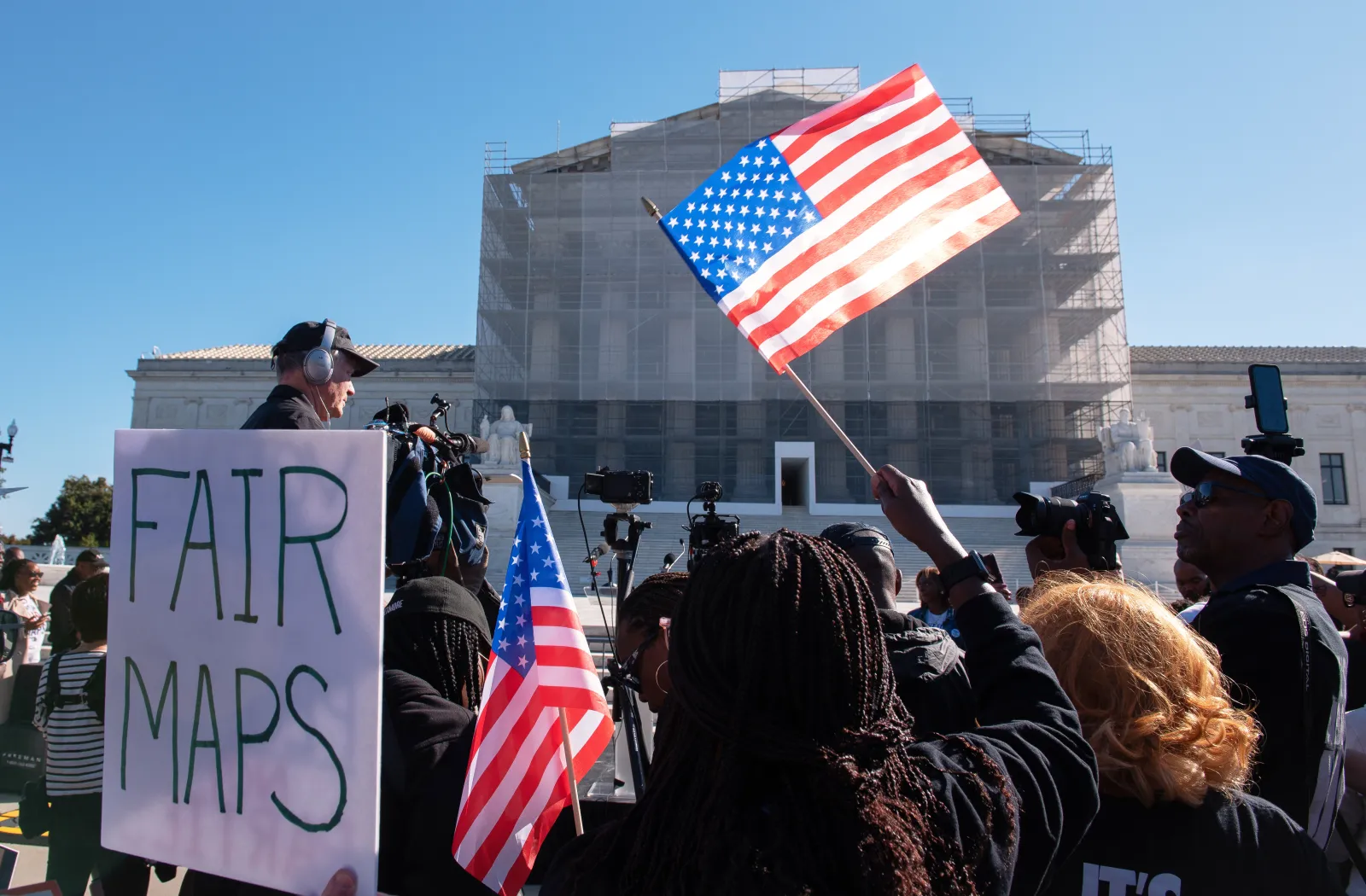
The Supreme Court’s eventual ruling in Louisiana v. Callais will not arrive immediately, and in the meantime, the political and legal maneuvering around redistricting continues across the country. What is already clear is that the decision, whenever it comes, will carry consequences that extend far beyond Louisiana’s borders.
For advocates of minority voting rights, the fear is that a ruling favoring Callais would effectively remove one of the most important legal tools available for ensuring that Black and other minority communities have meaningful representation in Congress. Without the enforcement mechanism that Section 2 provides, they argue, there is little to prevent legislatures in states with significant minority populations from drawing maps that concentrate those voters in ways that diminish rather than strengthen their collective political voice.
For those on the other side of the argument, the principle at stake is that drawing district lines primarily on the basis of race — even with the intention of helping historically marginalized communities — is itself a form of racial classification that the Constitution does not permit. In their view, the remedy for past discrimination cannot be the perpetuation of race-conscious decision-making in the present.
The Court must now navigate between those two positions, with the composition of the United States House of Representatives, and the voting power of millions of Americans, hanging in the balance.
