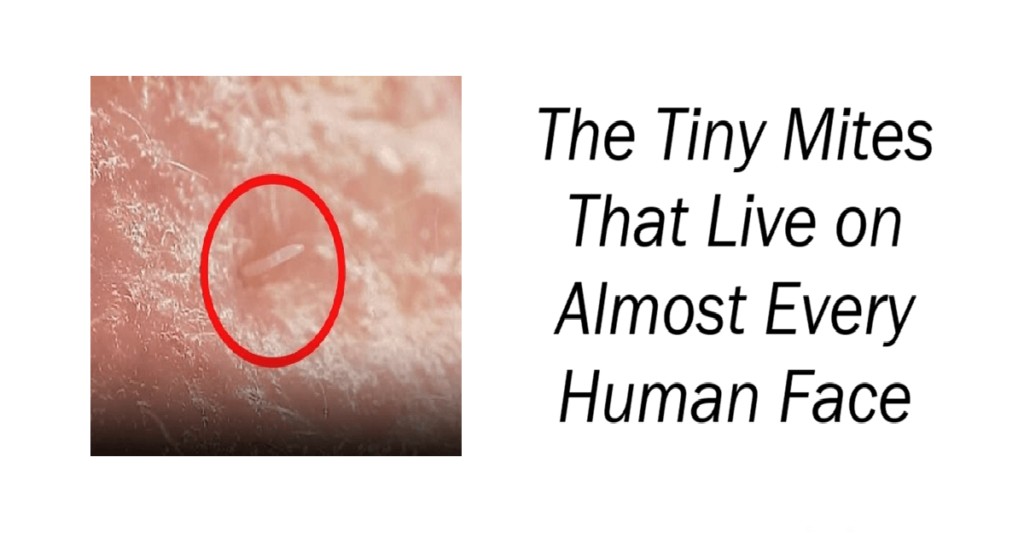

The Tiny Mites That Live on Almost Every Human Face
Microscopic mites known as Demodex folliculorum commonly live in the hair follicles of the human face. Although the idea may sound surprising, these tiny organisms are a normal finding on adult skin. They are usually harmless, invisible without magnification, and part of the wider ecosystem of microbes and microscopic life associated with the human body.
Scientists have known about Demodex mites for more than a century, but modern genetic research has renewed interest in how closely they are adapted to people. Their highly specialized lifestyle, reduced genome, and possible links with certain skin and eyelid conditions make them an important subject in dermatology, ophthalmology, microbiology, and evolutionary biology.
For most people, finding that these mites may live around the eyelashes, nose, cheeks, forehead, or chin is not a reason for concern. Healthy skin is not sterile. It supports a diverse community of bacteria, fungi, viruses, and microscopic animals. The key question is not whether this community exists, but whether its balance is associated with healthy, comfortable skin.
What Is Demodex folliculorum?
Demodex folliculorum is a microscopic, eight-legged mite that lives primarily in human hair follicles. It is one of two Demodex species regularly found on people. The other, Demodex brevis, tends to live deeper in sebaceous glands, where the skin produces oil.
Adult D. folliculorum mites are generally about 0.3 to 0.4 millimetres long. Their narrow, elongated bodies are well suited to the confined space of a follicle. They cannot be seen with the unaided eye, but they can be identified by microscopy and, in clinical settings, by examining samples from eyelashes, skin surface material, or follicles.
These mites are especially common in areas where hair follicles and oil-producing glands are abundant, including the:
- Eyebrows and eyelashes
- Forehead and cheeks
- Nose and the folds around the nose
- Chin and other parts of the face
- Scalp and outer ear area
Studies indicate that Demodex colonization becomes more common with age. They are less often detected in young children and are very common among older adults. Transmission is thought to occur mainly through close physical contact, including contact within households. Their presence does not mean that a person is unclean or has poor hygiene.
Why Face Mites Are So Well Adapted to Humans
Human facial follicles provide Demodex folliculorum with a stable habitat, a regular source of material to consume, and protection from many changing outdoor conditions. The mite spends much of its life inside or near the opening of a follicle, where it is sheltered from direct sunlight, temperature swings, and physical disturbance.
Research published in 2022 in Molecular Biology and Evolution examined the genome of D. folliculorum. The researchers reported that the mite has an unusually reduced genome compared with many related species. Genome reduction can occur when an organism lives in a very stable environment and becomes strongly dependent on a host. Over evolutionary time, genes that are no longer essential may be lost.
The study suggested that human follicular mites have become increasingly specialized for life on people. This does not mean that human and mite DNA are combining, nor does it mean that mites are becoming part of the human body in a genetic sense. Rather, it describes a close ecological relationship in which the mites appear poorly equipped for life away from their human host.
Scientists have described this possibility using the term “symbiosis,” which refers broadly to a close association between different species. Whether the relationship is beneficial, neutral, or harmful can depend on the circumstances. In ordinary numbers on healthy skin, Demodex mites are generally regarded as commensals: organisms that live alongside a host without usually causing noticeable harm.
Are Demodex Mites Active at Night?
Demodex mites are often described as being more active in darkness. Their behavior is difficult to observe directly because of their tiny size and the protected habitat in which they live. However, laboratory and clinical observations have supported the view that they may move toward the skin surface more readily in dark conditions, including for mating.
Their apparent preference for darkness is consistent with their anatomy and genetics. The 2022 genomic study found evidence of reduced biological pathways related to environmental sensing and protection from ultraviolet radiation. Since direct sunlight can be damaging to many small organisms, remaining inside follicles during the day may be advantageous.
It is important not to interpret this behavior in alarming terms. These mites do not roam visibly across the face, and their routine activity is not normally felt by people. The human skin surface hosts an extensive microscopic world that operates beyond ordinary perception.
What Do Human Face Mites Eat?
Demodex folliculorum is associated with material naturally found in and around hair follicles. Its diet is believed to include skin cells, oils known as sebum, and other cellular material within the follicular environment. The skin continually sheds and renews cells, while sebaceous glands produce oil that helps support the skin barrier.
Some popular descriptions claim that face mites act as cleaners that remove debris from pores. This is possible in a limited ecological sense, but scientists do not yet have enough evidence to describe them as essential skin-cleaning organisms. Their role is more complex than a simple benefit-or-harm label.
Another long-running myth claimed that Demodex mites had no anus and therefore stored waste throughout life. Modern anatomical research has challenged that claim. The genetic study of D. folliculorum identified a digestive system and an anus, correcting an idea that had been widely repeated in older popular accounts.
Demodex Mites and the Skin Microbiome
The human skin microbiome is the collection of microorganisms and microscopic life that inhabit the skin. It includes bacteria, fungi, viruses, and organisms such as mites. The exact composition differs from person to person and varies between body sites. Oily areas, dry areas, moist folds, and hair-bearing regions each provide distinct environments.
A balanced skin microbiome can contribute to the skin’s protective barrier and influence immune responses. At the same time, the relationship between microbes and skin health is not always straightforward. A species that is harmless in one setting may become associated with irritation or disease when the skin barrier is disrupted, inflammation is present, or population levels change.
Demodex mites may also carry or interact with microorganisms. Researchers are continuing to investigate whether these interactions influence inflammation, particularly in people with chronic facial or eyelid symptoms. Much remains uncertain, and scientists caution against treating every detection of mites as evidence of a problem.
Can Demodex Mites Cause Skin or Eye Problems?
Most people with Demodex mites have no symptoms and need no treatment. In some circumstances, however, high mite density has been associated with inflammatory conditions. These associations do not always prove that mites are the sole cause. They may contribute to inflammation, thrive in already affected skin, or be one factor among several.
Conditions that have been studied in connection with increased Demodex populations include:
- Rosacea: a common chronic facial skin condition that may involve redness, visible blood vessels, sensitivity, or acne-like bumps.
- Blepharitis: inflammation of the eyelid margins, which can cause irritation, crusting, redness, or a gritty sensation in the eyes.
- Demodicosis: a term used for skin disease thought to be associated with an overgrowth of Demodex mites in particular clinical situations.
The American Academy of Ophthalmology notes that Demodex mites can be involved in some cases of blepharitis. Symptoms such as persistent eyelid irritation, recurrent styes, crusting at the base of the eyelashes, eye redness, or changes in vision should be assessed by an eye-care professional. Vision changes, eye pain, or significant swelling warrant prompt medical attention.
Likewise, persistent facial redness, burning, itching, bumps, or irritation should be discussed with a dermatologist or qualified clinician. These symptoms can have many causes, including rosacea, allergy, eczema, acne, infection, contact irritation, or other inflammatory conditions. Self-diagnosis based on internet images or social-media claims can lead to unnecessary or irritating treatments.
Should You Try to Remove Face Mites?
Routine attempts to eradicate Demodex mites are not necessary for people without symptoms. Over-cleansing, harsh scrubs, undiluted essential oils, or unproven home remedies can damage the skin barrier and worsen redness or irritation. Healthy skin care generally focuses on gentle cleansing, moisturising when appropriate, sun protection, and using products suited to an individual’s skin type.
When a clinician believes Demodex is contributing to a skin or eyelid condition, treatment may be recommended based on the diagnosis. Dermatologists and eye-care specialists can advise on evidence-based options, which may include prescription medicines or carefully selected lid-hygiene measures. The right approach depends on the person’s symptoms, medical history, and the condition being treated.
People should avoid applying products close to the eyes unless they are specifically intended for ophthalmic use or recommended by a qualified professional. The eye area is sensitive, and some substances promoted online can cause irritation or injury.
Why Research on Human Follicular Mites Matters
Research into Demodex folliculorum offers a useful window into evolution and human health. These mites are deeply adapted to a specific human habitat, making them a notable example of how organisms can change over long periods through close association with another species.
Their reduced genome may help scientists understand how dependence on a host develops. Studies of Demodex may also improve knowledge of the skin microbiome, the biology of hair follicles and sebaceous glands, and inflammatory disorders affecting the face and eyelids. As researchers learn more, they may be better able to distinguish harmless colonization from clinically relevant overgrowth.
More broadly, face mites are a reminder that the human body is an ecosystem. People coexist with a vast number of microscopic organisms every day. Many are harmless, some are helpful under certain conditions, and others can become problematic only when the normal balance is altered.
Understanding the Tiny Mites That Live on Human Faces
Demodex folliculorum mites are common microscopic residents of human facial follicles, particularly in adults. They have likely shared our evolutionary history for a very long time, and their biology is closely tied to the sheltered environment of the skin.
For the overwhelming majority of people, they are not a danger and do not require special action. Their presence is not a sign of poor hygiene, and it should not cause alarm. At the same time, medical research supports a cautious and evidence-based approach when persistent skin or eyelid symptoms occur.
The continuing study of these tiny mites demonstrates how much remains to be learned about the organisms that live with us. What may initially seem unsettling is, in fact, a scientifically valuable example of the complex and often peaceful relationships within the human skin ecosystem.
Sources
- Molecular Biology and Evolution: Human follicular mites—ectoparasites becoming symbionts
- American Academy of Ophthalmology: Blepharitis and eyelid health
- American Academy of Dermatology: Rosacea overview
- National Center for Biotechnology Information: Demodex folliculitis and related clinical information
- CDC: Information on healthy interactions with animals and microorganisms
Disclaimer: This content is intended for entertainment purposes only and is not based on real events.