

Lionel Messi Was a Small Boy Whose Family Struggled to Afford His Medical Treatment — Then He Became a Football Legend
From an Uncertain Childhood to an Extraordinary Football Career
Lionel Messi’s rise from a football-loving child in Rosario, Argentina, to a World Cup-winning captain is among the best-known stories in modern sport. His career is often measured through records, trophies and memorable performances, but his early life also involved a significant health challenge and difficult decisions for his family.
Messi was diagnosed in childhood with growth hormone deficiency, a medical condition that can affect a child’s growth and development. Treatment required regular medical care over an extended period, creating financial pressure for a working-class family already supporting several children. His exceptional ability with a football did not remove those practical concerns.
An opportunity with FC Barcelona changed the course of his development. At 13, Messi moved from Argentina to Spain and joined the club’s youth system, where he could continue his football education while receiving support for treatment. The move did not guarantee a professional career, but it gave him access to coaching, competition and healthcare support at a crucial stage of his life.
Over the following decades, Messi became one of football’s most decorated players. His achievements include major titles with Barcelona, individual awards, the 2021 Copa América with Argentina and the 2022 FIFA World Cup. His story is not simply one of individual talent; it also reflects family support, medical care, opportunity and years of disciplined development.
Lionel Messi’s Childhood in Rosario, Argentina
Lionel Andrés Messi was born in Rosario, in Argentina’s Santa Fe province, on June 24, 1987. He grew up in a close-knit family where football was a regular part of daily life. His father, Jorge Messi, worked in a steel factory and coached youth football, while his mother, Celia Cuccittini, worked in a magnet-manufacturing workshop.
Rosario has a strong football culture and has produced several prominent Argentine players. In that environment, Messi began playing at a very young age. Family members and local coaches quickly noticed his close control, balance and ability to move with the ball in tight spaces. He played for Grandoli, a local club, before joining the youth setup of Newell’s Old Boys.
Accounts of Messi’s early years frequently highlight the encouragement of his maternal grandmother, also named Celia. She supported his wish to play and is widely associated with his childhood football journey. Messi has often marked goals by looking upward, a gesture commonly understood as a tribute to her.
Although the family encouraged his sporting ambitions, they did not have unlimited resources. Like many parents of young athletes, they had to balance work, school, household responsibilities and the costs connected with a child’s health and sporting development.
Early Football Talent and a Distinctive Playing Style
Messi’s talent was evident long before he became physically mature. Coaches and teammates saw a young player with unusual coordination, quick decision-making and a natural ability to protect the ball. His technical qualities enabled him to compete effectively against larger opponents.
Rather than relying primarily on strength, Messi developed a style based on acceleration, body balance, awareness and precise touches. His relatively low center of gravity helped him change direction quickly, while his vision allowed him to identify passing options and open spaces. These traits later became defining features of his professional game.
His childhood performances also illustrate an important point about youth sport: physical size alone does not determine long-term potential. Players develop at different rates, and technical skill, coaching, confidence and access to appropriate support can all influence a young athlete’s progress.
Messi’s Growth Hormone Deficiency Diagnosis
When Messi was around 10 years old, he was diagnosed with growth hormone deficiency. This condition occurs when the body does not produce enough growth hormone, which plays an important role in normal childhood growth. Medical professionals assess the condition through specialist evaluation, and treatment plans depend on an individual patient’s needs.
Growth hormone deficiency is a medical issue, not a reflection of a child’s character, effort or athletic potential. According to established medical guidance, treatment may involve prescribed growth hormone therapy and continuing monitoring by qualified clinicians. Families should always seek advice from pediatric endocrinology professionals rather than relying on general information or individual public stories.
For the Messi family, the diagnosis brought uncertainty. Reports about his early career consistently state that treatment costs were difficult for the family to manage. Newell’s Old Boys provided some help, but long-term funding remained unresolved. The situation was especially challenging because Messi’s football future, however promising, was still uncertain.
His experience is often retold as a story of perseverance, but it also underlines the importance of access to healthcare. Determination can be valuable, yet medical treatment depends on trained professionals, family support and financial or institutional resources. Messi’s later success should not obscure the reality that many families face barriers when seeking specialist care for children.
Barcelona’s Offer and the Move to Spain
In 2000, Messi travelled to Barcelona for a trial after the club became aware of his ability. The story of sporting director Carles Rexach recording an agreement on a paper napkin has become part of football folklore, though the key outcome is clear: Barcelona chose to bring Messi into its youth system and agreed to support his medical treatment.
Messi moved to Spain when he was 13. The decision was consequential for the entire family. Leaving Rosario meant adapting to a new country, culture and football environment while also continuing school and medical care. Such a move can be demanding for any young person, particularly one leaving familiar friends and routines behind.
Barcelona’s support created an opportunity, not a guarantee. Messi still needed to develop physically, adapt socially and demonstrate that he could succeed in one of Europe’s most competitive youth academies. His progress depended on sustained work as well as the environment around him.
La Masia and the Development of a Future Star
At Barcelona, Messi developed through the club’s famed academy structure, commonly known as La Masia. The academy has long emphasized technical ability, positional awareness and collective play. For Messi, it provided regular training alongside talented young players and coaches who could refine his existing strengths.
He advanced rapidly through youth levels, showing an ability to dribble through pressure, create opportunities and score goals. Yet academy football is highly competitive, and many gifted young players do not reach the senior level. Messi’s ascent reflected not only natural talent but also consistency, tactical learning and resilience.
His official competitive first-team debut for Barcelona came in October 2004, when he was 17. The appearance marked the beginning of a senior career that would reshape expectations of what an attacking footballer could achieve.
Messi’s Historic Career With FC Barcelona
Messi spent the majority of his senior career at Barcelona, becoming the club’s all-time leading scorer and a central figure during one of its most successful eras. Alongside teammates including Xavi Hernández, Andrés Iniesta and later many others, he helped Barcelona win domestic league titles, Copa del Rey trophies and UEFA Champions League titles.
His influence extended beyond goals. Messi became known for combining elite finishing with passing, chance creation and intelligent movement. He could operate as a winger, central forward, playmaker or false nine, often changing the rhythm of matches through a single run or pass.
Individual recognition followed. Messi has won the Ballon d’Or multiple times, a record that reflects his longevity at the highest level. However, football remains a team sport, and his major achievements were built within successful squads, under coaches with different tactical approaches and alongside teammates who complemented his abilities.
After leaving Barcelona in 2021, Messi played for Paris Saint-Germain before joining Inter Miami CF in Major League Soccer in 2023. His move to the United States increased attention on the league internationally and demonstrated his continuing influence beyond European football.
Argentina, Expectations and International Setbacks
Messi’s career with Argentina carried a particular emotional weight. Argentina is one of football’s most passionate nations, and Messi was often compared with Diego Maradona, who captained the country to the 1986 World Cup title. Those comparisons were persistent and, at times, unfairly simplistic.
Before Argentina’s later success, Messi experienced several painful final defeats with the national team, including at the 2014 FIFA World Cup and Copa América tournaments in 2015 and 2016. These losses prompted widespread debate about his international legacy despite his individual quality and longstanding commitment to the team.
Such scrutiny showed how national-team football can place collective expectations on a single player. No footballer can control every outcome in a tournament, where results depend on teammates, opponents, tactics and small moments across multiple matches. Messi nevertheless remained a central figure for Argentina.
The 2021 Copa América and a New Chapter for Argentina
Argentina’s 2021 Copa América victory in Brazil was a major turning point. Argentina defeated Brazil 1-0 in the final at the Maracanã Stadium, securing Messi’s first major senior international trophy. The result ended a long wait for the national team and brought evident significance for players and supporters alike.
Messi was a leading contributor throughout the tournament, and the victory changed the framing of his international career. It did not erase earlier disappointments, but it demonstrated the team’s ability to recover, develop cohesion and succeed under pressure.
The win was followed by another important result: Argentina defeated Italy in the 2022 Finalissima, an intercontinental match between the reigning Copa América and European Championship winners. The team entered the World Cup later that year with increasing confidence.
Argentina’s 2022 FIFA World Cup Triumph
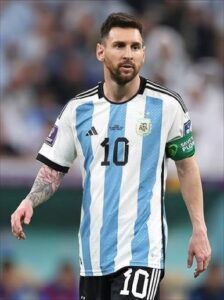
At the 2022 FIFA World Cup in Qatar, Messi captained Argentina to one of the most celebrated victories in the country’s sporting history. Argentina recovered from an opening defeat against Saudi Arabia, progressed through the knockout stages and reached the final against France.
The final ended 3-3 after extra time and was decided by a penalty shootout, which Argentina won. Messi scored twice during the match and converted his penalty in the shootout. The result gave Argentina its third men’s World Cup title, following triumphs in 1978 and 1986.
For supporters, Messi lifting the World Cup represented the culmination of a long international journey. It also prompted reactions around the world from athletes, former players, clubs and fans who recognized the scale of the achievement. FIFA named Messi the tournament’s best player, awarding him the Golden Ball.
The victory reinforced his standing in discussions about football’s greatest players, while also emphasizing the collective nature of Argentina’s success. Coach Lionel Scaloni, goalkeeper Emiliano Martínez, forward Julián Álvarez, midfielder Enzo Fernández and many other squad members played important roles throughout the tournament.
What Lionel Messi’s Story Means Beyond Football
Messi’s life story is often described as inspirational because it begins with uncertainty rather than certainty. He was a talented child, but talent alone did not pay for medical treatment, ensure a place at an elite academy or guarantee success in professional football. His path involved parents who supported him, medical specialists who addressed his condition, coaches who developed his skills and a club willing to invest in his future.
That context matters. Stories about successful athletes can sometimes imply that determination by itself overcomes every obstacle. Messi’s experience offers a more realistic lesson: personal effort is important, but access to healthcare, supportive family relationships, safe training environments and educational opportunities can be equally significant.
His style has also influenced younger generations of players. Messi demonstrated that intelligence, technique and spatial awareness can be as valuable as physical power. Coaches and young footballers frequently study his ability to receive the ball under pressure, create space and make effective decisions at speed.
From Rosario to Worldwide Recognition
The distance between Messi’s childhood in Rosario and his global status is enormous. He began as a young player surrounded by family and local football, while facing a diagnosis that created genuine concerns about treatment and affordability. The move to Barcelona gave him a route forward, but the outcome remained unknown.
His career eventually brought club success in Spain and France, a new chapter in the United States, and defining achievements with Argentina. He became a global sporting figure while retaining a strong connection to his home country and the city where his football journey began.
Messi’s story remains compelling because it contains both exceptional achievement and recognizable human realities: family sacrifice, health concerns, adaptation to change, setbacks and persistence. His accomplishments were extraordinary, but the early stages of his life show why opportunity and support can matter so much.
The Lasting Legacy of Lionel Messi
Lionel Messi’s legacy includes statistics and trophies, but it cannot be reduced to either. He is remembered for a distinctive football style, remarkable consistency and major success at club and international level. The 2021 Copa América and 2022 World Cup gave his Argentina career a triumphant conclusion to years of pressure and expectation.
His childhood medical treatment remains an important part of the broader story, not because it defines him, but because it explains some of the uncertainty his family faced before his career began. With medical support, family encouragement and an opportunity at Barcelona, Messi was able to continue developing his potential.
From a small boy playing football in Rosario to a world champion admired across continents, Messi’s career demonstrates how exceptional ability can flourish when it is matched by care, preparation and sustained support.
Sources
- FIFA: Qatar 2022 World Cup official coverage
- FC Barcelona: Lionel Messi player profile and club history
- Encyclopaedia Britannica: Lionel Messi biography
- CDC: Information on growth disorders
- Mayo Clinic: Growth hormone deficiency overview
- Reuters: International sports reporting
- BBC Sport: Football coverage
Disclaimer: This content is intended for entertainment purposes only and is not based on real events.