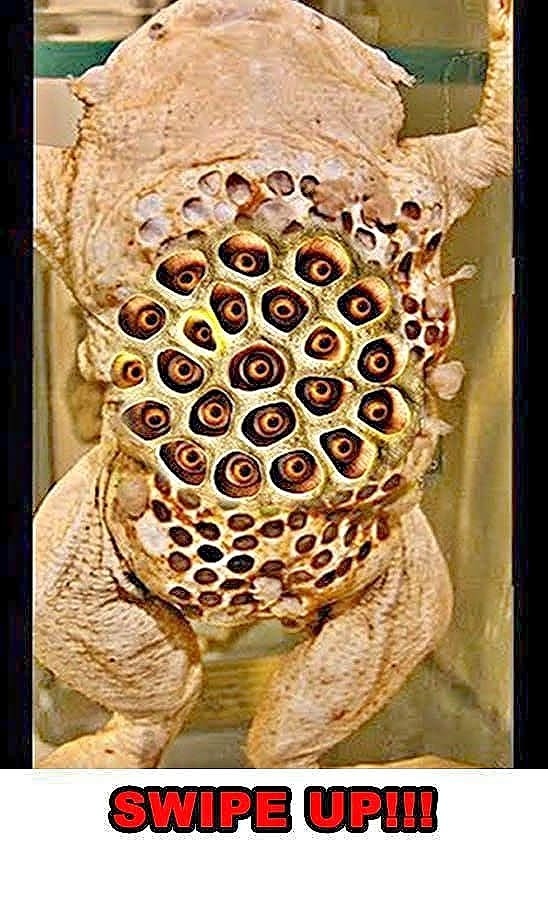

They warned you not to watch. You pressed play anyway. The first movement under her skin is small, almost deniable. Then the grid appears—dozens of blunt, rising bulges, like a body turned into bubble wrap from below. Something pushes, insists, tears the surface. This isn’t birth. It’s an invasion in reve…
In the dark hush of a shallow pool, the Surinam toad turns motherhood into something that feels closer to a possession. There is no soft nest, no hidden burrow—only her exposed back, offered up as a living chamber. Each egg is pressed into her skin, swallowed by it, until her body becomes a quilt of quiet, pulsing rooms. To us, it looks like a horror that should not exist. To her, it is simply survival.
Days pass with no visible drama. Beneath the sealed surface, entire lives are built in secret. Then, without warning, the calm breaks. Tiny, fully formed toads punch their way out, one after another, the skin rupturing in violent little miracles. It is grotesque, mesmerizing, unforgettable. And when her back finally smooths over, you’re left with a single, stubborn realization: nature never promised to be comforting—only astonishing.
The Evolutionary Logic Behind an Unsettling Strategy
To understand why Pipa pipa—the flat, leaf-shaped Surinam toad native to the murky waterways of South America—evolved one of the most visually arresting reproductive methods in the animal kingdom, one must look at the brutal mathematics of aquatic survival.
In tropical rivers, flooded forests, and slow-moving swamps, exposed amphibian eggs face relentless predation. Fish, aquatic insects, crustaceans, and water birds strip unprotected egg clutches clean within hours. Most frogs and toads counter these odds through sheer volume, laying thousands of eggs in open water and abandoning them to chance. The Surinam toad chose the opposite extreme: fortified parental custody.
Rather than building a nest out of mud or leaves that could be swept away by currents or discovered by scavengers, the female Surinam toad turns her own body into an armored, mobile nursery. Wherever she swims, her offspring travel with her, shielded beneath living tissue until they are mature enough to fend for themselves.
The Anatomy of a Living Honeycomb
What appears on camera like a sudden skin eruption is actually a precisely choreographed physiological process triggered by reproductive hormones. Prior to mating, the skin on the female’s back thickens and becomes richly vascularized, primed to respond to physical contact.
During a complex underwater mating ritual—in which the male and female perform vertical somersaults through the water column—the female releases between 60 and 100 eggs. As they arc downward, the male catches them against his belly and presses them firmly onto the receptive skin of her back.
Inside each sealed pocket—roughly the size of a small pea—the embryo bypasses the vulnerable, free-swimming tadpole stage entirely. Every pocket functions like a biological womb, exchanging gases through the mother’s dense network of capillaries while keeping the developing young insulated from sudden shifts in water chemistry or temperature.
Why the Human Brain Recoils: Trypophobia and Visual Paradox
Few wildlife clips provoke as visceral a reaction online as a Surinam toad giving birth. Even viewers who love nature documentaries often report feeling an immediate wave of skin-crawling discomfort, nausea, or fascination mixed with dread.
Psychologists point to trypophobia—an instinctive aversion to clusters of small holes, bumps, or asymmetrical organic patterns. Evolutionary researchers suggest that this reaction evolved as an automated disease-avoidance mechanism. Throughout human history, clustered bumps, blisters, and rupturing skin lesions on mammals signaled contagious parasites, infections, or venomous bites.
When the human brain watches dozens of living creatures push out through pores in a frog’s back, it misfires:
-
Category Confusion: Our visual cortex maps the amphibian’s flat, mottled skin onto human skin, triggering a phantom sympathetic sensation of itching or invasion.
-
Subversion of Expectations: Humans associate birth with softness, warmth, and mammalian care. Watching miniature adults tear through a sealed dermal grid shatters familiar mental templates, turning a miracle of maternal devotion into something resembling body horror.
Yet, from a strictly biological standpoint, the mother toad experiences no catastrophic injury. Once the last two-centimeter toadlet wriggles free and swims away, she rubs against submerged logs or stones, sheds the stretched outer layer of skin, and emerges completely intact—ready to repeat the cycle the following season.
Master of Camouflage in Murky Waters
Beyond its extraordinary reproductive biology, Pipa pipa is a masterclass in evolutionary specialization. Unlike typical frogs built for leaping across lily pads, the Surinam toad is flattened like a fallen dead leaf, measuring up to twenty centimeters long with mottled brown skin that blends seamlessly into decaying riverbed foliage.
It possesses no tongue and no teeth. Instead, it relies on specialized star-shaped sensory organs at the tips of its long, slender front fingers to detect subtle vibrations in pitch-black, muddy water. When a small fish or worm brushes past, the toad opens its wide mouth with explosive speed, creating a vacuum that sucks prey straight down its throat in a fraction of a second.
Redefining What Care Looks Like in the Natural World
Viral videos often reduce the Surinam toad to shock value—a brief clip shared for gasps and horrified comments. Yet looking past that initial flinch reveals one of evolution’s most devoted examples of maternal investment.
For up to four months, a female Surinam toad carries the weight, metabolic demand, and physical bulk of an entire generation embedded directly into her body. She does not abandon her young to the currents, nor does she leave them exposed to hungry jaws in the dark. Nature has no obligation to match human aesthetics or gentle expectations—and in the quiet, muddy waters of the Amazon, survival wears whatever shape works best.