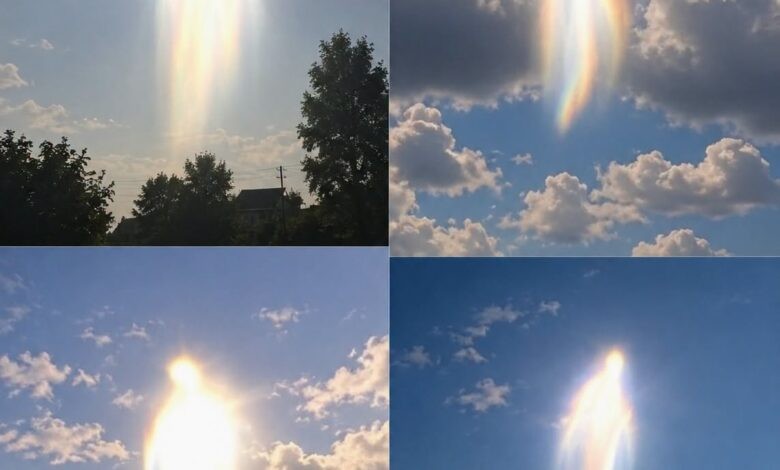

Understanding the Unusual Sky Above Ikaria: Atmospheric Optics, Mirages and Human Perception
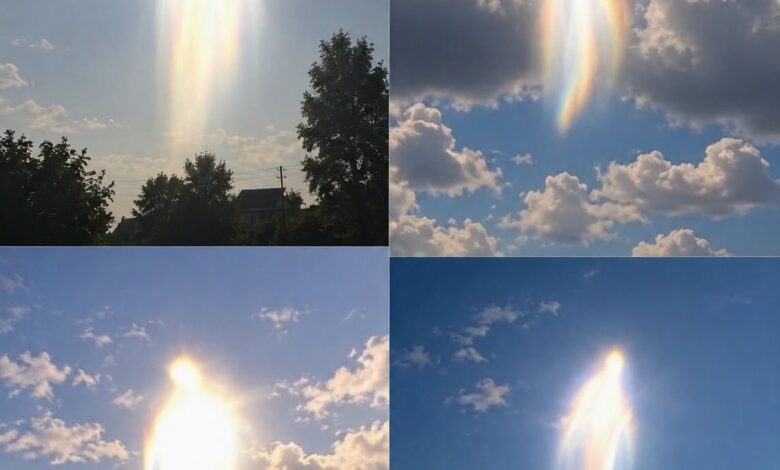
Unusual lights and shapes in the sky can be deeply compelling, particularly when they appear over an open sea at sunrise or sunset. Around Ikaria, a Greek island in the eastern Aegean Sea, the combination of broad horizons, changing coastal weather and low-angle sunlight can make ordinary atmospheric processes appear strikingly unfamiliar. A bright glow may seem to hover above the water. A distant cloud, vessel or shoreline feature may appear stretched, elevated or distorted. Bands of light can resemble pillars, arcs or sharply defined objects.
Without detailed observations, including the time, location, weather conditions and original image or video data, it is not possible to identify any particular sight with certainty. However, atmospheric science provides several well-established explanations for many reports of unusual sky displays. These include halos caused by ice crystals, mirages produced by temperature inversions, glare and reflections over water, cloud illumination, and the brain’s natural tendency to interpret ambiguous visual patterns as recognizable objects.
These explanations do not make a remarkable sight less meaningful. On the contrary, they show how complex and visually powerful the interaction between sunlight, air, water and human perception can be. The atmosphere is not a blank backdrop. It is an active optical medium that bends, scatters, reflects and filters light before it reaches an observer’s eyes.
Why Sunrise and Sunset Create Dramatic Optical Effects
Sunrise and sunset are among the most favorable times for unusual-looking atmospheric displays. When the Sun is high overhead, its rays take a relatively direct path through the atmosphere. Near the horizon, sunlight travels through a much longer stretch of air. That longer path increases the influence of tiny particles, water droplets, aerosols, dust and layers of air at different temperatures.
Rayleigh scattering, the process that scatters shorter blue wavelengths of sunlight more strongly than longer red and orange wavelengths, helps explain the warm colors often seen near dawn and dusk. Larger particles, including haze, sea salt and dust, can further affect how light is scattered and softened. The result may be a glowing horizon, intensely colored cloud edges or a luminous patch that appears separate from the Sun itself.
At low solar angles, contrast can also become misleading. A bright region of sky viewed against darker clouds, mountain silhouettes or the shaded sea may seem to have crisp boundaries. Although the feature may be only a gradient of illumination, the visual system can interpret it as a defined, solid form. This is especially likely when the light changes quickly as clouds drift or air layers shift.
The Aegean environment can add to this effect. Coastal air is influenced by daily heating and cooling over land and water, while winds can move moisture, haze and dust through the region. Each factor can alter visibility and color. The precise conditions vary by season and day, but the basic physics remains the same: light reaching the observer has already been shaped by the atmosphere.
Halos, Sun Dogs and Light Pillars
Some of the most recognizable atmospheric optical phenomena are created by ice crystals high in the atmosphere. Thin, high clouds known as cirrus or cirrostratus clouds often contain small ice crystals. When sunlight passes through crystals with particular shapes and orientations, it can be refracted or reflected into visible arcs, rings and bright spots.
A solar halo is commonly seen as a large ring around the Sun, often with a radius of about 22 degrees. It forms when light passes through randomly oriented hexagonal ice crystals. Depending on the crystal types and viewing conditions, observers may also see brighter areas at the sides of the halo. These bright patches are often called sun dogs, or parhelia. They can look like separate lights and may be especially noticeable when the Sun is low.
Light pillars are another possible effect. They appear as vertical columns of light extending above or below a bright source, such as the Sun near the horizon or artificial lights after dark. Pillars form when light reflects from flat, plate-shaped ice crystals that are nearly horizontal in the air. A solar pillar can appear as a luminous vertical beam, sometimes giving the impression that a bright object is suspended over the horizon.
Not every unusual glow is a halo or pillar, and the presence of ice crystals cannot be assumed without weather evidence. Still, these phenomena are documented by meteorological organizations around the world. Their unfamiliar shapes demonstrate that atmospheric optics can create scenes that appear extraordinary while following known physical principles.
Mirages Over the Sea and Temperature Inversions
Mirages are another important explanation for apparently displaced or hovering forms near a sea horizon. They are not imaginary; they are real optical images caused by the bending of light through layers of air with different temperatures and densities. Because air density affects its refractive properties, a steep temperature gradient can curve light rays enough to alter the apparent position or shape of distant objects.
Over water, temperature inversions can develop when cooler, denser air remains near the sea surface while warmer air sits above it. This arrangement can produce a superior mirage, in which an object appears higher than its true position. Distant islands, ships, clouds or sections of coastline may seem elevated, elongated or oddly layered. In more complex cases, multiple distorted images can appear above one another.
A related phenomenon, sometimes called looming, makes distant objects appear taller or closer than expected. Under suitable conditions, a faraway vessel may seem to float above the horizon because the lower part of its image is hidden, displaced or blended into the water and haze. The effect can look highly convincing from a fixed viewpoint, especially when there are few familiar reference points on the open sea.
Mirages are dynamic. As temperatures, wind and viewing angles change, the image can ripple, stretch, break apart or disappear. This movement may be interpreted as the motion of an object, even though it is primarily the changing path of light. Such variability is one reason eyewitness descriptions can differ substantially from one observer to another.
The Horizon as an Optical and Psychological Boundary
Sea horizons create ideal conditions for visual ambiguity. They provide a clean, horizontal boundary that makes any bright, dark or elevated feature stand out. At the same time, haze often reduces detail at great distances. An observer may see a compelling outline without enough visual information to determine its size, distance or source.
Perspective adds another challenge. People are very good at recognizing nearby objects in familiar settings, but they are less able to judge scale over open water. A small nearby cloud, a distant ship, a reflection or a refracted image can all appear difficult to place. At sunset, when color and contrast shift quickly, the brain must interpret incomplete information in real time.
Photography and video can amplify this uncertainty. Camera lenses, exposure settings, digital zoom, image stabilization and compression can change the appearance of a distant light or shape. A phone camera may brighten a dim glow, clip fine details around the Sun or exaggerate shimmering caused by atmospheric turbulence. An image can be useful evidence, but it should be assessed alongside metadata, weather records, the direction of view and any unedited original files.
How Human Perception Interprets Ambiguous Light
Human perception is designed to rapidly identify meaningful patterns. This ability is useful in everyday life, but it can also lead people to see familiar forms in ambiguous visual information. Psychologists refer to this broad tendency as pareidolia: the perception of recognizable patterns, such as faces or objects, in random or unclear stimuli.
In a changing sky, a bright patch may resemble a structured object because the visual system naturally searches for edges, symmetry, motion and contrast. A shifting outline becomes a shape; a shape may suggest an object; and a change in brightness can appear intentional. These impressions can form within moments, before a person has time to consider how clouds, haze, reflections or refraction might be influencing the view.
Emotional context matters as well. A rare or unexpected sight can create surprise, awe or unease. Those feelings are valid responses to an unfamiliar event, but they do not establish its cause. Careful observation is most useful when it separates what was directly seen from interpretations about what the sight may have been.
Scientists and investigators generally begin with the simplest testable possibilities: the position of the Sun, Moon or planets; aircraft and satellite paths; local weather; cloud type; known optical effects; marine traffic; and potential camera artifacts. This approach does not dismiss an observer’s experience. It helps build an explanation that can be checked against evidence.
How to Document an Unusual Sky Event Responsibly
Anyone who sees an unusual feature above Ikaria or elsewhere can improve the quality of the observation by recording a few practical details. Note the exact time and date, approximate location, compass direction, weather conditions and the feature’s apparent position relative to the Sun, Moon or horizon. If possible, take several wide-angle images before using digital zoom. A short sequence of photographs can show whether the feature moved independently or changed with clouds and light.
Keeping the original image or video file is important. Original files may retain timestamps, lens information and location data, depending on device settings. Avoid heavy editing, filters or repeated re-uploading before analysis, since these can change colors, detail and contrast. Nearby witnesses can also provide useful comparisons, particularly if they viewed the event from different locations.
Weather data can offer further context. Cloud cover, temperature profiles, humidity, wind and visibility reports may help determine whether a halo, mirage or other optical event was plausible. National meteorological services and established scientific organizations are better sources for such analysis than unsupported social-media claims.
Why a Scientific Explanation Can Increase the Sense of Wonder
The most compelling aspect of an unusual sky scene is often the meeting of ordinary ingredients: sunlight, water vapor, ice crystals, airborne particles, temperature differences and a human observer. None of these elements is unusual on its own. Together, they can produce an image that feels detached from everyday experience.
Ikaria’s island landscape and the surrounding Aegean Sea offer an especially evocative setting for this kind of observation. Clear horizons, coastal weather transitions and the changing colors of dawn and dusk can make atmospheric effects easier to notice. Yet similar events occur around the world, from polar regions with frequent ice-crystal displays to warm coastlines where inversions produce dramatic mirages.
A careful explanation should remain proportionate to the available evidence. In the absence of detailed, independently verifiable information, it is more accurate to describe a sight as consistent with possible atmospheric optics than to make a definitive claim. This standard protects both scientific integrity and the public’s ability to appreciate the genuine complexity of the natural world.
Ultimately, understanding refraction, scattering and perception does not reduce the beauty of a strange light over the sea. It reveals why the atmosphere can be such an accomplished visual artist. Sometimes the sky appears otherworldly not because it has ceased to follow natural laws, but because those laws are operating in combinations that people rarely get the chance to see.
Sources
Disclaimer: This content is intended for entertainment purposes only and is not based on real events.