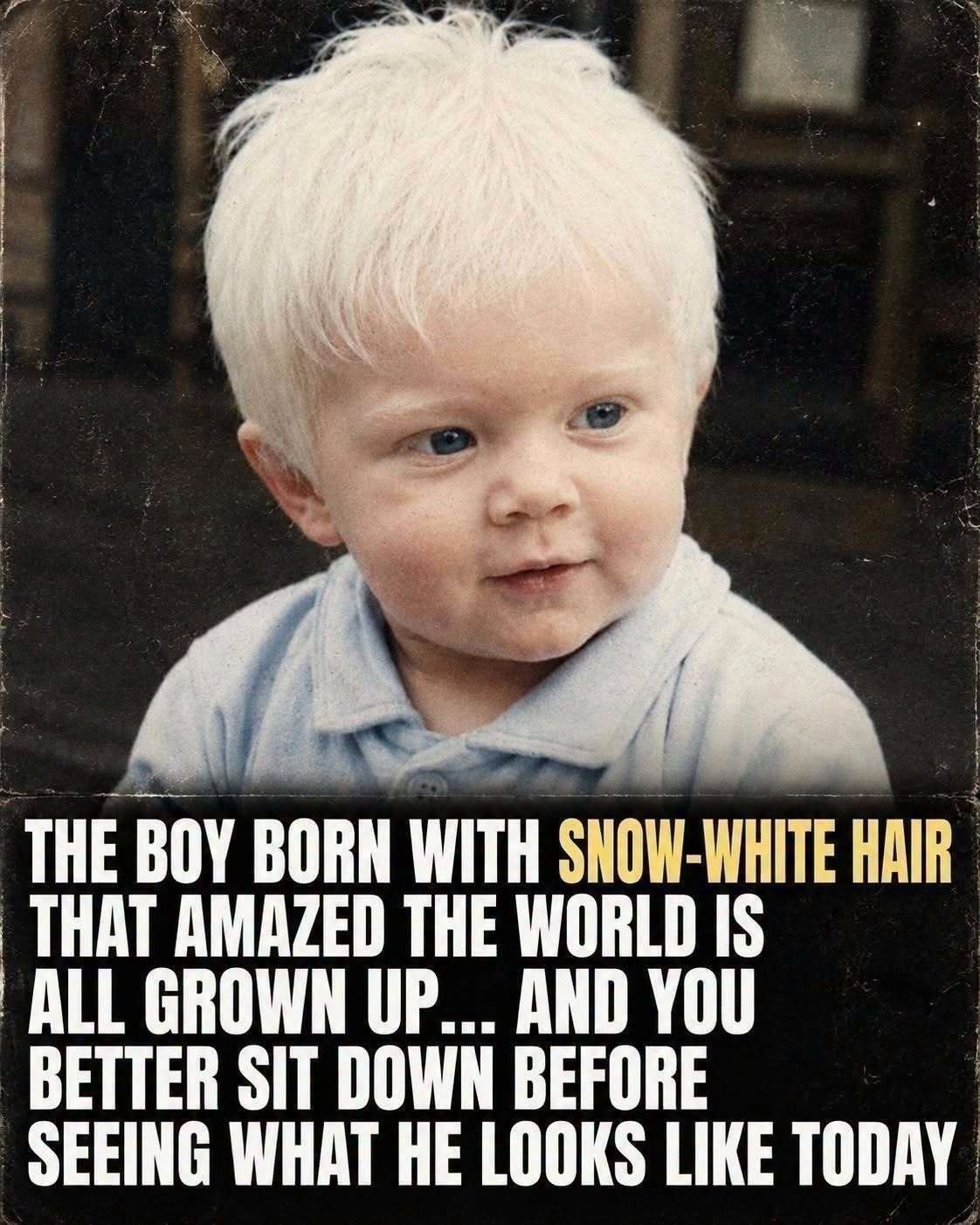

The Unforgettable White-Haired Boy: Looking Beyond Appearance
The world noticed his white hair before it knew his name. Images of a young boy with strikingly pale hair drew widespread attention online, prompting admiration, curiosity and countless assumptions from people who had never met him. Yet behind the photographs was a more important question: how can a child grow up as an individual when public attention focuses first on a visible physical trait?
Stories about children with distinctive appearances often spread quickly because images are immediate and emotionally powerful. A rare hair colour, a unique birthmark or an unusual eye colour can become the focus of online conversation within hours. But viral attention does not always capture the full reality of a child’s life, family, health or personality. It may also create lasting expectations that a young person did not choose.
The available description of this boy does not establish a diagnosis, his identity or the precise cause of his white hair. That distinction matters. White or very light hair can occur for several reasons, and no medical conclusion should be drawn from a photograph alone. The most responsible way to discuss such stories is to focus on reliable information, respect for privacy and the broader need to see children as more than an image.
Why White Hair Can Attract So Much Attention
Hair colour is shaped largely by melanin, a natural pigment produced by specialised cells called melanocytes. Differences in the amount and type of melanin influence whether hair appears black, brown, blond, red, grey or white. Because very pale hair is less common in many populations, it can stand out visually and attract attention in public spaces and on social media.
For adults, an unusual appearance may be treated as an individual style or defining characteristic. For children, however, attention can be more complicated. They are still developing their sense of self, learning how to navigate friendships and relying on parents or caregivers to make decisions about privacy. When strangers share or comment on a child’s image, the child may have little control over the story being told about them.
Online audiences often respond positively, with messages describing a child as beautiful, unique or memorable. While kind intentions are valuable, even praise can unintentionally reduce a person to one feature. A child is not simply “the white-haired boy” or “the unusual-looking child.” They are a student, family member, friend and growing individual with interests, routines and ambitions that may have nothing to do with public fascination.
What Can Cause Naturally White or Very Light Hair?
There is no single explanation for naturally white hair in childhood. Some people are born with very light blond or white-looking hair because of inherited traits. In other cases, changes in pigmentation may be related to a medical or genetic condition. Only qualified healthcare professionals, working with a child and their family, can assess whether any medical evaluation is appropriate.
One condition commonly discussed in relation to very light hair is albinism. According to the World Health Organization, albinism is a group of inherited conditions that affect melanin production. It can influence the colour of the skin, hair and eyes. Many people with albinism also have vision differences, because melanin plays a role in the normal development of the eyes.
It is important to understand that albinism varies widely. Hair colour among people with albinism may range from white or very pale blond to light brown, depending on the type of albinism and a person’s genetic background. Not every person with pale hair has albinism, and not every person with albinism has hair that appears entirely white. A photograph cannot provide enough information to make a reliable determination.
Other pigment-related conditions can also affect small areas of hair or skin. For example, poliosis refers to a localised patch of white hair caused by reduced or absent pigment in hair follicles. Vitiligo is a condition in which areas of skin lose pigment, and it can sometimes affect hair growing from those areas. Premature greying may also occur in some families. These possibilities illustrate why broad assumptions are neither medically sound nor respectful.
Health Considerations and the Importance of Professional Care
When a child has an unusual pigmentation pattern, families may seek advice from a paediatrician, dermatologist, eye specialist or genetic counsellor. The purpose is not to label a child unnecessarily, but to understand whether there are health needs that deserve attention. A clinician can consider family history, vision, skin sensitivity and other relevant factors in a way that an online audience cannot.
For people with albinism, eye care can be especially important. The National Eye Institute explains that albinism may be associated with reduced visual acuity, sensitivity to light, involuntary eye movements and differences in how the eyes work together. Regular ophthalmological care can help families understand a child’s visual needs and explore practical support at home and at school.
Sun protection is another important consideration for people with reduced skin pigmentation. The American Academy of Dermatology advises protective measures such as seeking shade, wearing sun-protective clothing and using broad-spectrum sunscreen when outdoors. These habits are useful for everyone, but they can be particularly significant for individuals whose skin has less natural protection from ultraviolet radiation.
Health information should always be presented carefully. Having a visible difference does not define a child’s overall wellbeing, intelligence, abilities or future. Many children with pigment-related conditions participate fully in school, sports, arts, family life and their communities. Supportive care is about removing barriers and helping children thrive, not treating difference as something that diminishes their value.
The Social Impact of Being Seen as “Different”
Children can be remarkably perceptive about difference. Questions from classmates or strangers may be innocent, but repeated attention can become tiring. Some children enjoy explaining a personal feature; others may prefer not to discuss it. Both responses deserve respect.
Parents and caregivers can help by giving children age-appropriate language to describe themselves if they want to. For example, a child may choose to say that their hair colour is natural, that they have a condition affecting pigment, or simply that they do not want to talk about it. Giving a child choices helps build confidence and establishes that their body and personal story belong to them.
Schools also have an important role. Inclusive classrooms can reduce stigma by teaching students that human variation is normal. Educators can address teasing promptly, encourage respectful questions and make reasonable accommodations when a child has vision or light-sensitivity needs. Creating a welcoming environment benefits not only children with visible differences but all students who may feel singled out for any reason.
Language matters in these conversations. Descriptions such as “strange,” “alien” or “unreal” may seem casual online, but they can reinforce the idea that a child does not belong. A better approach is to use neutral language, avoid speculation and recognise the person before the appearance. Curiosity should never override dignity.
Viral Images, Consent and Children’s Digital Privacy
The rapid spread of photographs raises broader questions about children’s privacy in the digital age. Once an image is copied, reposted or turned into a social-media trend, it may become difficult for a family to control where it appears or how it is described. Context can disappear quickly, while comments and captions may remain searchable for years.
Parents who share family images often do so with positive intentions: to celebrate a child, connect with others or raise awareness of a condition. At the same time, digital sharing involves trade-offs. Children may later have different feelings about images or personal details posted when they were too young to consent.
Child-safety experts commonly encourage families to consider privacy settings, avoid publishing identifying details such as full names, school locations or daily routines, and think carefully before sharing medical information. These steps do not require families to hide their lives. Rather, they help ensure that a child’s safety and future autonomy remain central.
For viewers, responsible engagement is equally important. Before sharing an image of a child, people can ask whether it comes from a verified source, whether the family has chosen public visibility and whether the post adds meaningful information. Avoiding speculation, invasive comments and reposting without context is a practical way to respect children online.
Representation Can Build Understanding When It Is Respectful
Thoughtful representation of people with visible differences can have real value. When stories include accurate information and centre the voices of individuals and families, they can challenge myths and help others feel less isolated. Seeing people with different appearances in education, media, fashion, workplaces and public life can broaden ideas about beauty and belonging.
However, representation should not turn people into symbols. A child should not be expected to educate strangers, represent an entire medical community or continually answer personal questions. The most meaningful stories are those that allow people to speak for themselves, on their own terms, while also recognising the ordinary parts of life that exist beyond public attention.
International advocacy groups working with people with albinism have repeatedly highlighted the importance of inclusion, access to healthcare, education and protection from discrimination. Their work shows that public understanding is most effective when it is paired with practical action: accessible eye care, sun-protection resources, supportive schools and legal protections for equal participation.
Looking Beyond a Child’s Appearance
The lasting lesson from the story of a white-haired boy is not simply that his appearance was remarkable. It is that every child deserves to be viewed in full. A photograph may reveal hair colour, but it cannot show a child’s favourite subject, sense of humour, friendships, worries, talents or dreams.
Families, schools, journalists and online audiences all shape the environment in which children grow up. By using accurate information, protecting privacy and avoiding assumptions, adults can make that environment kinder and more inclusive. The goal is not to ignore difference, but to respond to it with understanding rather than spectacle.
As public interest moves from one viral image to the next, the child at the centre of attention continues to grow. He deserves the freedom to define himself beyond the expectations of strangers. His white hair may have been what people noticed first, but it should never be mistaken for the whole story.
Sources
Disclaimer: This content is intended for entertainment purposes only and is not based on real events.
