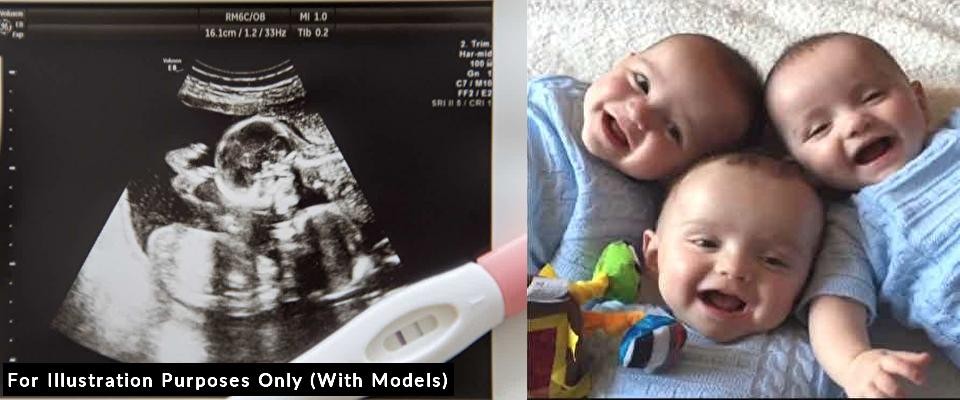

The phenomenon of multiple births has always fascinated both medical professionals and the general public. While twins are relatively common, the birth of triplets is much rarer—and identical triplets are exceedingly rare, with odds estimated at about one in 200 million. In England, Becki-Jo Allen’s story has captured international attention, not only for its extraordinary odds but also for the resilience and love she has shown in embracing this challenge.
Before experiencing this marvel, Becki-Jo Allen was already a proud mother to her young daughter, Indiana. In her early twenties, Allen’s life was set for a dramatic change when she began to experience symptoms of pregnancy. Upon confirming she was expecting again, she was filled with excitement. However, her journey took an unexpected turn when a routine medical visit revealed she was carrying not one, but three babies.
Allen’s discovery made headlines and prompted interest from the medical community and wider society, adding her experience to the very limited group of parents who have welcomed identical triplets.
The Rarity and Science of Identical Triplets
According to the Liverpool Echo, Allen learned she was carrying triplets, marking a unique moment in her family’s history. This rare event prompted questions about the scientific mechanisms that lead to such births.
Triplets occur either because three separate eggs are fertilized (fraternal triplets) or, more rarely, because one fertilized egg splits into three embryos (identical triplets). Most triplets are fraternal; identical triplets result from one egg dividing after fertilization, which is why their genetic makeup is nearly identical. The statistical odds of having identical triplets are extensively quoted: as highlighted by TODAY, most experts put the likelihood at one in 200 million births—making Allen’s case remarkable.
Becki-Jo Allen’s story underscores how medical science can still be surprised by natural occurrences, and it adds an important chapter to global understanding of genetics and reproductive health.
The Birth and Early Challenges
Allen gave birth to her three sons—Rocco, Roman, and Rohan—when she was 31 weeks pregnant. Like many multiples, the boys were born prematurely and required specialized medical care. The triplets weighed 3 lbs 5 oz, 3 lbs 6 oz, and 3 lbs 10 oz respectively, and were admitted to the neonatal intensive care unit (NICU) to ensure their health and development.
Premature birth is often associated with multiples due to limited space and medical factors. The NICU team closely monitored the triplets, assisting them in gaining weight and overcoming initial health challenges. The boys remained in care for approximately six weeks before being judged healthy enough to go home with their family.
This initial period was critical, showcasing the importance of neonatal medicine and highlighting the emotional journey endured by families of premature multiples.
Discovering Their Identical Nature
After bringing the triplets home, Allen noticed something extraordinary—her sons appeared to be identical. Although medical staff had initially told her the boys were not identical, Allen’s observations suggested otherwise; her intuition led her to seek scientific confirmation. She arranged for DNA testing, and results confirmed her suspicions: Rocco, Roman, and Rohan were indeed identical triplets.
For Illustration Purposes Only (With Models) – istockphoto.com/BorupFoto
“We don’t get anywhere fast because people are always stopping us when we’re out and asking if they are identical,” Allen explained. “I was always convinced they weren’t, because that’s what I had been told during my pregnancy.”
The DNA test provided conclusive evidence, settling the question for both the Allen family and the medical professionals. This was an emotionally significant moment, as scientific validation aligned with Allen’s maternal instincts.
Identical triplets challenge medical assumptions and remind experts that exceptions to common outcomes still occur. This case therefore has value both as a human story and a contribution to ongoing genetic research.
Individuality Among Identical Triplets
Despite their genetic similarities, Allen has noted that each son possesses a distinct temperament and personality. Their mother is adept at telling them apart, especially now as they have grown, but she sometimes found it difficult when they were babies asleep side-by-side. Small birthmarks and subtle differences helped Becki-Jo and her support network distinguish the brothers during infancy.
This speaks to a broader scientific understanding of nature versus nurture. While identical triplets may share DNA, environmental and social factors play critical roles in shaping personalities and behaviors over time.
Allen’s experience highlights how family dynamics adapt to the complexities presented by multiple births. Parenting identical triplets presents unique logistical and emotional challenges, from medical care to daily routines to fostering each child’s individuality.
The Family’s Journey in the Public Eye
As the triplets have grown, Allen has documented their lives on social media, sharing milestones, birthday celebrations, and everyday moments. In December 2021, Allen posted a throwback photo with the triplets using the hashtag #tripletmama. Such posts have resonated with a global audience, highlighting both the joys and challenges of raising multiples.
In July 2022, Allen marked the boys’ seventh birthday with a video celebrating their growth and resilience. She wrote:
In 2023, Allen shared another milestone as her sons turned eight, posting a delightful photo showing the boys in matching outfits and green headphones. These moments have allowed Allen to connect with other parents of multiples, share insights, and foster community.
The family’s story has received positive reactions from the media and society. Articles in leading outlets have chronicled their journey and provided educational value by highlighting the rarity of identical triplets and the dedication required in raising them.
Allen’s openness serves as a support mechanism for others facing similar circumstances and demonstrates the importance of sharing real-life experiences to demystify medical phenomena.
Expert Opinions and Medical Insights
Medical professionals have commented on the Allen case, emphasizing the need for attentive prenatal and postnatal care for parents expecting multiples. Dr. James Green, a consultant in obstetrics, notes that “every step in the care of multiple births has to be tailored, as each case presents unique risks and opportunities.” Neonatologists found Allen’s case instructive, as the triplets responded well to early medical intervention and ongoing parental support.
Geneticists are especially interested in identical triplet births. Dr. Megan Albright, a genetics researcher, states: “Cases like Becki-Jo Allen’s provide invaluable insight into how early embryo division occurs, and why triplet births are so rare compared to twins.”
International medical publications cite Allen’s experience as part of ongoing research into reproductive technologies, genetic inheritance, and the health of multiples.
Global and Societal Reactions
The story of Becki-Jo Allen and her identical triplets has resonated internationally. Families who have welcomed twins or triplets have reached out to Allen, sharing their own stories and forming a community based on shared experience. Social organizations and parenting groups have highlighted her journey, offering practical tips and emotional support.
The media’s coverage, from the UK to global outlets, has illuminated the way medical advances intersect with everyday family life. Allen’s openness has also contributed to greater awareness about the support networks available for families of multiples, including specialized medical care, counseling, and community programs.
The triplets’ story is now part of the ongoing narrative exploring how extraordinary births impact individual families and broader society.
Conclusion: Significance and Lessons
Becki-Jo Allen’s experience with identical triplets has provided a wealth of insight into the science of genetics and the realities of family life. Medical professionals, researchers, and the public alike have learned from her story, which showcases resilience, curiosity, and the importance of specialized care.
The odds-defying birth has demonstrated how remarkable events can bring communities together, inspire medical research, and highlight the diversity of human experience. Allen’s journey, publicly shared, reminds us of the importance of both scientific inquiry and emotional support in navigating rare and extraordinary life events.
Allen’s story continues to inspire: her commitment, adaptability, and love for her family set a powerful example for families everywhere.
Have you or someone you know experienced raising identical twins or triplets? Share your story and connect with others who can relate to the unique joys and challenges of multiples.
Disclaimer: This content is intended for entertainment purposes only and is not based on real events.
