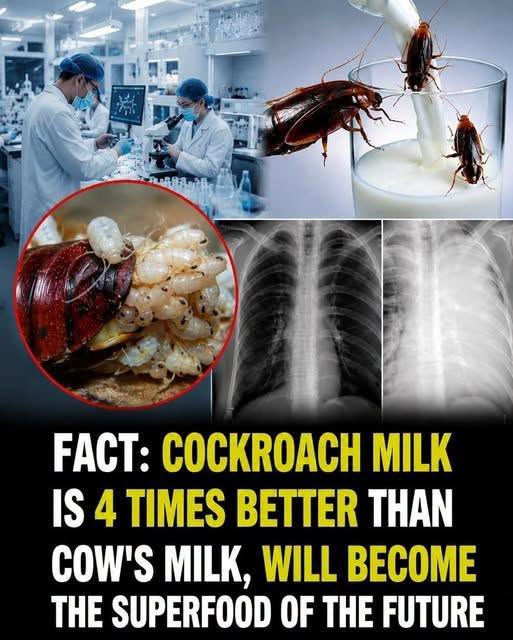

The Mysteries and Promise of Cockroach Milk: Could It Become the Superfood of the Future?
On a humid afternoon deep in the heart of India, a team of researchers gathered around a small, delicate insect that would become the center of much scientific and cultural fascination. Unlike its notorious relatives, this rare cockroach species had eluded public attention for centuries. As research unveiled the astonishing properties of its “milk,” a quietly brewing debate began: Could cockroach milk truly become the next superfood, or would it remain an enigmatic oddity?
Unveiling a Peculiar Discovery
Milk and cockroaches—two words rarely used together—have found an unlikely synergy in the species Diploptera punctata, the only known cockroach that gives live birth instead of laying eggs. Scientists studying the reproductive process of this Pacific beetle cockroach made a remarkable observation: the mother produces nutrient-rich crystals to feed her developing young. This “cockroach milk” quickly drew comparisons to the world’s most nourishing substances.
Cultural Responses and Myths About Cockroaches
Throughout history, cockroaches have sparked discomfort and intrigue in equal measure. In many cultures, they symbolize adaptability and survival, though often with a hint of unease. Cockroaches are known for thriving in diverse environments, which has—in folklore—granted them a kind of immortality. Yet, the notion of consuming anything derived from these insects, let alone as nourishment, remains taboo in most societies. Stories passed through generations have framed cockroaches as resourceful survivors, sometimes casting them in tales as wise spirits, but more often associating them with uncleanliness. This has made the idea of cockroach milk particularly difficult to introduce to the mainstream.
At the same time, cultures accustomed to entomophagy (the practice of eating insects) present a more open-minded approach. In some parts of Southeast Asia, Africa, and Latin America, insects are celebrated for their nutritional density, and their role in food security is widely recognized. Could cockroach milk, then, be poised for a similar transformation in perception as edible insects?

The Science Behind Cockroach Milk
Scientific attention to cockroach milk accelerated in the mid-2010s, when researchers isolated the protein crystals from the digestive tracts of Diploptera punctata embryos. Subsequent analysis uncovered something extraordinary: these crystals are packed with proteins, fats, and sugars in proportions that outclass even cow’s milk and buffalo milk. Each “milk” crystal is a complete food, delivering all amino acids required by humans, as well as essential fatty acids and micronutrients often lacking in conventional dairy.
Researchers, such as those from the Institute of Stem Cell Biology and Regenerative Medicine in Bangalore, India, sequenced the milk protein’s structure and found it to be highly efficient in nutrient storage and utilization. In a world challenged by growing populations and food insecurity, these findings sparked comparisons to other sustainable protein sources. Though still speculative, some scientists have posited that cockroach milk could offer a new frontier in nutritional science.
Nutritional Value: Fact Versus Speculation
So, what makes cockroach milk a candidate for superfood status? According to laboratory analyses, cockroach milk crystals possess nearly three times the energy content found in equivalent masses of cow’s milk. They are also rich in essential amino acids, which help in cell repair, growth, and overall health. Scientific models suggest the unique structure of cockroach milk allows for the slow release of nutrients, potentially making it ideal for people with higher energy demands or those who need sustained nourishment over time.
However, it’s important to note that these findings come from highly controlled scientific settings, and typically require the extraction of minuscule amounts of milk from a limited number of cockroaches. No large-scale commercial farming or extraction methods have been established, so widespread consumption remains firmly in the realm of possibility rather than practical reality.
Challenges and Ethical Considerations
The prospect of producing cockroach milk beyond laboratory settings introduces substantial ethical, technical, and cultural obstacles. For one, the process of collecting this milk is labor-intensive and currently only yields tiny amounts. Unlike cows or goats, cockroaches can’t be milked in the conventional sense. Biotechnological approaches to replicate the protein in yeast or other hosts offer a more scalable option, but this is still in developmental stages.
Furthermore, as with many innovations derived from insects, acceptance hinges on the ability to shift public perception. Food safety standards, allergic potential, and long-term health effects are all under investigation. While some see cockroach milk as the culmination of a new, sustainable protein trend, others remain deeply skeptical, emphasizing the need for thorough testing and regulation before any form of human consumption.
The Superfood Debate: Skepticism and Hope
Any newly discovered food source, particularly one so unconventional, is bound to provoke debate. Supporters highlight the environmental benefits of insect-based foods: low resource consumption, minimal land requirements, and reduced greenhouse gas emissions. As the discussion extends beyond sustainability, advocates hope cockroach milk could serve as a supplement for malnourished populations, astronauts on deep space missions, or people with specialized dietary requirements.
On the other side are critics who caution against premature enthusiasm. Scientific research on the effects of consuming these milk proteins is still in its infancy, with no large-scale human trials conducted to date. Individuals with shellfish or insect allergies may face risks, and standardizing production methods poses logistical challenges. Experts underscore that, while promising on paper, cockroach milk is still a subject of scientific speculation rather than established nutritional dogma.
Cultural Shifts: From Taboo to Trend?
Food culture is always evolving. The notion of once-exotic foods becoming mainstream is well documented—think sushi, edible seaweed, or even plant-based burgers. If insect-based proteins have gained popularity in protein bars and supplemental powders, could cockroach milk move from curiosity to kitchen staple in the future?
That question remains open. While some chefs and food futurists see it as a novel ingredient, consumer surveys suggest that widespread acceptance is still a long way off. Marketing, clear labeling, and public education will likely play critical roles in shaping the journey from laboratory to marketplace.
A Future of Possibilities
In the grand story of human food innovation, cockroach milk is positioned as an intriguing chapter. Its nutritional profile is unquestionably impressive, and initial scientific research is compelling. However, significant work remains to determine its safety, ethics, and practicality. As the world seeks sustainable solutions for nourishment, open-mindedness toward unconventional food sources may become increasingly important.
Reflection: The Endless Curiosity of Humanity
From myths of eternal cockroach resilience to cutting-edge laboratory research, the story of cockroach milk is a testament to humanity’s relentless curiosity. Our willingness to question, to discover, and to see potential where others may see only the unusual has led to some of the most remarkable innovations in history. Whether cockroach milk becomes a common sight or remains an enigmatic wonder, it reminds us that the search for knowledge—and nourishment—often begins in the most unexpected places.
Disclaimer: This content is intended for entertainment purposes only and is not based on real events.
