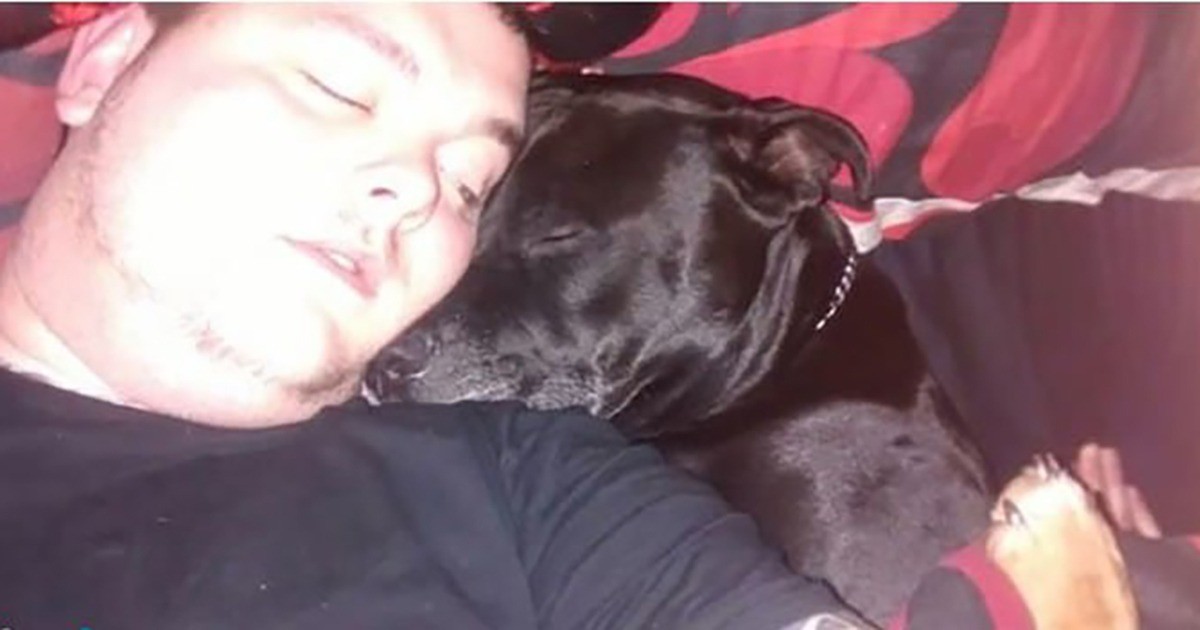

There are moments when the bond between a person and a dog seems almost impossible to explain. A dog may suddenly become unusually attentive, follow its owner from room to room, rest its head against a familiar hand, or refuse to leave someone who appears emotionally overwhelmed. To many people, these moments feel like evidence of an extraordinary connection.
One widely shared story from England tells of a man named Byron and his dog, Geo, a Welsh Bullmastiff. According to a report published by Newsner, Byron was experiencing an extremely difficult period in his life when Geo unexpectedly intervened by taking an important object away from him and refusing to return it. The story later became an example of what many people describe as canine intuition.
The story is deeply emotional, but it also raises an interesting scientific question. Can dogs really sense when something is wrong with their human companions?
Science does not support the idea that dogs possess a supernatural sixth sense. However, research increasingly shows that dogs are remarkably skilled at noticing changes in human behavior, body language, voice, scent, routines, and emotional states. What may appear mysterious could sometimes be the result of an extraordinary combination of sensory abilities, learning, attachment, and close observation.

The Story of Geo and Byron
The story of Geo was reported by Newsner and attributed to earlier reporting by the Daily Mail. According to the account, Byron was going through a serious period of emotional difficulty after the end of a relationship.
During one particularly difficult moment, Geo reportedly took an object away from Byron and refused to give it back. Rather than treating the behavior as ordinary play, Byron eventually understood it as something unusual.
The reported incident became meaningful because Geo and Byron had a close relationship. Byron later believed that his dog had recognized that something was wrong before he fully changed direction himself.
Newsner presented the event as an example of the extraordinary loyalty of dogs. The story has since circulated widely online, helping reinforce a familiar idea about canine intuition.
It is important, however, to distinguish a compelling personal story from scientific evidence. There is no scientific basis for concluding that Geo possessed a supernatural ability or could predict the future. The available account describes what happened from the perspective of those involved, while scientific research asks a different question: what abilities could allow a dog to notice subtle changes in a person’s condition?
That distinction makes the story even more interesting.
Why Dogs Can Notice When Something Feels Different
Dogs live remarkably close to humans. Unlike many other animals, domestic dogs regularly share our homes, schedules, sounds, smells, and social routines.
Over time, a dog can become familiar with what its owner normally looks like, sounds like, smells like, and does throughout the day. A small change may therefore stand out.
For example, an owner who normally walks quickly around the house might suddenly move slowly. Someone who usually speaks energetically may become unusually quiet. A familiar routine may change, or a person may spend more time sitting in one place.
Humans might overlook these differences because they happen gradually. Dogs, however, rely heavily on observation and sensory information.
Research has shown that dogs can respond differently depending on their owner’s emotional state. A 2024 study published in Animal Cognition found that dogs behaved differently when their owners were experiencing different emotional states. The researchers concluded that dogs can distinguish meaningful differences in human emotional expression, although the findings do not establish that dogs experience human emotions in exactly the same way people do.
This provides an important scientific perspective on stories like Geo’s.
The dog may not have understood the situation in human terms. Instead, Geo may have noticed a combination of familiar signals that indicated that his owner was behaving differently.

The Remarkable Power of a Dog’s Nose
One of the biggest differences between humans and dogs is their sense of smell.
Dogs experience the world through scent to an extent that humans can hardly imagine. Changes in a person’s physical state can alter the chemicals released through breath and skin. Researchers have therefore investigated whether dogs can distinguish odors associated with different emotional or physiological states.
Recent research continues to explore this ability. A 2026 study published in Frontiers in Veterinary Science examined how dogs responded to subtle combinations of human-derived cues associated with different states. The researchers found that dogs displayed context-dependent responses to combinations of facial, vocal, and odor information.
Other research has also examined whether trained dogs can distinguish scent samples associated with human stress. A 2024 proof of concept study involving scent detection dogs found that the dogs could discriminate between certain breath samples collected during different experimental states. The researchers emphasized that this area still requires further investigation.
This does not mean that an ordinary family dog can diagnose a person’s emotional condition simply by smelling them.
It does suggest, however, that dogs may notice chemical and behavioral changes that are invisible to human senses.
Is It Empathy or Emotional Contagion?
People often describe a dog’s reaction to a distressed owner as empathy. Scientists use the term more carefully.
Empathy involves complex processes, and it is difficult to determine exactly what an animal understands internally. A dog approaching a person who appears upset may be responding to facial expressions, vocal changes, posture, movement, scent, previous experiences, or a combination of these factors.
Research on canine emotional behavior has produced fascinating results. One study found that dogs approached people who appeared distressed more often than people engaged in neutral activities. The researchers suggested that the behavior could be explained by emotional contagion combined with the dog’s previous learning history rather than necessarily proving human-like empathy.
This distinction matters.
A dog does not need to understand a human situation exactly as another person would in order to respond appropriately. The animal may simply recognize that a familiar person is behaving differently and react according to its social relationship with that person.
That ability is still remarkable.
The Special Bond Between Dogs and Humans
The relationship between humans and dogs has developed over thousands of years. Dogs have become exceptionally skilled at interpreting human communication, including gestures, facial expressions, tone of voice, and patterns of attention.
Research into the human dog relationship has also investigated biological mechanisms associated with social bonding.
One well known line of research involves oxytocin, a hormone associated with social behavior and attachment. Studies have suggested that interactions between humans and dogs can involve changes in oxytocin systems, although results are not always consistent across experiments.
A landmark study published in Science reported evidence for an oxytocin related feedback loop involving mutual gaze between dogs and their owners. The researchers proposed that this mechanism may have contributed to the close social relationship that developed between humans and dogs.
Other research has produced more cautious conclusions. For example, a study examining oxytocin responses during human dog interactions did not find a significant increase under the experimental conditions used. The authors emphasized the need for additional research and standardized methods.
Together, these findings illustrate an important principle of science: the human dog bond is real and biologically interesting, but researchers are still working to understand exactly how it operates.

Why Stories Like Geo’s Feel So Powerful
Stories about dogs recognizing that something is wrong often resonate because they reflect something familiar in everyday life.
Many dog owners have experienced moments when their pet seemed unusually attentive. A dog may sit beside someone who is having a difficult day or become excited when its owner returns home. These ordinary interactions can create the impression that dogs understand us in ways other people sometimes cannot.
There is also a cultural history behind this belief.
Dogs have appeared in human stories, legends, folklore, and literature for centuries. They are frequently portrayed as loyal companions capable of sensing things that humans overlook. Such stories do not constitute scientific evidence, but they reveal how deeply humans value the relationship between people and animals.
The idea of canine intuition therefore exists at the intersection of culture and biology.
The cultural interpretation may describe a dog as having a special sense. The scientific interpretation looks for observable explanations involving smell, hearing, vision, learning, memory, emotional responsiveness, and attachment.
These interpretations do not necessarily have to compete. A person can appreciate the emotional meaning of a story while still recognizing the limits of what science can establish.
What Science Can and Cannot Tell Us About Geo
The story of Geo is best understood as a personal account rather than a scientific experiment.
There was no controlled study measuring Geo’s behavior before, during, and after the reported incident. There were no comparison groups and no instruments measuring every possible cue available to the dog.
For that reason, scientists cannot conclude from the story alone that Geo consciously understood Byron’s intentions.
What can be said is that the reported behavior is consistent with abilities that researchers have documented in dogs. Dogs can recognize changes in human behavior. They can respond to emotional expressions. They possess highly developed sensory abilities and form strong social relationships with familiar people.
It is therefore reasonable to consider several possibilities.
Geo may have noticed changes in Byron’s behavior. He may have responded to unfamiliar body language or vocal patterns. He may have been reacting to changes in scent or routine. He may also have responded simply because he was strongly attached to his owner and noticed that something unusual was happening.
The exact explanation cannot be established from the story alone.
And that uncertainty is not a weakness. It is precisely what makes the subject worthy of further research.
The Meaning Behind the Story
Regardless of how Geo’s behavior is interpreted, the story highlights something important about companionship.
Dogs do not need to understand every aspect of human life to become meaningful parts of it. Their presence can create routines, encourage interaction, provide companionship, and offer a sense of connection.
For someone experiencing a difficult period, a pet can also provide a reason to maintain everyday routines and remain connected to another living being. That does not mean animals replace professional support or human relationships, but their companionship can have genuine emotional value.
Geo’s story has endured because it represents the extraordinary possibility that an animal may notice something about us before we consciously recognize it ourselves.
Perhaps the most accurate description is not supernatural intuition, but remarkable attentiveness.
A Meeting Point Between Science and Wonder
The story of Geo invites two different responses.
The first is wonder. It is easy to understand why people describe such behavior as a sixth sense. Dogs can sometimes appear to react to changes that humans have not consciously noticed.
The second is curiosity. Instead of immediately attributing unusual behavior to something mysterious, science asks what information the dog could have detected.
That question has already produced fascinating discoveries about canine cognition, communication, smell, social bonding, and emotional responsiveness.
The more researchers learn, the clearer it becomes that dogs are highly observant social animals. At the same time, scientific evidence does not justify claims that dogs possess supernatural powers or can always predict what a person will do.
Geo’s story should therefore be viewed as a moving reported account, not proof of a paranormal ability.
Perhaps that is what makes it most meaningful. The real mystery is not whether dogs have a magical sixth sense. It is how much information they can gather from a world that humans experience very differently.
Conclusion: What Our Dogs May Notice That We Miss
The story of Geo and Byron continues to attract attention because it captures one of the most fascinating aspects of the human dog relationship: the feeling that our companions sometimes understand us without words.
Science offers several possible explanations. Dogs can recognize emotional cues, observe subtle behavioral changes, respond to familiar routines, and use their extraordinary sense of smell to gather information that humans cannot easily perceive. Research also shows that long term relationships can influence how dogs respond to their human companions.
Yet science has not explained every remarkable moment between people and animals.
That leaves room for curiosity without requiring extraordinary claims.
Maybe Geo did not possess a mysterious sixth sense. Perhaps he simply knew his human companion extraordinarily well. Perhaps he noticed tiny changes that nobody else could see. Or perhaps several ordinary canine abilities came together in one extraordinary moment.
Whatever the explanation, stories like this remind us that there is still much to learn about the animals who share our lives.
Human curiosity often begins with a simple question: how did they know?
Sometimes, the most fascinating discoveries begin when we resist the urge to answer too quickly.
Sources
Newsner, “The reported story of Byron and his dog Geo.” The article presents the personal account that inspired this discussion. Newsner source article
Bräuer, J. et al. “Dogs distinguish authentic human emotions without being empathic.” Animal Cognition, 2024.
Nagasawa, M. et al. “Oxytocin-gaze positive loop and the coevolution of human-dog bonds.” Science, 2015.
Handlin, L. et al. Research examining oxytocin and social bonding in dogs. Proceedings of the National Academy of Sciences.
Custance, D. and Mayer, J. Research examining empathic-like responses by domestic dogs to human distress. Animal Cognition.
Frontiers in Veterinary Science, 2026. Research examining canine responses to subtle owner-derived emotional and physiological cues.
Frontiers in Allergy, 2024. Proof of concept research investigating canine detection of stress-associated human scent cues.
