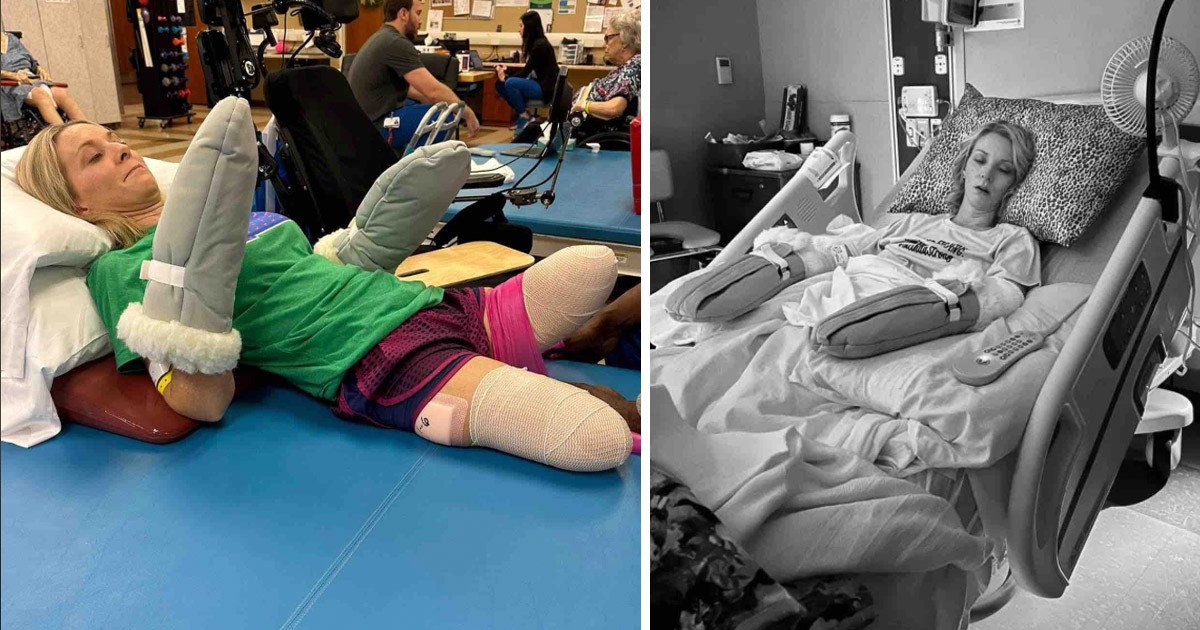

Lucinda Mullins went to the hospital expecting a routine medical procedure. She had kidney stones, a family waiting for her at home, and every reason to believe that she would soon return to her ordinary life.
Instead, complications during the procedure changed everything.
When Mullins eventually learned what had happened, she discovered that doctors had removed both legs and both hands and forearms in an extraordinary effort to save her life. Yet rather than describing her experience only as a tragedy, the Kentucky mother chose to focus on something else: she was still alive, and she could still return to the people she loved most.
Her story has since become one of resilience, family support and determination to build a new life after an unexpected medical crisis.
The Day Everything Changed
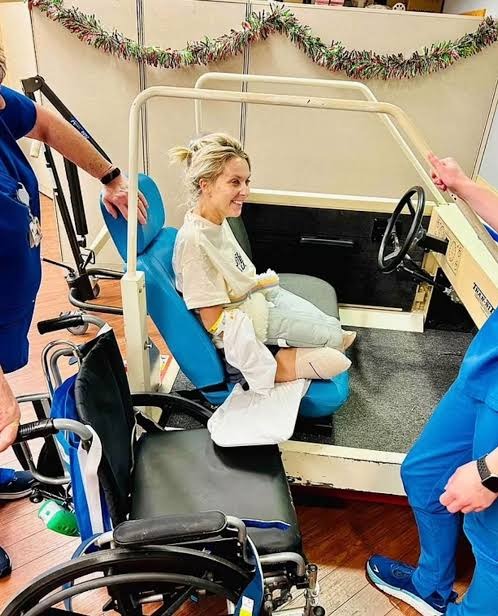
In December 2023, Mullins went to a Kentucky hospital for a procedure related to kidney stones.
Nothing about the situation seemed to suggest that her life was about to take a completely different direction.
During the procedure, however, she experienced septic shock, a severe medical condition that can occur when the body’s response to an infection causes widespread complications.
Her condition became critical.
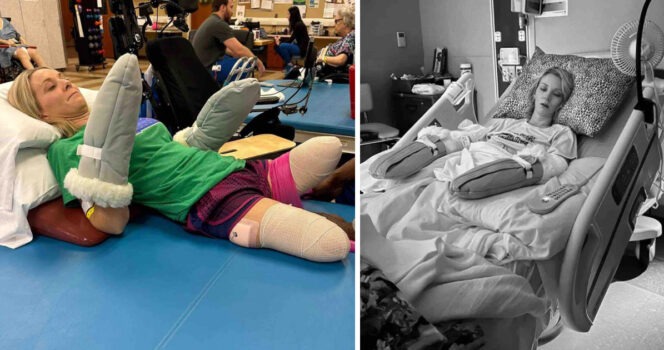
Doctors faced an extremely difficult situation. According to reports about Mullins’ case, medical intervention eventually resulted in the removal of her legs and her hands and forearms.
For Mullins, the next chapter of her life would begin in a hospital room.
But her first reaction was not what many people might expect.
“This Has a Happy Ending”
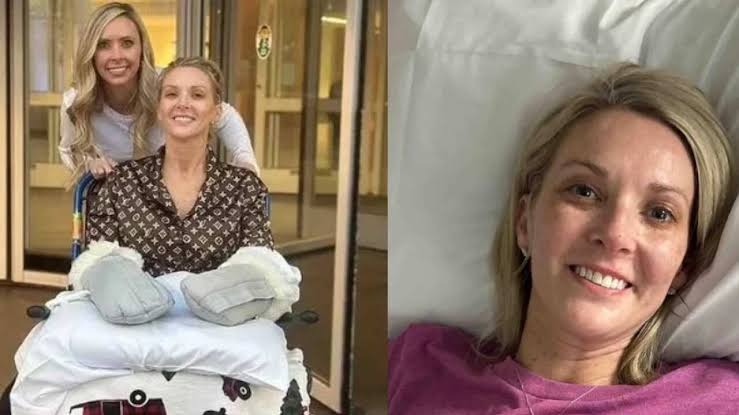
When Mullins was eventually able to understand what had happened, she said she did not view the situation simply through the lens of what she had lost.
Instead, she focused on what remained.
In an interview reported by the Daily Mail and VT, Mullins described her experience as a story with a happy ending because she was alive and could be reunited with her husband and children.
“I was alive, and I got to see my family again,” she explained.
That perspective became an important part of her recovery.
Rather than denying that difficult days were ahead, Mullins acknowledged that her future would involve major challenges. She would have to learn new ways of performing everyday tasks, adapt to significant physical changes and navigate a rehabilitation process that would require patience.
Yet she also had something she considered even more important.
She had her family.
A Mother Focused on Her Children
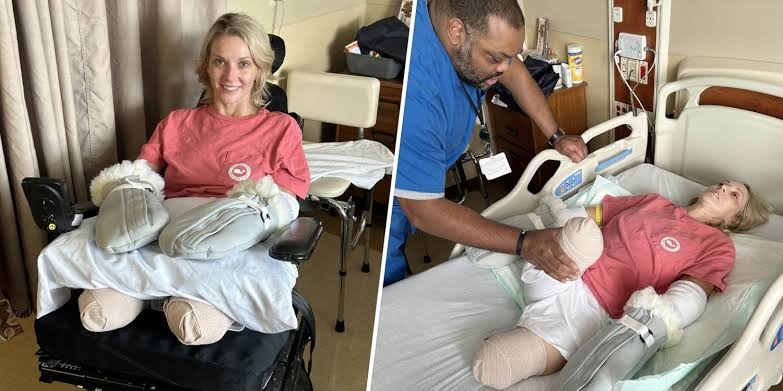
Mullins’ relationship with her children became one of the strongest sources of motivation during her recovery.
She has two sons, Teegan and Easton, with her husband DJ.
For the family, the sudden transformation was difficult to understand. Children naturally have questions when something so significant happens to a parent.
But the family adapted together.
DJ described how their younger son, Easton, remained particularly close to his mother.
“He doesn’t leave her side,” DJ said, explaining that the boy would help with everyday activities and wanted to remain close to her.
The family’s response illustrates something often overlooked when discussing major changes in a person’s physical abilities.
Recovery does not happen in isolation.
It can involve parents, children, spouses, friends, healthcare professionals and an entire community learning new routines together.
Finding Strength Through Faith
Faith also became an important part of Mullins’ understanding of what had happened.
She described feeling a strong spiritual presence during her recovery and said she believed there was a larger purpose behind the experience.
For Mullins, that belief helped her make sense of circumstances that would otherwise have been extraordinarily difficult to process.
Her interpretation is deeply personal and belongs to her own faith.
From a scientific perspective, spirituality can also play an important role in how some people cope with major life changes. Research into resilience and psychological adaptation has found that meaning, social connection and personal beliefs can influence how people respond to difficult circumstances.
That does not mean faith produces a particular medical outcome. Rather, it can provide a framework through which someone understands and navigates a life-changing experience.
For Mullins, that framework appeared to give her a sense of direction.
She believed that her story was not finished.
Learning to Live Differently
After her hospitalization, Mullins faced an entirely different daily routine.
Simple activities that many people perform without thinking can become complicated when someone experiences major changes to mobility and upper-limb function.
Getting dressed, preparing food, moving around the home and returning to work can all require new techniques, equipment and support.
Mullins, however, was determined to regain as much independence as possible.
Before the medical crisis, she worked as a certified medical assistant at a local family practice. She hoped to return to her professional life rather than allowing the experience to completely define her future.
That determination became another important part of her recovery.
Rehabilitation for people with major limb loss can involve physical therapy, occupational therapy, mobility training and psychological support. Prosthetic technology may also become part of the process, depending on an individual’s medical circumstances, goals and access to care.
But recovery is rarely a straight line.
There can be progress, setbacks and periods of adjustment.
A Home Designed for a New Future
One of the most remarkable developments in Mullins’ story came through the support of her community.
A GoFundMe campaign helped raise money for a large accessible smart home designed around the family’s new circumstances.
According to reports, the family reached its fundraising goal for the approximately 7,000-square-foot accessible home in only 10 days.
The significance of such a home goes beyond its size.
Accessibility can fundamentally change how someone with significant mobility limitations interacts with their surroundings.
Wider doorways, accessible bathrooms, adapted kitchen areas, automated technology and carefully designed living spaces can reduce barriers and give residents greater independence.
For Mullins and her family, the home represented something symbolic as well.
It was not simply a response to what had happened.
It was preparation for what came next.
Turning Personal Experience Into Advocacy
Mullins eventually used her experience to advocate for others living with limb loss.
She later announced that she had helped support the passage of Senate Bill 97 in Kentucky, legislation that she explained would give people with private insurance an opportunity to obtain more than one prosthetic device.
Access to prosthetic technology can be an important issue for people living with limb loss because different devices may serve different purposes.
A person might require one device for everyday mobility and another designed for a particular activity.
Insurance coverage, however, can determine what options are realistically available.
By speaking publicly about her experience, Mullins moved beyond simply sharing her own recovery.
She became an advocate for changes that could potentially benefit other people facing similar challenges.
The Science Behind Her Medical Journey
Mullins’ story also highlights the complexity of modern medicine.
Septic shock is a serious medical emergency involving an abnormal response to infection that can cause dangerous changes throughout the body.
Treatment may require rapid medical intervention, intensive monitoring and multiple forms of supportive care.
In severe situations, reduced blood flow and other complications can result in serious damage to tissues.
The exact medical decisions in an individual case depend on numerous factors, including the underlying infection, the person’s condition, how quickly treatment begins and how the body responds.
That is why Mullins’ experience should not be interpreted as evidence that the same outcome would occur in every case of septic shock.
Her medical history was unique.
Only the healthcare professionals involved in her treatment can explain the specific clinical decisions made during her hospitalization.
More Than a Story About Loss
It would be easy to describe Mullins’ experience only in terms of what changed physically.
But that would leave out perhaps the most important part of her story.
She did not stop being a mother.
She did not stop being a wife.
She did not stop being a medical professional.
And she did not stop thinking about the future.
Her circumstances changed, but her identity remained much larger than her medical condition.
That distinction is important when discussing disability.
People who experience major physical changes are often described primarily through what they can no longer do. Yet rehabilitation increasingly emphasizes independence, participation, accessibility and quality of life.
Technology can help.
Family support can help.
Professional rehabilitation can help.
And perhaps most importantly, allowing people to define their own goals can help them build a future that reflects who they are rather than what happened to them.
A Family Still Moving Forward
Today, Mullins lives with her husband and two sons in Waynesburg, Kentucky.
The family continues adapting to their circumstances.
Her children have had their own learning process, asking questions and discovering new ways to support their mother.
Her husband has also become an important caregiver and companion.
That kind of support can make a significant difference during long-term rehabilitation.
For Mullins, however, family support appears to work both ways.
She is not simply receiving help.
She remains an active mother, wife and member of her community.
Her determination to return to work and advocate for better access to prosthetic care demonstrates that she continues to look beyond the hospital experience that changed her life.
The Meaning Behind Her Story
There is no simple way to describe what happened to Lucinda Mullins.
It was unexpected, complicated and life-changing.
Yet her response offers a different perspective on resilience.
Resilience does not necessarily mean pretending that everything is easy.
It can mean acknowledging that life has changed while still searching for reasons to keep moving forward.
For Mullins, those reasons included her children, her husband, her faith, her work and the possibility of helping others.
Her story also reminds us that accessibility is not merely a technical issue. It can determine whether someone can participate fully in everyday family life, employment and the wider community.
A home can be redesigned.
Technology can evolve.
Medical rehabilitation can create new possibilities.
And people can discover forms of independence they may never have imagined before.
A Reflection on Human Resilience
Lucinda Mullins entered the hospital expecting one kind of future and woke up facing another.
The difference between those two lives was enormous.
But perhaps the most memorable part of her story is not the medical event itself. It is what happened afterward.
She chose to focus on seeing her children again. She worked toward independence. Her family adapted alongside her. Her community rallied around her. And eventually, she began using her experience to advocate for others.
Stories like this capture something deeply human: our tendency to search for meaning when circumstances change beyond our control.
Curiosity makes us ask how such an extraordinary transformation could happen. Compassion makes us wonder what the person and family experienced afterward. And resilience reminds us that a changed life is not necessarily an unfinished life.
Mullins’ journey is still continuing, one adjustment at a time.
Sources
Daily Mail, reporting on Lucinda Mullins’ recovery and family life.
VT, interview coverage discussing Mullins’ experience and her perspective on recovery.
GoFundMe, information shared by the Mullins family regarding their accessible home and fundraising efforts.
Kentucky Legislature, information regarding state legislation and accessibility initiatives.
National Institute of General Medical Sciences, background information on sepsis and septic shock.
National Institute of Neurological Disorders and Stroke, general information concerning rehabilitation and recovery following major physical changes.
