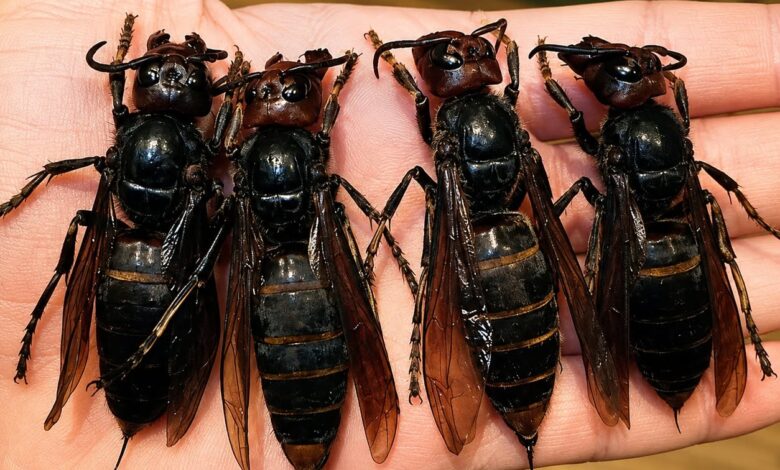

The northern giant hornet (Vespa mandarinia), widely labeled in headlines as the “murder hornet,” is one of the most striking and closely watched insects in the world. Its large size, potent venom, and predatory behavior toward honeybees have made it a focus of public concern and scientific attention, especially since confirmed detections in North America in 2019. While media coverage has sometimes emphasized fear, researchers and public agencies have worked to provide accurate information, manage the risks, and protect critical pollinators and ecosystems.
What Is the Northern Giant Hornet?
The northern giant hornet is the largest known hornet species on Earth. Native populations are found in temperate and tropical regions of East Asia, South Asia, and mainland Southeast Asia. Adult workers typically measure up to about 5 centimeters (roughly 2 inches) in length, with a robust yellow-and-black striped abdomen, a large orange or yellowish head, and a wingspan that can exceed 7 centimeters. This impressive size and distinct coloration make the species relatively easy to recognize compared with other wasps and hornets.
In its native range, the hornet is part of complex ecological communities and has natural predators and competitors. There, it preys on a variety of insects, including other wasps, hornets, and beetles. Its role as a top predator among social insects helps shape local insect populations. Problems arise when the hornet is introduced outside its native range, where local species have not evolved alongside it and may lack effective defenses.
How the Northern Giant Hornet Threatens Honeybees
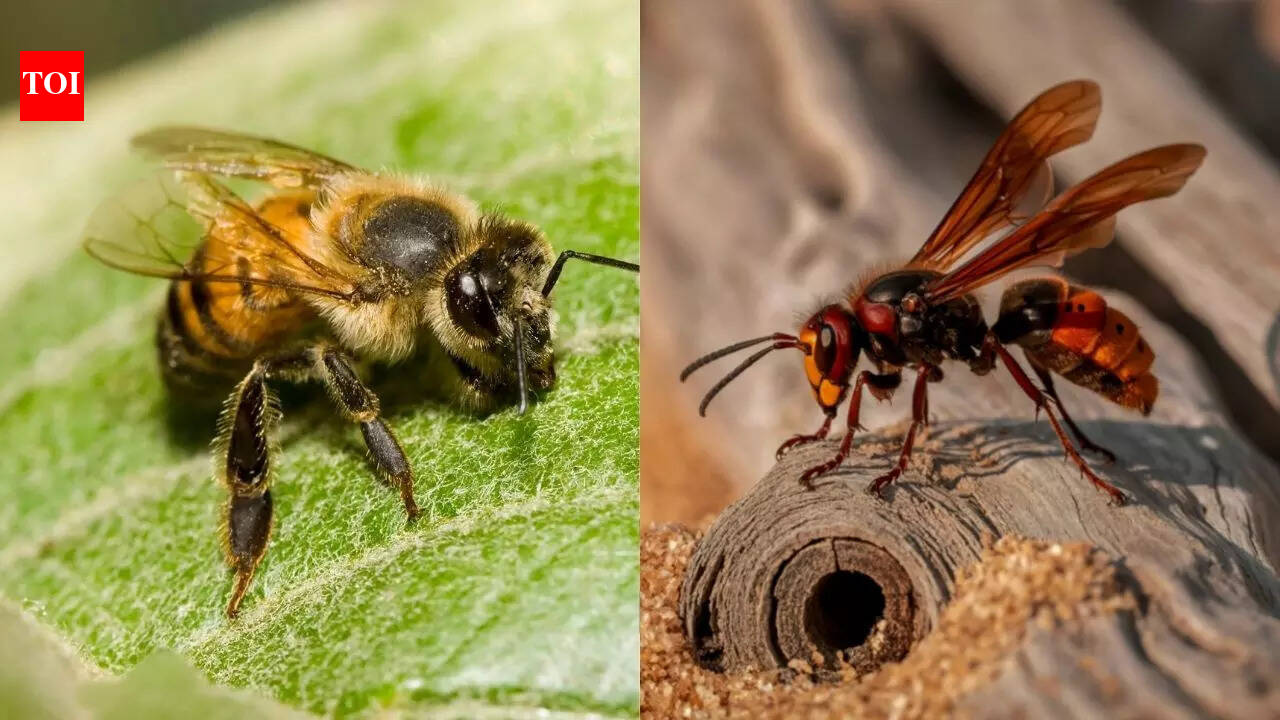
One of the most important concerns about the northern giant hornet is its effect on honeybee colonies. European honeybees (Apis mellifera), widely used in commercial agriculture and hobby beekeeping in North America and Europe, are highly vulnerable to hornet attacks. A small group of giant hornets is capable of launching intense assaults on beehives, a behavior entomologists describe as a “slaughter phase.”
During such an attack, hornets use their powerful mandibles to kill adult bees at the entrance of the hive. Unlike stinging, the primary method is mechanical: hornets bite and decapitate or dismember bees rapidly. Research observations from Asia show that a few dozen hornets can kill tens of thousands of bees within a few hours if the hive is not protected by effective defenses. Once the adult workers are removed, hornets enter the hive, tear open the comb, and carry off bee larvae and pupae. These immature bees are rich in protein and serve as important food for hornet larvae back in their own nest.
For beekeepers, the loss of a hive is more than a local setback. Honeybees provide essential pollination services for many fruits, vegetables, and other crops. In regions such as North America and Europe, European honeybees are a cornerstone of commercial pollination systems and are also important for wild plant reproduction. When hornets destroy hives, they not only eliminate honey production and queen lines but also reduce pollination capacity for the surrounding landscape.
Why Asian and European Honeybees Respond Differently
The difference between Asian honeybees and European honeybees is a key factor in understanding the potential impact of northern giant hornets in new regions. In areas where the hornet is native, some populations of the Asian honeybee (Apis cerana) have evolved sophisticated, collective defenses. When a hornet scout approaches a hive, the bees may rapidly surround it, forming a tight ball of hundreds of bees. By vibrating their flight muscles, the bees raise the temperature and carbon dioxide concentration inside this “heat ball” to levels that are lethal to the hornet but still tolerable for the bees. This behavior can prevent the hornet from marking the hive as a target and can stop an attack before it escalates.
European honeybees, by contrast, generally lack this heat-balling defense against giant hornets. They may respond by attempting to sting or by forming a loose cluster, but these strategies are far less effective against a large, armored predator. This absence of coevolved defenses makes European honeybee colonies particularly vulnerable if northern giant hornets become established in areas where these bees are the main managed pollinators.
Implications for Agriculture and Food Security
Pollinators, including honeybees, wild bees, butterflies, moths, and other insects, contribute to the production of a substantial share of the world’s food crops. According to international agricultural and environmental organizations, a significant portion of global crop species depend, at least in part, on animal pollination. Commercial pollination by European honeybees is especially important for crops such as almonds, apples, blueberries, cherries, and many other fruits and vegetables.
When invasive predators like the northern giant hornet threaten honeybee populations, the potential ripple effects extend beyond individual apiaries. Reduced pollination can translate into lower yields, smaller fruit sizes, and economic losses for farmers. In regions already facing challenges such as habitat loss, pesticide exposure, diseases, and parasites like the Varroa mite, additional pressure from invasive species can further stress bee populations. For this reason, agricultural authorities consider the early detection and containment of northern giant hornets a high priority.
Human Health Risks and Safety Considerations
Although the term “murder hornet” has captured public attention, experts emphasize that the northern giant hornet does not typically seek out humans as prey. Like other social wasps and hornets, it tends to sting in defense of its nest or when it feels threatened. However, due to its size and the composition of its venom, stings can be more painful and potentially more serious than many other wasp or bee stings.
The hornet’s stinger, which can be about 6 millimeters long, is capable of penetrating some forms of protective clothing, including standard beekeeping suits. Its venom is a complex mixture that can cause intense pain, localized tissue damage, and systemic reactions. In its native regions, medical reports indicate that most stings result in temporary pain and swelling that resolve with basic care. Nevertheless, multiple stings or stings in individuals with allergies or underlying health conditions can be dangerous.
Documented severe reactions to multiple stings may include anaphylactic shock, acute kidney injury, or cardiovascular complications. In rare cases, fatalities have been recorded following large numbers of stings or delayed treatment. Public health guidance therefore stresses avoidance of nests, prompt medical care for suspected allergic reactions, and appropriate training and equipment for professionals involved in nest removal and research activities.
Detection and Early Response in North America
The appearance of northern giant hornets near the border between Washington State in the United States and the Canadian province of British Columbia in late 2019 and 2020 prompted an intensive, science-based response. State and provincial agriculture agencies, federal partners, universities, and local beekeeping organizations cooperated to locate and eradicate any nests before the hornets could spread widely.
Officials and volunteers deployed thousands of traps in forests, rural areas, and near apiaries. These traps were designed to attract hornets using baits such as sugar-based solutions or other lures while minimizing harm to non-target insects. When a hornet was captured alive, entomologists sometimes attached lightweight radio transmitters to track the insect back to its nest. This technique, known as radio telemetry, allowed teams to follow hornet movements through dense vegetation and difficult terrain.
Once a nest was located, specialized teams conducted eradication operations, typically at night when most hornets were inside the nest and less active. To protect workers, they used reinforced protective suits and face shields designed to resist hornet stings. Methods to neutralize nests included vacuum equipment to remove hornets, injection of approved insecticidal substances, and sealing of tree cavities or underground nest entrances. The goal was to destroy the colony before new queens could emerge, mate, and disperse to start additional nests the following year.
State and provincial authorities reported the successful removal of several nests in the region. Ongoing surveillance continues to check for any new detections. These early actions are widely cited as an example of how rapid, coordinated responses can reduce the risk that an invasive species will become permanently established.
Invasive Species and Global Biosecurity
The northern giant hornet case illustrates broader challenges associated with invasive species in an increasingly interconnected world. International trade and travel allow organisms to move across natural barriers that historically limited their ranges. Insects can inadvertently travel in cargo shipments, wood packaging materials, nursery plants, and even passenger luggage. When these species arrive in new environments that lack the predators, parasites, or diseases that kept them in check in their native regions, they may spread rapidly.
Globally, invasive species affect agriculture, forestry, fisheries, and biodiversity. They can outcompete native species for resources, introduce new diseases, and alter habitats. The economic costs, including lost production and control measures, are estimated in many countries to reach into the billions of dollars annually. For pollinators and crop systems, new threats from invasive insects add to existing concerns such as climate change, pesticide exposure, and habitat fragmentation.
Because of these wide-ranging effects, governments and international organizations promote biosecurity measures aimed at preventing introductions in the first place. These measures include inspection of imported goods, treatment of high-risk materials like untreated wood, and rapid response protocols when potentially harmful species are detected.
Expert Views and Scientific Research
Entomologists, ecologists, and agricultural scientists have been closely studying the northern giant hornet to better understand its biology, behavior, and potential distribution. Research in its native range has provided detailed information on its nesting habits, seasonal cycles, and prey preferences. These data help model how the species might behave in new environments and what types of climates and habitats would be suitable.
Experts emphasize that, while the hornet is a serious concern for beekeeping and biodiversity if established, accurate risk assessment is essential. Climate models suggest that only certain parts of North America and Europe may provide suitable conditions for long-term establishment. Continuous trapping and surveillance are therefore crucial in these areas, especially near points of entry such as ports and major trade routes.
Researchers also explore potential management strategies, including improved trapping methods, monitoring technologies, and educational tools to help the public distinguish northern giant hornets from local, often harmless look-alike species. Accurate identification is important to ensure that beneficial native insects are not mistakenly targeted.
Public Participation and Precautionary Measures
Public involvement has been an important part of efforts to manage the hornet threat. Agricultural departments and environmental agencies encourage residents, especially beekeepers, gardeners, and outdoor workers, to learn what the northern giant hornet looks like and to report suspected sightings to local authorities rather than attempting to handle or destroy nests themselves.
Guidance typically includes the following key points:
- Do not approach or disturb large wasp or hornet nests.
- Take a clear photograph from a safe distance if possible and note the location.
- Submit sightings through official reporting channels provided by state, provincial, or national agencies.
- Wear appropriate protective clothing when working around bees or potential hornet habitats, especially in regions where detections have occurred.
At the same time, environmental groups and agricultural agencies promote broader pollinator-supportive practices, such as planting native flowering plants, reducing unnecessary pesticide use, and maintaining diverse habitats. Healthy, resilient pollinator populations are better able to withstand multiple stressors, including potential pressure from invasive predators.
Balancing Awareness With Accurate Information
Media coverage of the northern giant hornet has often highlighted dramatic aspects of the insect’s biology and its nickname. While it is important to take the threat to honeybees and agriculture seriously, experts caution against sensationalism. Human encounters remain relatively rare, especially in areas where the hornet has not established stable populations, and most people will never be stung.
For policymakers and the public, a balanced understanding is essential: the northern giant hornet is a powerful predator of honeybees and a significant concern if it spreads, but it is also a species that can be managed through early detection, informed public participation, and coordinated scientific response. Continued monitoring and research will determine whether eradication efforts have been fully successful in North America or whether ongoing management will be needed in the future.
By staying informed, supporting pollinator health, and following guidance from qualified authorities, communities can help protect both local ecosystems and agricultural productivity while reducing unnecessary fear.
Sources
- Reuters – Environment and Science Coverage
- BBC News – Science & Environment
- The Guardian – Environment
- Al Jazeera – Environment
- World Health Organization (WHO)
- U.S. Centers for Disease Control and Prevention (CDC)
- USDA APHIS – Plant Protection and Quarantine
- Canadian Food Inspection Agency – Invasive Species
Disclaimer: This content is intended for entertainment purposes only and is not based on real events.
