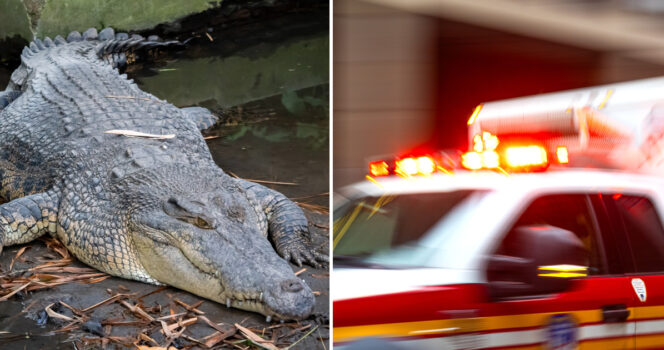

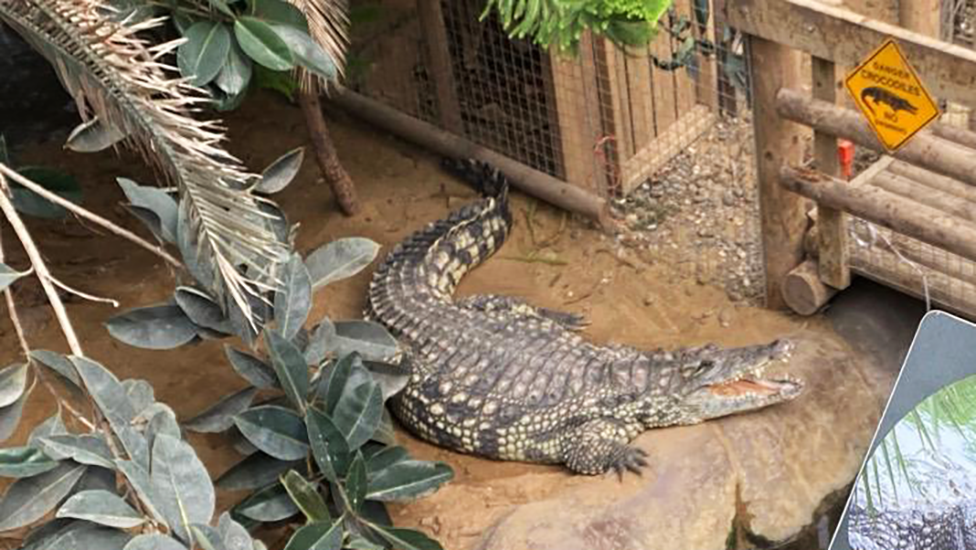
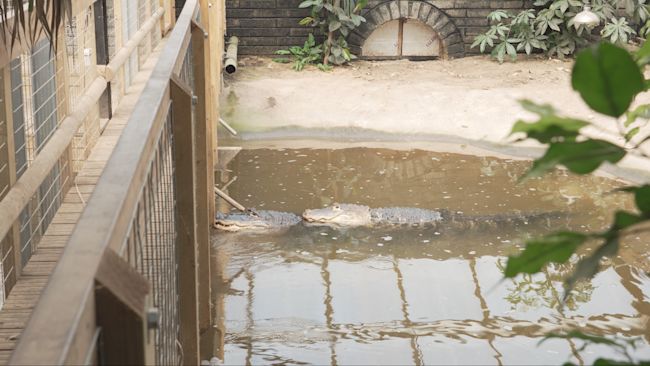
The warm afternoon air inside the Tropical House at Johnsons of Old Hurst zoo in Cambridgeshire, England, was suddenly shattered by a sound no parent or visitor ever expects to hear: a sharp, terrifying scream. Within seconds, the cheerful atmosphere of a family day out evaporated, replaced by an eerie, breathless silence. For those standing near the crocodile exhibit, the unthinkable had just unfolded. A three-year-old toddler had plunged approximately 15 feet from a viewing area directly into the enclosure below.
The young boy first struck a harsh concrete walkway, sustaining a fractured pelvis and a broken arm, before tumbling helplessly into the water below. In that water swam large, powerful crocodilians. It was a moment of sheer, absolute crisis. Yet, before the panic could paralyze the onlookers, a display of remarkable human courage took over. Tracey Johnson, co-owner of the zoo, acted on pure instinct and leapt directly into the enclosure. Joined immediately by her husband, Andy, and their adult son, Edward, the family worked desperately to retrieve the child from the grasp of a reptile, pulling him to safety.
While the incident sent shockwaves through the local community and sparked a major police investigation, it also opened up a profound conversation. Beyond the immediate headlines of a miraculous rescue, this event highlights the delicate boundaries between humans and apex predators, the deep-seated cultural myths surrounding crocodiles, and the precise behavioral science that explains how these ancient creatures react in moments of unexpected intrusion.
Ancient Guardians and Monsters of the Deep: The Cultural Myth of the Crocodile
For thousands of years, the crocodile has occupied a dual space in the human imagination, serving as both a symbol of primal terror and a revered deity. In ancient Egypt, the Nile crocodile was personified as Sobek, a powerful god associated with fertility, military prowess, and pharaonic power. The Egyptians respected the crocodile’s stealth, strength, and swiftness so deeply that they mummified hundreds of them, burying them in sacred tombs to ensure protection in the afterlife. Sobek was viewed not as a mindless monster, but as a guardian of the Nile who controlled the life-giving waters.
In contrast, Western folklore and literary traditions have often painted the crocodile as a calculating, cold-blooded villain. The famous myth of “crocodile tears”—the belief that the reptile weeps deceptive tears of grief while consuming its prey—has been used for centuries to describe insincere displays of emotion.
This cultural polarization has left us with a highly sensationalized view of these animals. We tend to see them either as mythical monsters waiting to devour anything that crosses their path, or as completely static, mechanical predators devoid of nuance. In reality, modern herpetology—the study of amphibians and reptiles—reveals that crocodilian behavior is governed by highly specific biological triggers, energy-conservation strategies, and environmental factors rather than a malice-driven desire to hunt humans.
The Science of the Strike: How Apex Predators Process Unexpected Stimuli
When a child unexpectedly fell into the crocodile pool at Old Hurst, the immediate question on many minds was why the animals did not instantly consume the toddler. To understand this outcome, herpetologists point to the evolutionary biology of crocodilians. Crocodiles are ectothermic (cold-blooded), meaning they rely on their external environment to regulate their body temperature. Because they cannot generate their own body heat, their metabolism is incredibly slow, and they must conserve energy at all costs.
A crocodile does not hunt continuously. Instead, it is an opportunistic ambush predator. It waits for familiar prey to cross its path at the water’s edge, calculating the energy cost of a strike against the nutritional reward. When an object as large as a human child suddenly plunges 15 feet into their quiet environment, it does not register to a crocodile as a standard, familiar food source.
Furthermore, experts like Chris Newman from the National Centre for Reptile Welfare suggest that while a crocodile is highly likely to bite defensively if stepped on or startled by a sudden fall, they are not inherently inclined to view humans—especially unfamiliar, fast-moving ones—as immediate food. In this specific case, local wildlife experts speculated that because the zoo’s crocodiles are consistently fed a structured diet of livestock offcuts, they did not associate the sudden splash of a child with their typical feeding routines. The bite the child sustained, though severe enough to require extensive surgeries, was likely a defensive or startle reaction rather than an active hunting attempt.
The Biology of Bravery: The Neurochemistry of the Rescue
The heroic intervention of the Johnson family is a testament to the extraordinary capabilities of the human nervous system under extreme pressure. When Tracey Johnson witnessed the child fall, her brain instantly bypassed analytical, slow-paced thinking and shifted into an acute survival state.
In a split second, the brain’s amygdala sent a distress signal to the hypothalamus, triggering a massive surge of adrenaline and cortisol into her bloodstream. This chemical cascade causes immediate physiological changes:
-
Vasoconstriction: Blood is redirected away from non-essential organs and skin, flooding the major muscle groups with oxygen and glucose to maximize physical strength and speed.
-
Tunnel Vision and Auditory Exclusion: The brain filters out peripheral sights and sounds to focus entirely on the threat and the objective, explaining why rescuers can act with absolute precision amidst chaos.
-
Diminished Pain Perception: Endorphins flood the system, temporarily masking physical pain and fear, allowing a person to perform tasks they would normally find terrifying or physically impossible.
For the Johnson family, this neurochemical cocktail enabled them to execute a rapid, coordinated rescue. By scaling the barriers and physically pulling the young boy from the water, they acted in a window of time that was measured in seconds, ultimately saving the toddler’s life.
Behind the Investigation: Unraveling a Complex Social Scenario
As the medical team at Addenbrooke’s Hospital in Cambridge worked tirelessly to stabilize the young boy—who has since undergone multiple complex surgeries, including nerve reconstruction in his arm—law enforcement began the difficult task of piecing together how the fall occurred. The incident was not a simple case of a child slipping over a barrier; police confirmed that a 30-year-old man had been arrested on suspicion of attempted murder.
The investigation took a complex turn when it was revealed that the suspect had severe learning difficulties and was visiting the zoo under the supervision of professional carers. After a thorough psychological assessment, authorities determined the man was not fit for a formal police interview and released him on bail.
This revelation shifted the focus of public scrutiny to the care system, prompting the Care Quality Commission (CQC) to launch regulatory action against the care provider responsible for the suspect’s supervision. It serves as a somber reminder of the vulnerabilities inherent in community care systems and the vital importance of vigilant supervision when visiting environments that feature dangerous wildlife.
Reflections on Human Curiosity, Empathy, and Our Shared Responsibilities
Our global fascination with this story goes far deeper than a passing interest in a dramatic rescue. It touches upon a fundamental aspect of human nature: our profound curiosity about the boundaries that separate our civilized world from the wild, untamed forces of nature. Zoos are unique spaces designed to satisfy this curiosity, allowing us to gaze safely into the lives of ancient predators that have survived virtually unchanged since the age of the dinosaurs.
Yet, when those carefully constructed boundaries fail, we are forced to confront our own vulnerability and our deep capacity for empathy. The overwhelming support shown to the young boy’s family, the bravery of the zoo owners, and the dedication of the medical teams caring for the child highlight the best of human nature.
Ultimately, this extraordinary incident teaches us that while we continue to look at the animal kingdom with wonder and scientific curiosity, we must maintain a deep, abiding respect for the power of these apex predators. By understanding the biological realities of the creatures we share the planet with, and by fiercely protecting the vulnerable among us, we can continue to explore the wonders of the natural world safely, ensuring that the ancient habitats we replicate remain places of education, appreciation, and awe.
Sources
-
Cambridgeshire Constabulary: Official police press releases and major incident updates regarding the June 18, 2026, investigation at Johnsons of Old Hurst.
-
The Care Quality Commission (CQC): Public regulatory announcements regarding the assessment and action taken against the care provider.
-
The National Centre for Reptile Welfare: Expert herpetological commentary by Director Chris Newman regarding crocodilian strike behavior and defensive biting.
-
Addenbrooke’s Hospital / NHS Foundation Trust: Medical updates and pediatric rehabilitation guidelines relating to orthopaedic and nerve reconstruction surgeries.
-
The Journal of Herpetological Medicine and Surgery: Academic research on the predatory instincts, feeding habits, and ectothermic metabolism of captive crocodilians.
