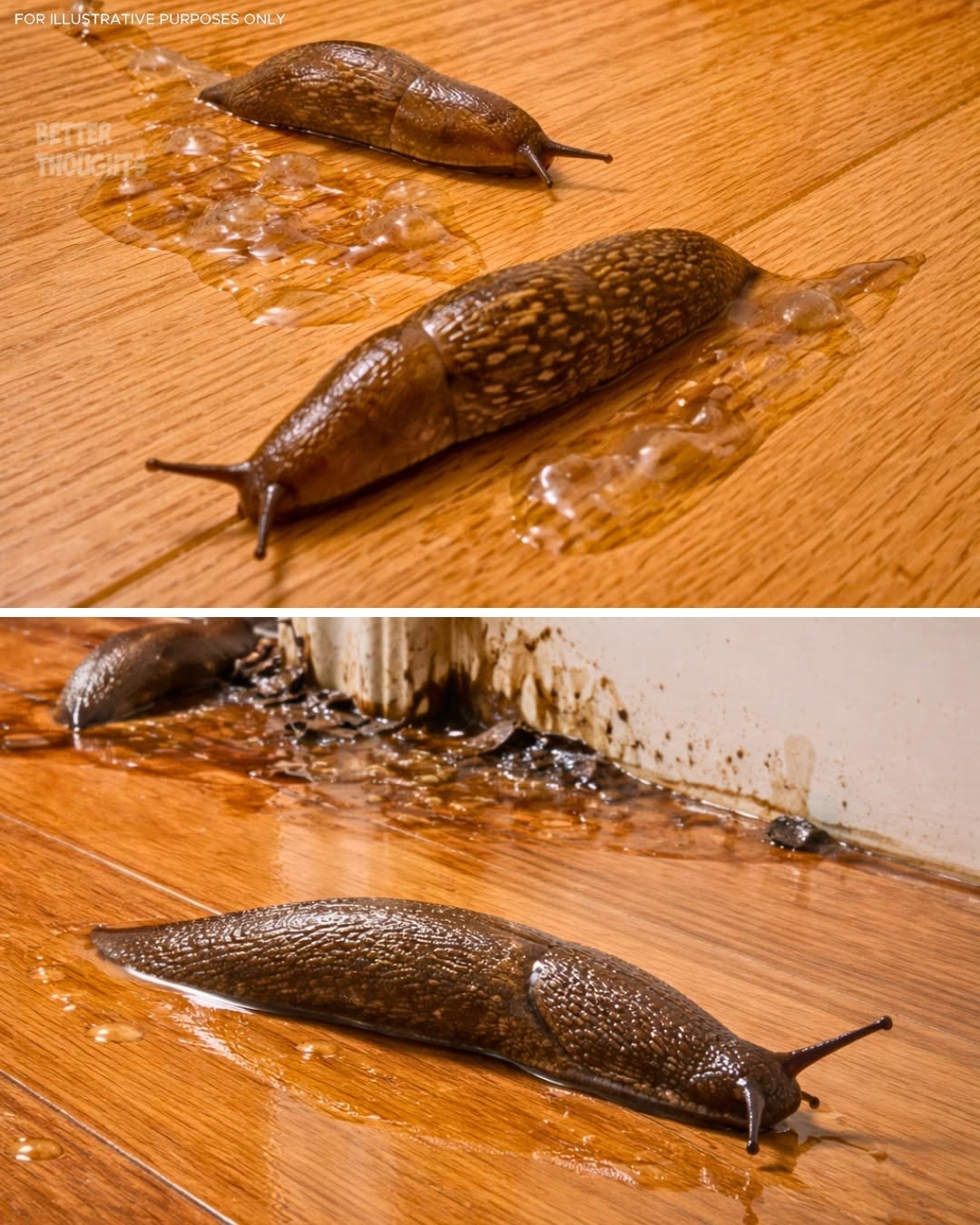

Imagine walking into your dark kitchen in the middle of the night to grab a glass of water. As the moonlight filters through the window, it catches a faint, shimmering ribbon of silver winding across the linoleum tile. This glistening pathway, delicate and almost artistic, tells a story of a silent traveler that crossed your floor while the household slept. While your first reaction might be a mixture of surprise and mild annoyance, this nocturnal trail is far more than a simple nuisance. It is a highly accurate diagnostic report from the natural world, delivered directly to your living space.
For generations, homeowners have occasionally discovered these winding, iridescent tracks on their kitchen floors, basement steps, or hallway carpets. It is easy to view these encounters as random, isolated events—a simple case of a stray garden visitor losing its way. However, from an ecological and structural standpoint, a slug inside your home is never a random occurrence. These soft-bodied creatures do not wander into human spaces without a very specific, biological invitation. Their presence is a quiet, reliable indicator that something within the hidden layers of your home—under the floorboards, behind the drywall, or deep within the crawlspace—has shifted, creating a microclimate that mirrors the damp forest floor.
By learning to interpret these silver trails, we can transform an unwelcome household surprise into a valuable opportunity for preventative maintenance. Rather than focusing solely on removing the visitor, we can listen to the structural story they are telling us, using their unique biology to map the moisture levels, ventilation quality, and physical integrity of our living environments.
The Biology of the Trail: Why Gastropods Seek the Indoors
To truly understand why slugs make their way onto our floors, we must first look at the specialized biology of these fascinating terrestrial gastropods. Unlike snails, which carry a protective calcified shell to shelter them from dry air, slugs evolved to sacrifice this heavy armor in exchange for greater physical flexibility and speed. This evolutionary trade-off, however, came with a significant vulnerability: a highly delicate, permeable skin that is exceptionally prone to drying out, a process known as desiccation.
To survive in a terrestrial environment, a slug must constantly maintain a thick layer of protective moisture over its entire body. They achieve this by secreting a specialized mucus composed of water, glycoproteins, and complex mucopolysaccharides. This mucus serves multiple survival purposes: it acts as a physical barrier against dry air, provides traction to glide over rough surfaces, and protects their sensitive undersides from sharp objects. When a slug travels, it leaves behind a portion of this highly resilient mucus, which dries into the characteristic silver trails we find on our floors.
Because their survival depends entirely on moisture, slugs are incredibly sensitive to changes in humidity and temperature. They possess specialized sensory organs that can detect even minor fluctuations in atmospheric moisture from a distance. In the wild, they spend the dry, sunny hours of the day hiding deep within leaf litter, rotting logs, or damp soil, emerging only at night when the relative humidity rises. When the outdoor environment becomes too dry, or when a home’s internal systems begin to leak, the elevated humidity leaking from a house acts as a beacon, drawing these moisture-seeking travelers toward the physical boundaries of our living spaces.

Ancient Lore and Myth: The Cultural History of the Gastropod
Long before the development of modern building science and structural engineering, human societies observed the movements of slugs and snails with a mixture of curiosity, respect, and folklore. Because these creatures emerged from the earth during times of high moisture, they were deeply tied to agricultural calendars and weather patterns in the minds of early communities.
In Celtic and old English folklore, gastropods were frequently viewed as natural rain prophets. Farmers noticed that a sudden increase in the number of slugs crawling on stone walls or entering outbuildings almost always preceded a heavy, soaking rainstorm. While early societies often attributed this to a mystical sensitivity or a spiritual connection to the earth, modern science has validated the core of this ancient observation. Slugs are highly sensitive to drops in barometric pressure, which signal approaching storm fronts, prompting them to move to higher ground or seek shelter before the heavy rains arrive.
Other cultural traditions viewed the glistening trails left by these creatures through a more speculative lens. In some European folk beliefs, discovering a silver path inside a home was considered a sign of hidden wealth or a message from earth spirits warning the inhabitants of unstable, shifting foundations. Some historical households even looked at the specific direction of the winding trail to speculate on the family’s upcoming fortunes. While these extraordinary interpretations are understood today as charming mythology, they highlight a historical truth: humans have always recognized that the appearance of these quiet travelers is a sign that demands our attention and respect.
The Structural Diagnosis: Translating the Silver Warning Signs
When a slug manages to cross your kitchen tile, it is not simply demonstrating curiosity; it is mapping the physical vulnerabilities of your home. To enter a living space, a gastropod must navigate a continuous path of moisture and find a physical breach in the building envelope. Therefore, their presence serves as a highly reliable biological indicator of two specific conditions: excess moisture and unsealed access points.
The primary factor that invites these travelers indoors is elevated humidity, which is often the result of hidden plumbing issues, poor ventilation, or drainage problems. When water pools under a sink, condenses along uninsulated pipes, or seeps through a porous concrete basement wall, it creates a localized zone of high humidity. This damp air slowly migrates through floorboards and wall cavities, creating a continuous trail of moisture that leads directly from the damp earth outside to the interior of your home.
In addition to moisture, the presence of a slug indicates that there is a physical opening in your home’s defenses. Because of their flexible, bone-free anatomy, slugs can compress their bodies to squeeze through remarkably small gaps. They often enter through hairline cracks in the concrete foundation, unsealed utility penetrations, gaps beneath exterior doors, or poorly fitted basement windows. By tracking the origin of the silver trail, homeowners can often pinpoint the exact location of these tiny breaches, allowing them to seal the openings and protect their homes from pest entry, draft issues, and energy loss.
Restoring Balance: Sustainable and Preventative Home Management
Addressing the appearance of slugs indoors is not about using harsh chemicals or focusing on elimination; rather, it is about restoring the environmental balance of your home. Because these creatures are drawn to very specific conditions, the most effective and sustainable way to prevent their entry is to remove the moisture and seal the physical gaps that invite them inside.
The first step in a successful management plan is to conduct a thorough moisture audit of the area where the trails were discovered. Check beneath sinks for slow pipe leaks, inspect the crawlspace for standing water or torn vapor barriers, and ensure that your home’s gutters and downspouts are directing rainwater far away from the foundation. Utilizing a dehumidifier in naturally damp areas, such as basements or utility rooms, can also dramatically lower the relative humidity, making the indoor environment completely uninviting to moisture-loving wildlife.
Once the moisture sources are controlled, focus on sealing the physical entry points along the perimeter of your home. Use high-quality silicone caulk to seal cracks in the foundation, install durable weatherstripping under exterior doors, and place fine wire mesh over crawlspace vents. Additionally, keeping the immediate exterior of your home clear of heavy mulch, leaf piles, and dense vegetation reduces the natural habitat of these creatures near your foundation, creating a clean, dry buffer zone that naturally deters them from approaching your walls.
Human Curiosity and the Unseen Forces of the Natural World
The quiet journey of a slug across a kitchen floor is a simple yet powerful reminder of the intricate connections that exist between our built environments and the natural world. Our homes, no matter how modern or well-constructed, are not isolated bubbles; they are constantly interacting with the ecosystems, weather patterns, and wildlife that surround them.
Our innate curiosity drives us to look beyond the surface of everyday occurrences, asking why a small creature has crossed our path and what its journey can teach us about our own spaces. By approaching these moments with a desire to learn rather than a desire to control, we gain a deeper appreciation for the delicate feedback loops that govern our planet. The humble slug, with its simple biology and quiet movements, serves as a gentle reminder that even the smallest visitors can offer us valuable wisdom, helping us build safer, healthier, and more harmonious homes for generations to come.
Sources
-
The Entomological Society of America: Academic resources and research papers regarding the behavior, survival mechanisms, and environmental preferences of terrestrial gastropods.
-
The National Association of Home Inspectors (NAHI): Standardized guidelines for moisture control, crawlspace maintenance, and preventing structural damage from elevated indoor humidity.
-
The Journal of Chemical Ecology: Scientific studies exploring the composition, function, and persistence of gastropod mucus trails in varying atmospheric conditions.
-
The Folklore Society of Great Britain: Historical archives detailing agricultural myths, weather prediction lore, and the cultural history of garden wildlife in European traditions.
