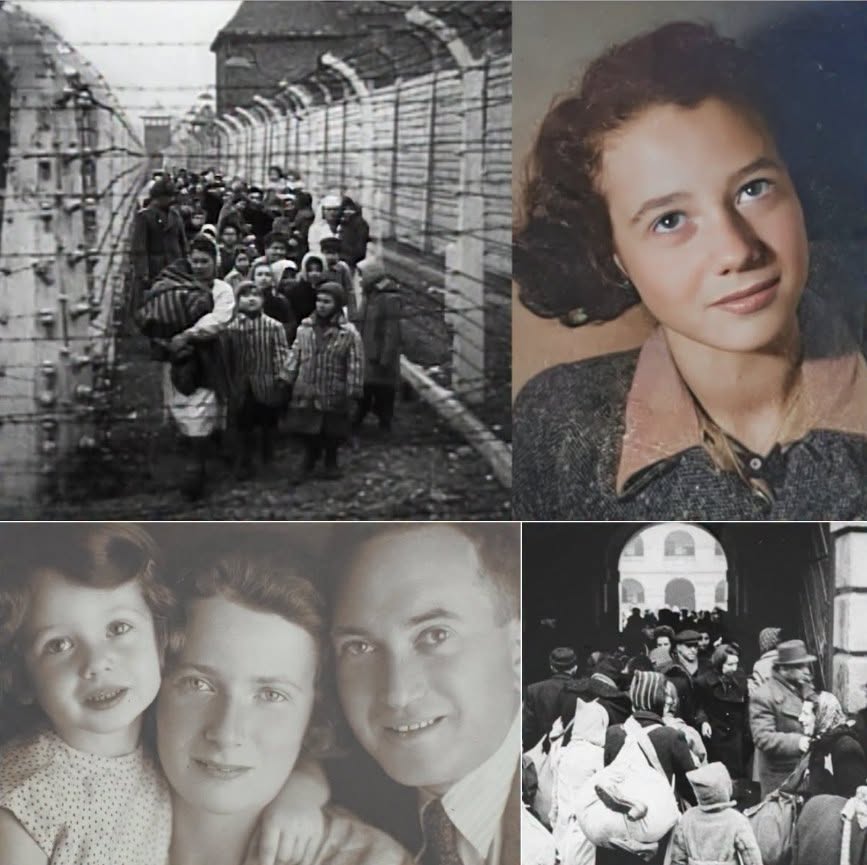

How does an individual find the resolve to preserve the human spirit when surrounded by systemic destruction? Why should anyone dedicate themselves to history, education, and literature when the very foundation of human decency has been torn away?
These profound questions lie at the absolute heart of The Librarian of Auschwitz, a historical novel by Spanish journalist Antonio Iturbe (translated into English by Lilit Thwaites). The narrative pulls back the heavy curtain of the past to illuminate the extraordinary life of Dita Kraus (née Poláchová). As a young girl, Dita served as the clandestine custodian of a fragile collection of books within the children’s section of the Auschwitz-Birkenau concentration camp—a small sanctuary of learning that existed just moments before thousands of its inhabitants were tragically lost in the spring of 1944.
To construct this moving account, Iturbe interviewed Kraus extensively, weaving her personal recollections together with the true stories of other historical figures who inhabited that bleak landscape. Though structured as a biographical novel, the book breathes life into real people: from the notorious camp physicians who viewed children merely as subjects for cruel medical observation, to Fredy Hirsch, the charismatic instructor who oversaw the children’s block and utilized every ounce of his energy to shield, educate, and uplift the young minds in his care.
“The written descriptions naturally differ from the stark reality that I lived through day after day,” Kraus, then 88, shared in a reflective interview from her home in Netanya, Israel. “The truth is that no one who did not experience the inside of those fences can ever fully capture it. For the depths of those experiences, proper words simply do not exist in our vocabulary.“
Yet, despite the inherent limitations of translating such profound hardship into prose, Kraus viewed the publication as deeply gripping. She emphasized that literature remains a vital bridge for connecting modern readers with essential historical truths that must never be forgotten.
In the book’s commentary, Iturbe addresses a critique that some might raise: that establishing an underground school and preserving a handful of forbidden books was ultimately an act of futile bravery, given the tragic fate that awaited so many of the children. But for the author, the existence of that hidden library represents the ultimate victory of the human spirit. It demonstrates how teachers and students alike refused to let their inner lives be diminished by their surroundings.
By sharing Dita’s journey, the narrative challenges us to look beyond mere survival and reconsider what it truly means to maintain our humanity in the darkest of times.
A Sanctuary in the Shadow of Loss
Born in Prague in 1929, Dita Kraus was only thirteen years old when her family was uprooted and sent to the Terezín ghetto. Even amidst the severe restrictions and pervasive anxiety of the ghetto, her inner world grew. She developed a deep passion for painting under the guidance of her art teacher, Friedl Brandeis, who would later perish in the camps. It was also during this period that Dita first encountered Fredy Hirsch, a dedicated youth leader and sports instructor known for his discipline and unyielding commitment to young people.
In December 1943, Dita’s family, along with Hirsch and hundreds of others, were transported to Auschwitz-Birkenau. It was there that her father, Hans, succumbed to the harsh conditions.
Their environment was uniquely distinct from the rest of the vast complex. They were placed in Block 31, a designated family sector. Historians note that this specific area was maintained under a veneer of relative normalcy by the authorities to serve as a deceptive showcase, obscuring the grim reality of the mass casualities occurring elsewhere in the camp.
“We were in a unique section because it contained families and children,” Kraus recalled in her recorded testimonies. “Fredy Hirsch was the driving force behind the children’s care, and because of him, I was given the responsibility of looking after a small, precious handful of books that had been smuggled in.“
Within the confines of the children’s block, a quiet defiance took root. Counselors organized improvised, secret lessons, gathering the children in small groups based on their age. Though resources were virtually nonexistent and rations were meager, the structured environment provided a vital psychological shield. The children did not succumb to the immediate physical neglect that claimed so many others nearby; they had found an intellectual and emotional oasis.
“Fredy was uncompromising about certain standards,” Kraus explained. “He ordered the counselors to ensure that the children washed regularly. Cleanliness and basic hygiene were treated as essential tools of survival and self-respect.“
Tragically, these measures could not alter the ultimate trajectory of the camp. After a few months, the illusion of the family camp was shattered, and thousands were lost in a single night.
Hirsch himself passed away just before that final enforcement. While historical underground movements had approached him to lead an organized uprising upon learning of the camp’s imminent liquidation, his life ended abruptly due to a medication overdose. While some accounts historically pointed toward suicide, Iturbe and several survivors have questioned the true circumstances, wondering if an administrative error or intentional targeting took place.
Kraus remained firm in her defense of his memory: “He would never have chosen to leave those children behind voluntarily. To us, he was an absolute protector.“
The Value of a Single Moment
Was such a dangerous effort worth it if the lives they sought to enrich were cut so terribly short? Iturbe explores this delicate question through a poignant dialogue in his novel, where a counselor comforts the fictionalized Dita:
“It was completely worth it. Nothing we did was in vain. Do you remember their laughter? Do you remember the wonder in their eyes when they sang together or listened to the stories from our ‘living books’—the people who memorized texts to recite them? Do you remember how they jumped for joy over a mere fragment of a biscuit? They experienced genuine happiness, Edita.“
The narrative suggests a powerful truth: sometimes, experiencing happiness for a brief moment—even as fleeting as the scratch of a match in the dark—is a profound victory against absolute cruelty.
Following the closure of the family camp, the teenage Dita and her mother, Elisabeth, were transferred to Bergen-Belsen. This was the very same destination where Anne Frank would lose her life. When British forces finally liberated the camp in April 1945, the scene was far from celebratory.
“It is nearly impossible to feel standard joy when you are walking among the fallen,” Kraus reflected. The profound neglect of the camp caused thousands more to pass away even after the liberation arrived—including Dita’s mother, who left her completely alone in a fractured world.
Dita was forced to rebuild her life from nothing. She eventually reunited with Otto Kraus, a fellow survivor she had known by sight from the children’s block in Auschwitz, though they had never spoken there. Together, they emigrated to Israel, built a life as English teachers, and raised three children. Yet, even across decades of peace, the memories of her youth and her time as the keeper of the secret library remained vivid.
Reflections on a Fractured Century
Looking back on her life, Kraus offered sharp insights into the nature of trauma, survival, and the enduring human condition:
On the premature end of her youth: “The war began when I was only ten years old, and the severe anti-Jewish decrees forced me to adapt instantly. I had to learn self-reliance by the time I was thirteen in the ghetto. Conversely, because I was barred from formal schooling after the fifth grade, my education had massive gaps. I don’t think I ever experienced a conventional childhood.“
On finding light in dark places: “True happiness was impossible under those conditions. The absolute most one could hope for was a brief, temporary sense of relief from the daily dread.“
On the power of literature in crisis: “Books have always been a necessity for me; I cannot imagine a life spent without reading. But if I am being entirely honest, the books in Auschwitz did not save our bodies. We were all caught in a system designed for our elimination. They saved our minds, but physical survival required something else entirely.“
On the secret to her survival: “It came down to an initially resilient physical constitution and luck—layered with luck, and supplemented by more luck.“
On her lifelong partnership: “I met Otto again in Prague a few weeks after the war ended in 1945. It wasn’t an instant romance. He didn’t resemble the flawless prince of a young girl’s imagination. But as we shared our paths, my affection for him deepened gradually, transforming into a profound bond that sustained us for the rest of our lives.“
On lessons for future generations: “People must look at history and realize exactly what human beings are capable of inflicting upon one another. It should serve as a permanent warning.“
On the concept of closure: “With the steady passage of time, I find myself less capable of understanding how civilized people could systematically carry out such actions. The generation that perpetrated those specific deeds has passed on, but the incomprehension remains.“
On navigating modern discord: “I don’t possess a simple cure for the world’s divisions. Far greater minds are constantly working to replace animosity with mutual respect, while others actively work to deepen societal fractures. This is why cultivating empathy and understanding in our educational systems is paramount. Literature plays an indispensable role here, groundtesting readers in the realities of our shared past.“
On the permanent imprint of the past: “Enduring nearly three years of systematic deprivation, degradation, and the total loss of my parents, extended family, and childhood friends reshaped my entire existence. It gave me a permanent internal compass for what truly matters versus what is trivial. But it also taught me to love carefully. When you have lost everyone, you learn to protect your heart because you know the agonizing pain that follows when a loved one is gone.
