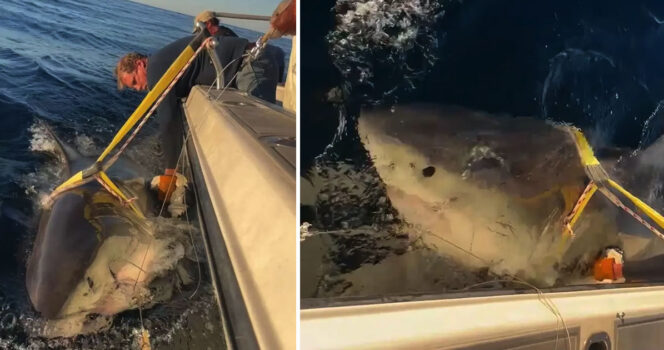

The Atlantic Ocean is a vast world of mysteries, but few of its secrets capture the human imagination quite like the silent journeys of its apex predators. Beneath the rolling blue waves, a massive traveler has been navigating the deep, leaving researchers in anticipation. For months, a quiet blank space sat on the tracking maps of marine biologists, marking the unmonitored path of a true giant.
Then, on a quiet summer morning, a brief, faint signal flickered on a satellite receiver.
Contender, a massive great white shark measuring nearly 14 feet long and weighing an estimated 1,653 pounds, had broken his silence. This magnificent creature, the largest male great white shark ever tagged in the Western North Atlantic by the research organization OCEARCH, had just made his presence known once again. As the faint signal registered on tracking screens, researchers and ocean enthusiasts alike began to wonder: where is this ocean wanderer heading next?
The Silent Sentinel of the Deep
To understand the excitement surrounding Contender’s reappearance, one must appreciate the sheer scale of this ocean giant. Tagged by the marine conservation organization OCEARCH on January 17, 2025, near the Georgia-Florida border, Contender immediately became a biological celebrity. Stretching 13 feet, 9 inches in length, he stands as a monument to his species’ resilience and the success of marine conservation efforts in the Atlantic.
Since his initial tagging, Contender has logged an incredible journey of more than 7,000 miles, traveling along the Eastern Seaboard. For scientists, every movement of a mature male of this size provides invaluable data. While female sharks of the species can grow even larger—such as the famous 20-foot Hawaii resident known as Deep Blue—male great whites rarely reach the proportions that Contender displays. At an estimated age of over 30 years, Contender represents a critical demographic of breeding-age males essential to the long-term health of the Northwest Atlantic shark population.
Following his movements is like reading a biological diary of the Atlantic. After spending the winter months in warmer southern waters, his tracking history shows a steady northern migration as spring progresses. His last precise location was recorded on April 23 off the coast of the Outer Banks of North Carolina. After that, the map went quiet, leaving a gap in his journey that lasted through the late spring and early summer.
Decoding the Whisper of a Z-Ping
On July 8, 2026, the silence was finally broken. A satellite orbiting high above the Earth captured a single, fleeting message from the transmitter attached to Contender’s dorsal fin. However, this was not a standard location ping, which requires multiple consecutive transmissions to calculate an exact coordinate. Instead, it was what marine scientists refer to as a “Z-ping.”
A Z-ping is a weak, non-locational signal. It typically occurs when a shark’s dorsal fin breaks the surface of the water only briefly, perhaps for just a few seconds as the animal glides through a wave. While a Z-ping cannot pinpoint the exact latitude and longitude of the animal, it serves as a vital proof-of-life. It tells researchers that the tag is still functioning, the battery is active, and the shark is swimming close to the surface.
For the team at OCEARCH, this brief whisper from the deep was enough to spark exciting theories. While they cannot point to a exact spot on the map, historical migration data and seasonal ocean patterns allow experts to make highly educated hypotheses about Contender’s trajectory.
The Summer Journey North
Where is Contender going? Based on years of tracking more than a hundred white sharks in the Western North Atlantic, researchers believe he is on a northern summer pilgrimage. During the warm summer months, the coastal waters of New England and Atlantic Canada become an ideal environment for great whites.
Two regions in particular are likely destinations for Contender: Cape Cod, Massachusetts, and the waters of Atlantic Canada, such as Nova Scotia and the Gulf of St. Lawrence. These areas offer two crucial elements that a 1,600-pound apex predator requires: comfortable water temperatures and a plentiful food supply.
The waters off Cape Cod, in particular, have seen a significant ecological resurgence over the past few decades. Protective environmental legislation has allowed populations of grey and harbor seals to recover, establishing robust colonies along the shoreline. For a mature great white shark, these seal colonies represent a highly concentrated, energy-rich food source. Swimming near these coastal shelves allows sharks like Contender to forage efficiently, building up fat reserves that will sustain them during their long southward journey when winter returns.
Myths, Shadows, and the Realities of Ocean Coexistence
The idea of a massive shark moving toward popular summer destinations naturally stirs a mixture of awe and caution. For decades, popular culture has painted the great white shark as a relentless, shadowy figure of the deep, a narrative heavily influenced by classic cinema and sensationalized media reports. This cultural myth has often overshadowed the biological reality of these magnificent creatures.
In truth, great white sharks are not mindless wanderers seeking out human contact. Marine biologists emphasize that humans are not on the menu for these animals. Shark encounters are incredibly rare, and when they do occur, they are typically cases of mistaken identity in low-visibility waters, where a shark might confuse a swimmer or a surfboard with the silhouette of a seal.
To help local communities and visitors share the ocean safely, organizations like the Atlantic White Shark Conservancy have developed innovative public safety tools. Apps like “Sharktivity” allow beachgoers, researchers, and safety officials to upload and view verified shark sightings in real-time. This transparent sharing of data transforms fear into understanding, allowing residents and tourists to enjoy the beautiful New England beaches with peace of mind, knowing that modern science is keeping watch.
The Science of Tracking and Ocean Health
The technology that allows us to follow Contender is a marvel of modern conservation science. The SPOT (Smart Position and Temperature) tag attached to his dorsal fin is designed to last for approximately five years. Every time the tag breaks the dry air of the surface, it communicates with satellites to paint a picture of the shark’s life path.
But tracking is only one piece of the puzzle. When OCEARCH researchers first tagged Contender, they conducted a comprehensive health assessment, taking blood and tissue samples, measuring his physical dimensions, and even checking for environmental toxins. This open-source data is shared with scientists worldwide, helping us understand not just the sharks themselves, but the health of the entire marine ecosystem.
As apex predators, great white sharks play a fundamental role in maintaining the balance of the ocean. By keeping prey populations in check, they prevent single species from dominating the ecosystem, ensuring biodiversity thrives. A healthy population of great white sharks is a strong indicator of a healthy, productive ocean.
A Reflection on Human Curiosity
The enduring fascination with Contender’s journey speaks to a deep, underlying aspect of the human spirit: our unyielding curiosity about the natural world. In an age where almost every corner of our planet has been mapped, digitized, and illuminated, the ocean remains one of the last true frontiers of mystery.
When we track a giant like Contender, we are doing more than just collecting scientific data points on a screen. We are connecting with a creature whose lineage stretches back hundreds of millions of years, far predating the dinosaurs. The brief “Z-ping” of a dorsal fin breaking the surface reminds us that we share this planet with ancient, silent travelers who navigate by laws we are only beginning to comprehend.
Ultimately, our interest in Contender is a celebration of the wild and the unknown. It is a reminder of the beauty of conservation, the power of curiosity, and the importance of preserving the wondrous, untamed spaces of our blue planet for generations to come.
Sources
-
OCEARCH Global Shark Tracker: Real-time satellite tracking data and biological profiles for tagged marine animals, including Contender.
-
Atlantic White Shark Conservancy: Research and public safety resources regarding white shark populations in the Northwest Atlantic.
-
Boston 25 News / National Weather Desk Reports: Media coverage on regional sightings and tracking updates of large marine predators off the New England coast.
