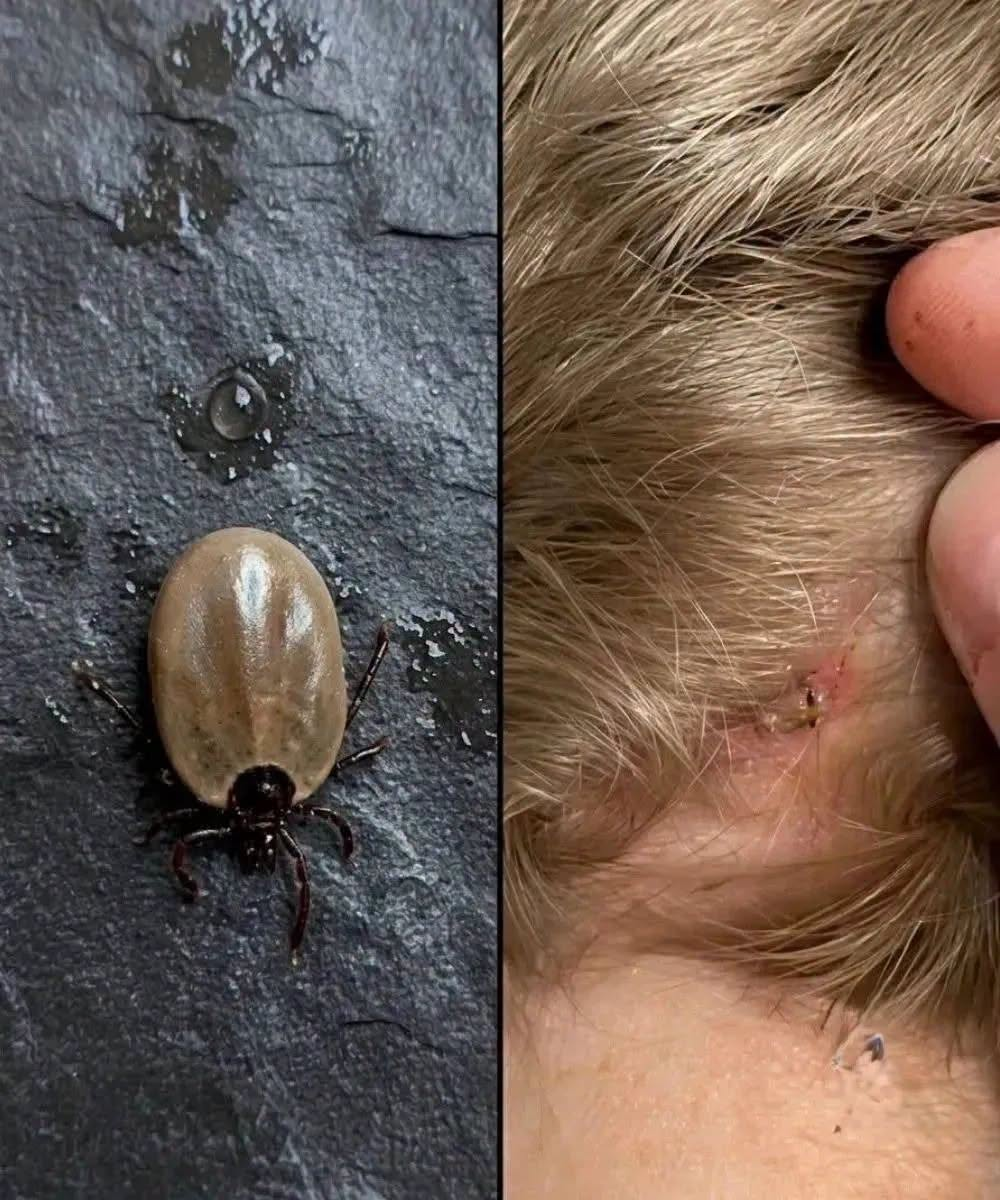

The morning sun filtered through the dense canopy of a New England forest, painting the forest floor in dappled gold. A young girl laughed as she chased a butterfly through the tall, dewy grass, her parents watching warmly from a nearby wooden bench. It was a picture-perfect summer morning, the kind of memory families build their lives upon. Yet, hidden on the underside of a single blade of grass, a tiny creature no larger than a poppy seed waited silently, sensing the warmth and carbon dioxide of a passing host.
Weeks later, the butterfly chase was forgotten, but a subtle change began to creep over the household. The once-vibrant child grew unusually quiet, complaining of a vague stiffness in her joints and a deep fatigue that sleep could not fix. Her parents, searching for answers, recalled a tiny dark speck they had brushed off her leg days after the hike. It is in these quiet, post-outdoor moments that a critical realization must dawn: a simple tick bite is never something to ignore, and a parent’s relentless attention to detail is often the primary defense against a persistent, invisible illness.
The Biology of the Bite: Understanding the Vector
To effectively protect our families, we must first understand the biology of the tiny arachnids that inhabit our woodlands, parks, and suburban backyards. Ticks are not insects; they are specialized arachnids belonging to the subclass Acari. The most notable species in the context of public health is the blacklegged tick (Ixodes scapularis), commonly known as the deer tick. These organisms rely entirely on hematophagy—feeding on the blood of vertebrate hosts—to progress through their complex multi-year life cycles.
During the feeding process, a tick does not simply bite and release. It secretes a highly sophisticated cocktail of bioactive compounds through its saliva. This specialized mixture contains natural anesthetics to numb the host’s skin, anti-inflammatory agents to prevent localized itching, and anticoagulants to keep the blood flowing freely. Because of this chemical cloaking mechanism, a host can remain entirely unaware of the tick’s presence for several days. It is during this prolonged attachment window that microscopic pathogens, such as the spiral-shaped bacterium Borrelia burgdorferi, can transition from the tick’s midgut into the host’s bloodstream.
The Myth and Reality of the Bullseye Rash
For decades, public health campaigns have emphasized the appearance of a specific, expanding circular rash known as erythema migrans—the classic “bullseye” rash—as the primary indicator of a Lyme disease infection. In cultural mythology, the absence of this rash is often equated with a clean bill of health, leading many families to let their guard down if their skin remains clear. However, modern clinical science paints a much more nuanced and complex picture.
Scientific research conducted by organizations like the Centers for Disease Control and Prevention (CDC) reveals that while erythema migrans is a highly specific indicator of infection, it does not present in every case. Up to 20 to 30 percent of individuals diagnosed with Lyme disease never develop a visible rash.
Furthermore, when a rash does appear, it may not assume the textbook concentric circle pattern; instead, it can present as a solid, expanding red patch, a bruised area, or even go unnoticed if it occurs in a hidden location like the scalp, underarms, or behind the knees. Relying solely on the presence of a bullseye rash to seek medical care is a risky strategy that can delay vital early intervention.
The Subtle Shift: Tracking Systemic Behavioral Changes
When pathogens evade early detection, they can begin to affect the body’s systemic systems, leading to a cluster of symptoms that are often difficult to define. In children, these early systemic responses can manifest not as clear physical markers, but as subtle shifts in mood, behavior, and cognitive function. A parent who observes their child daily is uniquely positioned to spot these early, quiet warning signs.
Pediatric specialists emphasize that a sudden, unexplained onset of irritability, emotional sensitivity, or a drop in academic focus can sometimes be the body’s internal response to an active immune challenge. These behavioral shifts, coupled with complaints of “growing pains” in the joints or a persistent, low-grade fatigue that does not resolve with rest, warrant a thorough evaluation.
By keeping a detailed, written log of these subtle changes alongside dates and outdoor activities, parents provide healthcare professionals with a vital historical record that standard laboratory tests might initially miss.
Navigating the Challenges of Diagnostic Testing
One of the most complex aspects of managing tick-borne illnesses is the inherent limitation of current diagnostic testing methodologies. The standard laboratory approach primarily relies on indirect serological tests, such as the Enzyme-Linked Immunosorbent Assay (ELISA) followed by a Western Blot. These tests do not detect the actual bacteria; instead, they measure the host’s antibody response to the infection.
Because it takes the human immune system several weeks to synthesize a measurable level of antibodies after a bite, testing performed during the initial days of an infection can frequently yield a false-negative result.
If a patient is dismissed based solely on an early negative test while exhibiting classic clinical symptoms, the window for highly effective early antibiotic treatment can be missed. Modern medical guidelines emphasize that early Lyme disease is a clinical diagnosis, meaning that treatment should be initiated based on known exposure, clinical symptoms, and geographical risk, rather than waiting for laboratory confirmation.
Cultivating a Proactive Partnership with Healthcare Professionals
Navigating the medical system when dealing with vague, multi-system symptoms requires a blend of persistence, organization, and clear communication. Healthcare environments are often fast-paced, and clinical guidelines can take years to integrate the latest scientific findings. In this landscape, a parent must transition from a passive observer to an active, informed historian and advocate for their family’s health.
When consulting with a physician, it is highly effective to present clear, chronological data. Show photographs of any rashes or bite sites, share your written symptom log, and ask direct, open-ended questions about regional tick-borne risks.
Requesting clear follow-up parameters—such as asking, “If these symptoms do not improve within five days, what is our next diagnostic step?”—helps establish a proactive partnership. If your concerns are met with quick dismissal or are attributed entirely to routine stress without a thorough evaluation, seeking a second opinion from a specialist who is deeply versed in regional vector-borne illnesses is a rational, protective choice.
Practical Strategies for Outdoor Protection and Prevention
While remaining vigilant is essential, the ultimate goal is to enjoy the restorative benefits of the great outdoors safely. By implementing a series of scientifically backed preventative habits, families can dramatically reduce their exposure to tick-borne vectors without sacrificing their connection to nature.
Simple post-adventure habits are equally critical. Upon returning indoors, placing outdoor clothing in a dryer on high heat for ten minutes effectively eliminates any hitchhiking ticks.
Conducting immediate, thorough body checks—paying close attention to warm, hidden areas like the scalp, behind the ears, and the waistband—allows for the rapid removal of any attached ticks before the window of pathogen transmission begins. If an attached tick is found, utilizing fine-tipped tweezers to grasp the tick close to the skin’s surface and pulling upward with steady, even pressure ensures clean, complete removal.
Conclusion: Human Curiosity and our Relationship with the Natural World
The sustained scientific exploration of tick-borne pathogens and our ongoing efforts to protect ourselves from them highlight a fundamental aspect of human curiosity. Since our earliest days, we have possessed an innate desire to explore the natural landscapes around us, seeking adventure, knowledge, and peace. Yet, this same curiosity also drives us to look closer, to study the microscopic ecosystems that share our world, and to develop the scientific tools and clinical insights required to navigate these environments safely.
By balancing our love for outdoor exploration with a deep, scientific understanding of the risks involved, we ensure that our families can continue to discover the beauty of our planet with confidence. A parent’s relentless focus on the small details—the quiet recording of a symptom, the thorough check after a hike, the determined conversation with a doctor—is not an overreaction. It is a beautiful expression of protective care, a vital bridge of vigilance that allows the next generation to explore the infinite wonders of our world safely and joyfully.
Sources
-
The Centers for Disease Control and Prevention (CDC): Public health guidelines, diagnostic testing protocols, and regional distribution maps for Lyme disease and other tick-borne pathogens.
-
The New England Journal of Medicine: Peer-reviewed clinical trials investigating early antibiotic intervention strategies and long-term outcomes of vector-borne infections.
-
The American Academy of Pediatrics: Pediatric clinical consensus statements regarding the behavioral and physiological presentation of early systemic infections in children.
-
The Entomological Society of America: Research publications detailing the life cycles, salivary chemical compositions, and behavioral ecology of Ixodes scapularis.
