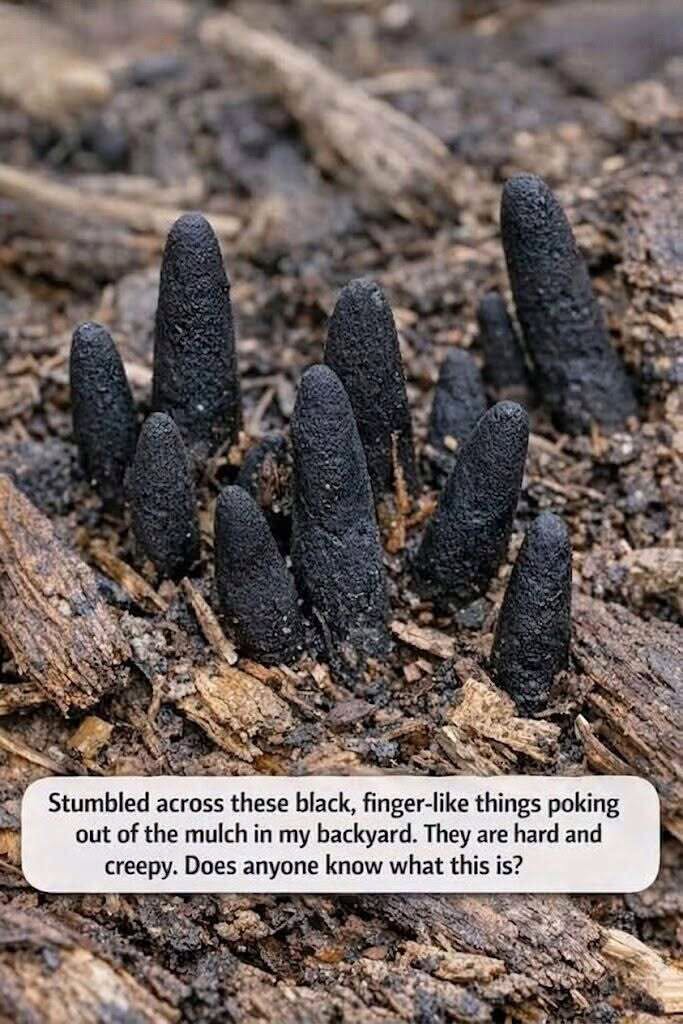

You step into your garden one morning, expecting to admire fresh flowers and neatly spread mulch. Instead, you notice several black, finger-like shapes reaching upward from the soil. Their rough texture and unusual appearance seem almost otherworldly, making it easy to wonder whether something unusual has invaded your yard.
Fortunately, these mysterious growths are usually far less alarming than they appear. Often called Dead Man’s Fingers, they are the fruiting bodies of a naturally occurring fungus known scientifically as Xylaria polymorpha. Although their appearance has inspired countless eerie descriptions, they are an important part of healthy ecosystems, helping recycle dead wood and return nutrients to the soil.
This article explores the fascinating biology of Dead Man’s Fingers, explains why they appear in gardens, separates myth from science, and offers practical advice for homeowners who encounter them.
What Are Dead Man’s Fingers?
Dead Man’s Fingers is the common name for the fungus Xylaria polymorpha, a species found throughout North America, Europe, and many other temperate regions.
Unlike flowering plants, fungi do not produce their own food through photosynthesis. Instead, they obtain nutrients by breaking down organic material already present in their environment.
Dead Man’s Fingers belongs to a group known as saprobic fungi, meaning it feeds primarily on dead or decaying wood rather than living plants.
Its unusual appearance has made it one of the most recognizable woodland fungi.

Why Does It Look So Unusual?
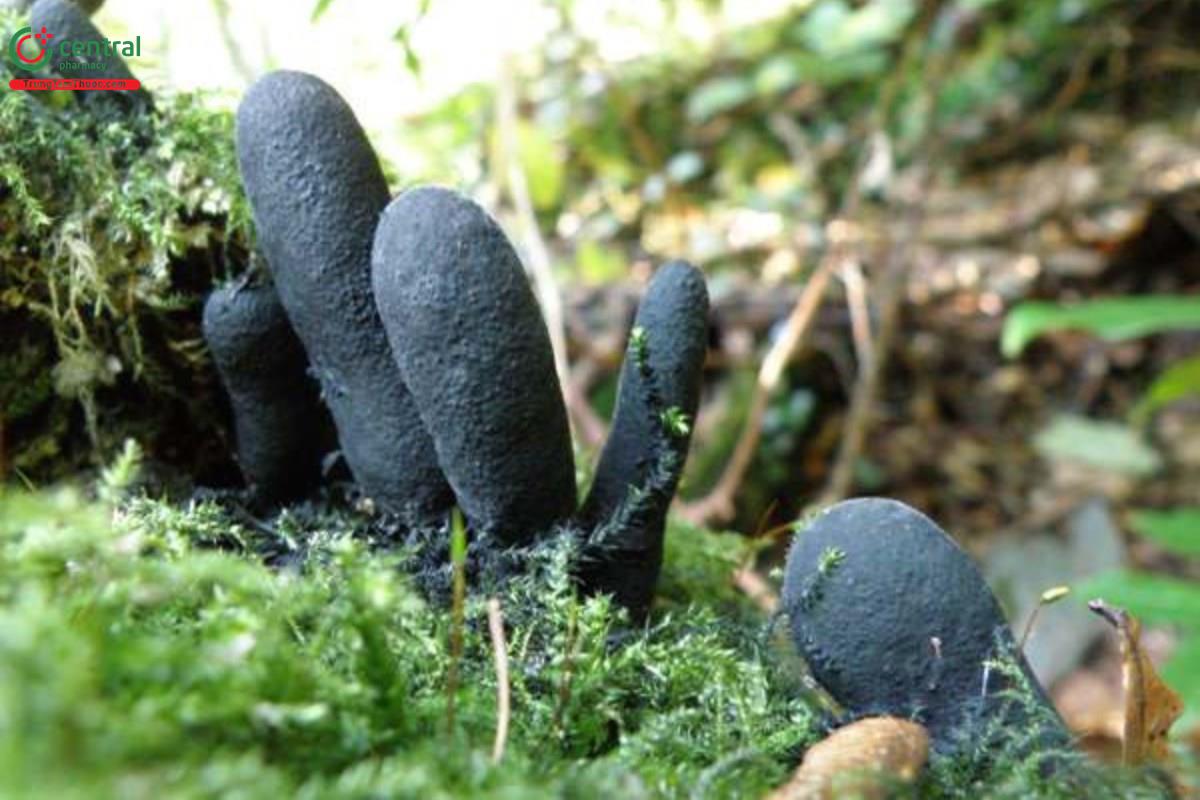
The fungus earns its memorable name because mature fruiting bodies closely resemble dark human fingers emerging from the ground.
As they develop, they undergo several distinct stages.
Early Growth
In spring or early summer, young fruiting bodies often appear pale gray, bluish, or whitish.
At this stage, they may resemble ordinary mushrooms or rounded club-shaped structures.
Mature Appearance
As the fungus matures, the surface gradually darkens to deep brown or black.
The outer layer becomes dry, rough, and slightly wrinkled, creating the appearance of weathered fingers.
Clusters commonly contain several upright stalks growing close together, adding to their distinctive silhouette.
Although visually striking, this appearance is simply part of the fungus’s natural reproductive cycle.
The Science Behind Dead Man’s Fingers
Fungi play essential roles in ecosystems by recycling organic matter.
Dead Man’s Fingers specializes in decomposing hardwood materials such as:
- Buried tree roots
- Decaying stumps
- Fallen branches
- Hardwood mulch
- Wood chips
Its underground network of thread-like structures, called mycelium, gradually breaks down complex compounds including cellulose and lignin.
These compounds are difficult for many other organisms to digest, making fungi essential contributors to nutrient cycling.
Without decomposer fungi, forests and gardens would accumulate enormous amounts of undecomposed wood over time.
Why Does It Grow in Garden Mulch?
Many homeowners first encounter Dead Man’s Fingers shortly after adding mulch to flower beds.
This occurs because hardwood mulch often contains exactly the material the fungus needs.
Several environmental conditions encourage its growth.
Decaying Wood
The fungus requires dead woody material as its primary food source.
Moisture
Consistently damp soil supports fungal development.
Shade
Partially shaded areas retain moisture longer, creating favorable conditions.
Limited Airflow
Poor ventilation slows drying and encourages fungal growth.
When these factors combine, fruiting bodies may eventually emerge through the mulch surface.
Is Dead Man’s Fingers Dangerous?
Despite its dramatic appearance, Dead Man’s Fingers is generally considered harmless to healthy people, pets, and garden plants.
It does not actively attack healthy trees or ornamental flowers.
Instead, it feeds on wood that has already begun decomposing.
Most gardening experts simply recommend avoiding consumption because the fungus has an extremely tough texture and is not regarded as edible.
As with any wild fungus, children should be discouraged from touching or tasting unfamiliar mushrooms or fungal growths without expert identification.
Myth vs. Science
Because of its eerie appearance, Dead Man’s Fingers has inspired numerous myths.
Myth: It Means Something Is Buried Underground
Some people jokingly speculate that the finger-like structures indicate buried remains or hidden objects.
Scientific Perspective
The fungus simply grows from decaying wood beneath the soil surface.
Its resemblance to fingers is purely coincidental.
Myth: It Is Highly Toxic
Its dark color sometimes causes homeowners to assume it is poisonous.
Scientific Perspective
While it is not considered edible, it is not known for producing dangerous airborne substances simply by growing in gardens.
Normal gardening precautions remain sufficient.
Myth: It Will Destroy the Entire Garden
Some fear the fungus will spread aggressively and kill nearby plants.
Scientific Perspective
Dead Man’s Fingers primarily decomposes already dead wood rather than attacking healthy vegetation.
Its presence often reflects active natural decomposition rather than plant disease.
The Ecological Importance of Fungi
Although fungi are sometimes overlooked, they perform remarkable ecological services.
Nutrient Recycling
They convert dead organic matter into nutrients available for other organisms.
Soil Health
Decomposition contributes to healthy soil structure and fertility.
Forest Maintenance
By breaking down fallen wood, fungi help prevent excessive accumulation of organic debris.
Biodiversity
Many insects, microorganisms, and other organisms depend upon fungal communities as part of healthy ecosystems.
Dead Man’s Fingers is one small contributor within this larger ecological network.
Should You Remove It?
Whether to remove the fungus depends largely on personal preference.
Some homeowners appreciate its unusual appearance and ecological role.
Others simply prefer a tidier landscape.
If removal is desired:
- Wear gardening gloves.
- Gently remove visible fruiting bodies.
- Remove buried decaying wood when practical.
- Dispose of the material through yard waste or compost according to local guidelines.
Removing only the visible structures may not eliminate the underground mycelium if suitable food sources remain.
Preventing Future Growth
Completely preventing fungal growth outdoors is neither practical nor necessary.
However, homeowners can reduce favorable conditions by:
Replacing Decaying Wood
Removing old buried roots or rotting stumps limits available food sources.
Improving Drainage
Reducing prolonged soil moisture discourages many fungi.
Increasing Sunlight
Selective pruning may improve airflow and allow soil to dry more efficiently.
Refreshing Mulch
Turning mulch periodically helps reduce moisture accumulation within compacted layers.
These practices contribute to healthier garden management overall.
Appreciating Nature’s Hidden Workers
Although Dead Man’s Fingers may initially seem unsettling, they represent a remarkable example of nature’s recycling system at work.
Beneath every healthy forest lies an enormous network of fungi quietly breaking down fallen trees, returning nutrients to the soil, and supporting future plant growth.
Most of this activity remains hidden underground.
Occasionally, fruiting bodies emerge, providing a rare glimpse into these invisible biological processes.
Rather than signaling danger, they often indicate that natural decomposition is proceeding exactly as intended.
Fascinating Facts About Dead Man’s Fingers
Several interesting characteristics make this fungus especially unique.
- It belongs to the genus Xylaria, which contains numerous wood-decomposing species.
- Fruiting bodies can remain visible for many months.
- Mature specimens feel remarkably hard and woody.
- The black outer surface contains microscopic reproductive structures that release spores into the environment.
- Similar species exist worldwide, although careful identification sometimes requires microscopic examination.
These features continue attracting interest from both amateur naturalists and professional mycologists.
Conclusion
Finding strange black growths emerging from garden mulch can certainly capture anyone’s attention. However, Dead Man’s Fingers is not a supernatural mystery or a sign of hidden danger. It is simply one of nature’s many specialized decomposers, quietly recycling dead wood and enriching the soil beneath our feet.
Science helps explain what first appears mysterious. The fungus thrives where decaying wood, moisture, and shade provide ideal conditions, performing an essential ecological service that benefits forests and gardens alike. While homeowners may choose to remove it for aesthetic reasons, its presence is generally a reflection of healthy natural decomposition rather than a cause for alarm.
Perhaps this is why unusual discoveries like Dead Man’s Fingers continue to fascinate us. They remind us that even familiar gardens contain hidden worlds filled with remarkable organisms. Human curiosity encourages us to look beyond first impressions, transforming surprise into understanding and revealing the extraordinary biological processes quietly unfolding all around us.

Sources
- Royal Botanic Gardens, Kew. Plants of the World Online: Xylaria polymorpha. https://powo.science.kew.org
- Missouri Botanical Garden. Plant Finder and Garden Resources. https://www.missouribotanicalgarden.org
- Royal Horticultural Society (RHS). Garden Fungi Information. https://www.rhs.org.uk
- University of California Integrated Pest Management (UC IPM). Fungi and Landscape Management. https://ipm.ucanr.edu
- North American Mycological Association (NAMA). Learning About Wild Fungi. https://namyco.org
