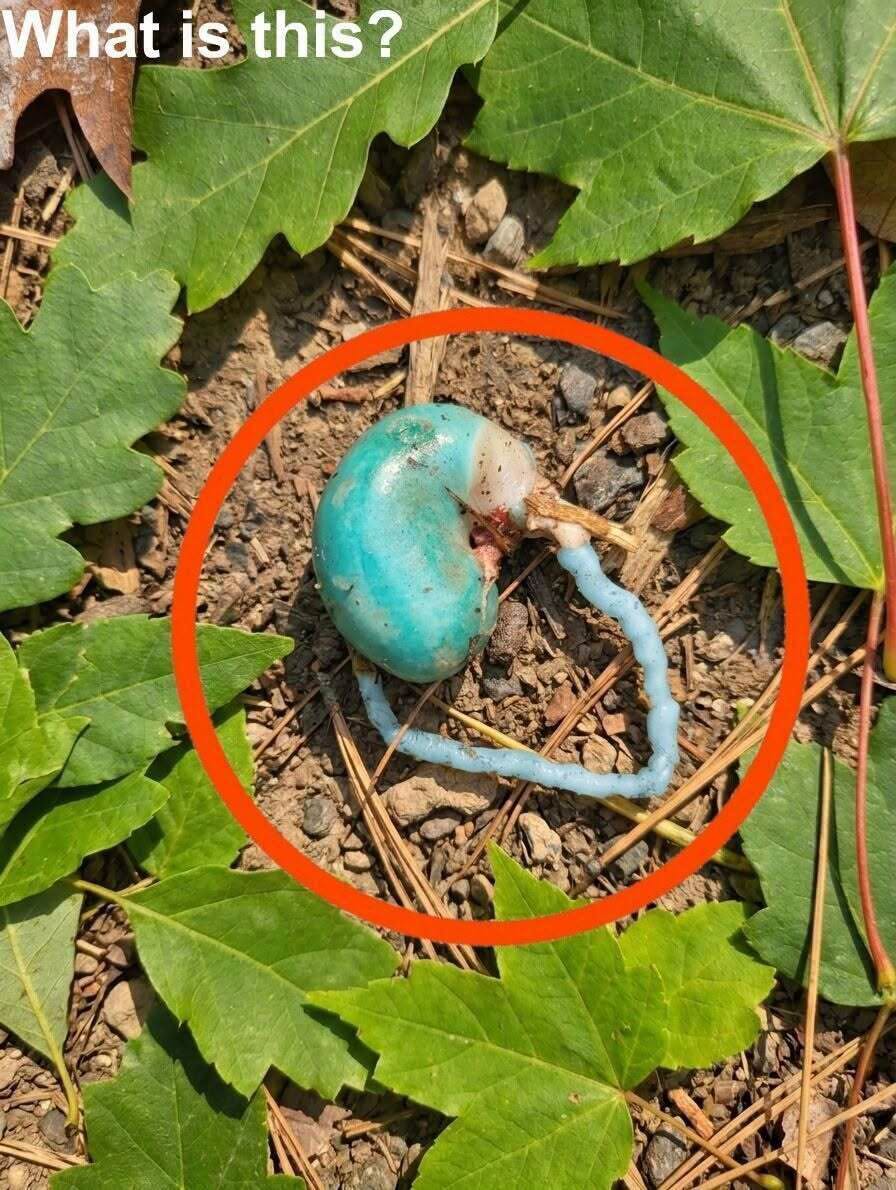

Imagine walking through a quiet woodland trail where sunlight filters gently through towering trees. Every step reveals fallen leaves, moss-covered logs, and the familiar sights of a healthy forest. Then, almost hidden among the leaf litter, you notice something completely unexpected.
A small, brilliant blue sphere.
Its smooth, glossy surface stands out against the earthy browns and greens surrounding it. It almost appears artificial, as though someone accidentally left behind a colorful object from another world. Curious, you lean closer and notice a small protrusion emerging from one side. The object feels surprisingly soft rather than solid.
Moments like these remind us why forests continue to inspire curiosity. Many natural objects seem almost impossible at first glance, encouraging observers to wonder whether they have discovered a rare plant, an unusual fungus, or something entirely different.
In many cases, the explanation is both simpler and more fascinating than imagination alone. What appears mysterious may actually be one stage in the remarkable life cycle of a fungus, such as a stinkhorn mushroom.
Why Some Forest Discoveries Look Unnatural
Nature often creates shapes, colors, and textures that challenge our expectations.
Most people associate mushrooms with the familiar umbrella-shaped caps growing from the forest floor. However, fungi display an astonishing variety of forms throughout their development.
Some resemble coral.
Others look like delicate lace.
Some resemble tiny cups or stars.
Others begin life as smooth, rounded structures that barely resemble mushrooms at all.
When unusual colors are involved, especially bright blue, purple, or vivid orange, the discovery can seem even more surprising.
Scientists explain that pigments, moisture, lighting conditions, and the stage of growth can dramatically influence how fungi appear.

The Curious Life Cycle of Stinkhorn Mushrooms
One of the forest’s most unusual fungi belongs to the stinkhorn family.
Rather than emerging immediately with a recognizable mushroom cap, many stinkhorn species begin underground inside a rounded structure commonly called an “egg.”
This early stage protects the developing fungus until environmental conditions become favorable.
Inside the egg, nearly all of the mature mushroom is already formed in miniature.
As moisture and temperature become suitable, pressure builds within the egg.
Eventually, the outer layer splits open, allowing the mature fruiting body to emerge rapidly.
For someone encountering only the unopened egg, it may appear more like an unusual plant bulb or an unfamiliar object than a mushroom.
Why Do Stinkhorn Eggs Feel Soft?
People who carefully examine these fungal eggs often describe several distinctive characteristics.
The outer layer feels smooth.
The interior has a spongy or foam-like texture.
The structure is surprisingly lightweight.
These observations match scientific descriptions of immature stinkhorn fungi.
The developing tissues inside contain soft cellular material that expands quickly during growth. This unique construction allows the mature mushroom to emerge within only a few hours under favorable conditions.
Because of this rapid expansion, the egg stage is relatively short-lived compared with other parts of the fungus’s life cycle.
Are Blue Stinkhorn Eggs Common?
Bright blue fungal eggs are not considered typical for most well-known stinkhorn species.
Several factors may contribute to unusual coloration.
Natural pigments within certain fungi.
Moisture affecting surface appearance.
Lighting beneath dense forest canopies.
Reflections from surrounding vegetation.
Digital photographs may also exaggerate certain colors depending on camera settings and lighting conditions.
Without laboratory examination, identifying a fungus solely by color can be difficult. Mycologists generally recommend considering multiple characteristics, including habitat, size, shape, texture, and mature appearance.
Why Stinkhorns Grow This Way
Unlike flowering plants, fungi reproduce through microscopic spores.
Stinkhorn mushrooms have evolved an especially interesting strategy for dispersing these spores.
After the mature fruiting body emerges, it produces a sticky coating that contains millions of spores.
Rather than relying entirely on wind, many stinkhorn species attract insects that inadvertently transport spores to new locations.
This ecological partnership helps the fungus spread efficiently through woodland environments.
Although this reproductive strategy may appear unusual, it represents one of countless adaptations found throughout the fungal kingdom.

Folklore and Cultural Interpretations
Long before modern biology explained fungal development, mysterious forest organisms inspired folklore across many cultures.
Odd mushrooms were sometimes viewed as:
Signs of enchanted forests.
Homes of woodland spirits.
Symbols of transformation.
Natural curiosities connected with seasonal change.
Because stinkhorn mushrooms emerge rapidly, sometimes appearing almost overnight, they naturally became associated with mystery and wonder.
These stories reflect humanity’s long tradition of interpreting unfamiliar natural phenomena through imagination and storytelling.
Today, while science provides biological explanations, cultural traditions continue to celebrate the sense of wonder these unusual organisms inspire.
The Hidden Importance of Fungi
Despite their unusual appearance, fungi perform essential ecological roles.
Forest ecosystems depend upon them in numerous ways.
They recycle fallen leaves and wood.
They return nutrients to the soil.
They support healthy plant growth through underground partnerships with tree roots.
They contribute to biodiversity.
Without fungi, forests would accumulate enormous amounts of undecomposed organic material, disrupting nutrient cycles that sustain countless organisms.
Even the strangest-looking mushrooms contribute to maintaining healthy ecosystems.
Why Curiosity Leads to Discovery
Many scientific discoveries begin with simple observations.
Someone notices something unusual.
They ask questions.
They compare possibilities.
They seek reliable information.
This process mirrors the curiosity that countless hikers experience when encountering unfamiliar fungi.
Rather than immediately assuming extraordinary explanations, scientists encourage careful observation and evidence-based identification.
Field guides, local nature organizations, and professional mycologists can often help identify unusual fungal finds more accurately than appearance alone.
Safe Observation in the Forest
Exploring nature becomes even more rewarding when approached thoughtfully.
When encountering unfamiliar fungi, consider these simple practices.
Observe before touching.
Take photographs from several angles.
Notice nearby trees and habitat.
Avoid disturbing the surrounding environment.
Wash hands after handling unknown organisms.
These habits help preserve delicate ecosystems while allowing future visitors to enjoy the same discoveries.
Nature’s Ability to Surprise Us
One reason forests continue captivating visitors is their unpredictability.
A fallen log may shelter dozens of miniature fungi.
Tree bark may support colorful lichens.
Moss may conceal tiny insects.
An ordinary walk can suddenly reveal an organism unlike anything you’ve seen before.
These encounters remind us that much of nature remains unnoticed until curiosity slows our pace.
Even experienced naturalists regularly discover species they have never previously encountered.

Science and Wonder Can Coexist
Scientific explanations do not reduce nature’s beauty.
Instead, they often deepen our appreciation.
Learning that an unusual blue object represents an early stage in a fungus’s remarkable life cycle transforms confusion into admiration.
The mystery becomes richer because it is grounded in real biological processes rather than speculation.
At the same time, cultural stories and folklore remind us that humans have always found inspiration in the unexpected shapes and colors of the natural world.
Both perspectives encourage careful observation and respect for nature’s creativity.
Conclusion
Finding an unusual blue object in the woods can spark countless possibilities. At first glance, it might resemble an artificial object or something completely unfamiliar. Yet, with patient observation and scientific understanding, such discoveries often reveal the extraordinary diversity of fungal life.
Stinkhorn mushrooms demonstrate that nature frequently creates forms that challenge our expectations. Their egg stage, rapid growth, and remarkable reproductive strategy highlight just how inventive evolution can be.
Perhaps the greatest lesson from these woodland encounters is not simply identifying an unusual fungus but recognizing how curiosity transforms ordinary walks into opportunities for learning. Every forest holds hidden stories waiting to be noticed, reminding us that the natural world is often more imaginative than we first realize.

Sources
- Royal Botanic Gardens, Kew – Fungi Overview: https://www.kew.org
- Missouri Botanical Garden – Fungi and Forest Ecology: https://www.missouribotanicalgarden.org
- USDA Forest Service – The Ecological Role of Fungi: https://www.fs.usda.gov
- Encyclopaedia Britannica – Fungi: https://www.britannica.com/science/fungus
- National Geographic – Fungi and Forest Ecosystems: https://www.nationalgeographic.com
- North American Mycological Association (NAMA) – Mushroom Identification Resources: https://namyco.org
